
 Worksheets
exam 1 trig review
Total questions: 100
Worksheet time: 3hrs 22mins
Slopes of parallel lines are _________.
equal
reciprocals
opposite reciprocals
unrelated
negative
Calculate the slope of the line passing through the points (2, 4) and (5, 10).
2
23
56
35
34
The line x=5 ________.
is vertical
is horizontal
has a slope of 5
has a slope of 0
is undefined
What is the equation of the line that passes through the point (-3, 5) with a slope of 2?
y=2(x−3)+5
y−5=2(x+3)
y+3=2(x+5)
y−5=2(x−3)
y+5=2(x−3)
If h(x)=−x2+6x−2 , find h(3) .
7
11
10
5
9
If g(x)=x2−2x , find g(x+2) .
x2+3x+4
x2+x−2
x2+2x
x2+5x+2
x2+3x

Determine f(3) for the given piecewise function.
3
-2
-1
4
none of these
For g(x)=−x2+5 , determine the range.
(−∞,5]
[5,∞)
(−5,∞)
(−∞,∞)
(−∞,5)

Is this graph even, odd, or neither?
even
odd
neither
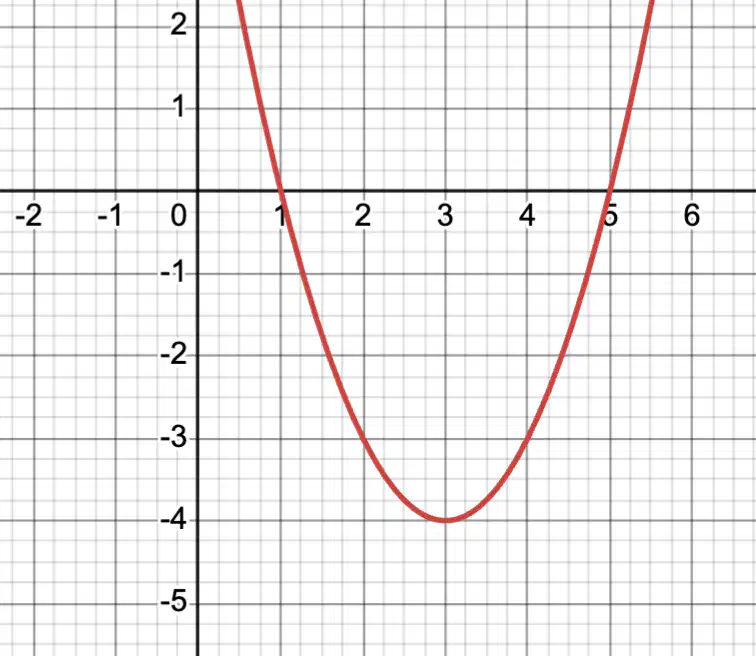
Which equation represents the transformation of the parent function y = x2?
y=(x−3)2+4
y=(x+3)2−4
y=(x−3)2−4
y=x2−3+4
Pick the composite function notation.
f(g(x))
f(x)+g(x)
f(x)⋅g(x)
f(x)+c
g(x)f(x)
Convert the quadratic function y=x2+6x+8 into its vertex form.
y=(x+3)2−1
y=(x−3)2+1
y=(x+3)2+1
y=(x−3)2−1
Find the y-intercept of the line y=3x−5 .
0
5
-5
3
Which of the following is the inverse function notation?
f(x)+g(x)
1/f(x)
f(x)−1
f−1(x)
Find the equation of the line parallel to y=2x+3 passing through the point (1, 2).
y=2x+1
y=2x−1
y=2x
y=−21x
What is the axis of symmetry for the quadratic function y=x2−4x+3 ?
x=−4
x=4
x=−2
x=2
Determine the slope of the line perpendicular to y=21x+3 .
2
−2
−21
21
What is the domain of the function f(x)=x−31 ?
[3,∞)
(−∞,3]
(−∞,∞)
(−∞,3)∪(3,∞)
What is the range of the function f(x)=x2−5 ?
[−5,∞)
[0,∞)
(−∞,∞)
(−∞,−5]
(−5,∞)

What is the function for this graph?
y=x
y = 1/x
y = |x|
y = ln x
y = x2

What is the function for this graph?
y=x
y = 1/x
y = |x|
y = ln x
y = x2
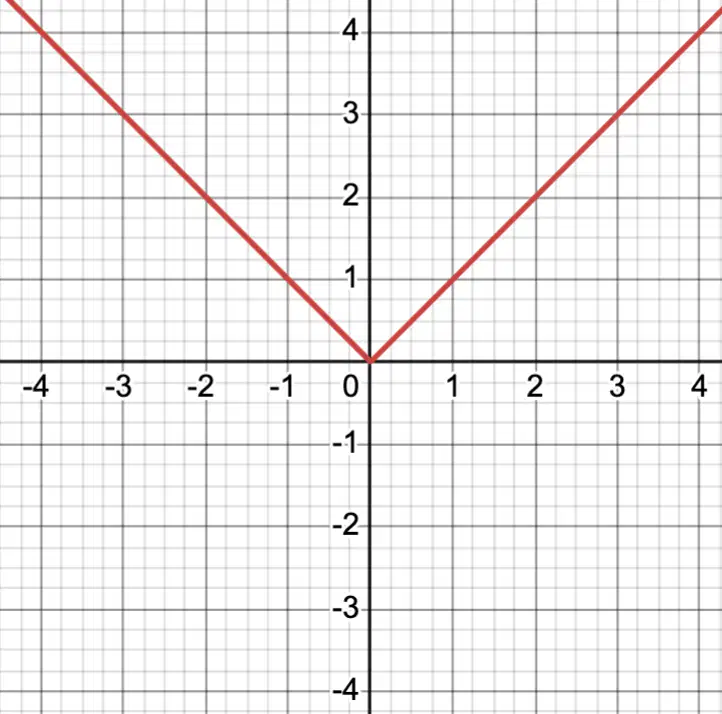
What is the function for this graph?
y=x
y = 1/x
y = |x|
y = ln x
y = x2

What is the function for this graph?
y=x
y = 1/x
y = |x|
y = ln x
y = x3
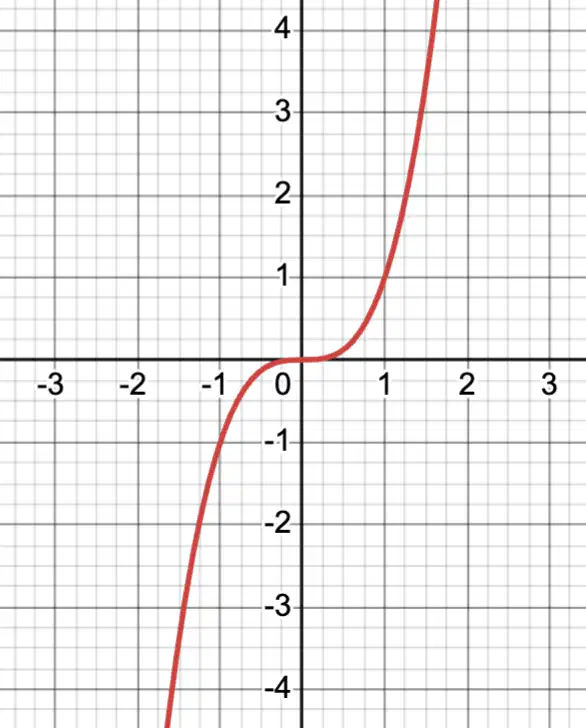
What is the function for this graph?
y=x
y = 1/x
y = |x|
y = ln x
y = x3
What is the domain of f(g(x)) for f(x) = x+31 and g(x) = x+21 ?
x=−2
x=−2, −37
x=−2,−3
x=−3
x=−2, −73
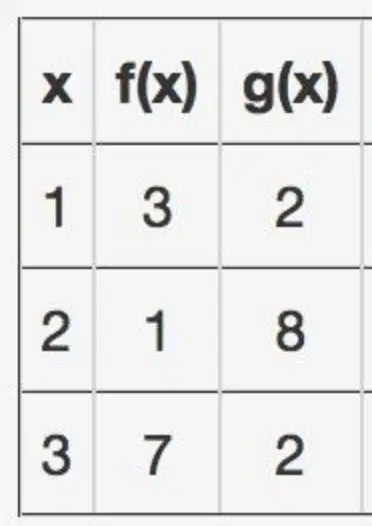
Find g(f(2)) using the table.
8
2
3
1
7
What is the inverse of y = x+37
y = 7x+3
y = 7x−3
y = x7−3
y = 3x−7
If g(x) has the point (5, 7), what point must be on the inverse of g(x)?
(7, 5)
(-5, -7)
(-7, 5)
(5, -7)
(0, 0)
Factor this polynomial: x2 - 10x + 25
(x - 5)2
(x - 1)(x - 25)
(x + 5)2
(x - 2)(x - 5)
(x - 3)(x - 7)
Complete the square: y = x2 - 4x + 5
y = (x - 2)2 + 1
y = (x + 2)2 - 3
y = (x - 2)2 - 3
y = (x + 2)2 + 1
y = (x - 4)2 + 5
Find the vertex: y = x2 - 4x + 5
(2, 1)
(-2, 9)
(0, 5)
(1, 0)
(-1, 10)
Given x2 - 4x + 4 = 0 and x · m = 1/2, find the value of m.
1/2
-1/2
2
1/4
4
Consider the function g(x) = 2x3 + 5x. What is the end behavior of this function?
As x →∞ , f(x) → (a) .
As x →−∞ , f(x) → (b)
∞
−∞
Multiply: (5 + 3i)(2 - i)
13 + 7i
11 - i
7 + 11i
10 + 5i
13 + i
What is the complex conjugate of 5 + 4i?
-5 + 4i
5 - 4i
-5 - 4i
4i - 5
5 + 4i
Find the product of 5 - 2i and its complex conjugate and simplify.
29
21
25
27
31
Use the quadratic formula to solve: x2 + 4x + 5 = 0
−2±i
−2±3i
2±3i
−2±3i
An x-value that makes both the numerator and denominator of a rational function equal to zero is
a horizontal asymptote.
a vertical asymptote.
a hole.
in the domain.
An x-value that makes only the denominator of a rational function equal to zero is
a horizontal asymptote.
a vertical asymptote.
a hole.
in the domain.
8x3 - 18x
x2 + 9x - 36
x2 - 8x + 15
Factor
3x2 + 4x + 1
Factor
x2 -2x - 24

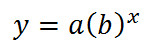
which equation best fits this graph
y=ax
y=a2
y=mx+b
y=∣x∣
What is the range for
f(x) = 5x-6 - 3 ?
y = 2x+2 + 1
right 2, up 1
left 2, up 1
right 2, up 1
right 1, up 2
Describe the transformation on
y=2(4)x when if becomes y=2(4)(x−5)Down 5
Right 5
Left 5
Up 5
Identify the domain of the exponential function: y=5(31)(x−1)
y > 1
All real numbers
y > -1
x > -1

Which function matches the graph?


Choose ALL the transformations of f(x)=3x that creates g(x)=3(x−4)
Vertical Shift up 4
Horizontal Shift left 4
Vertical Shift down 4
Horizontal Shift right 4
Choose ALL the transformations of f(x)=4x that creates g(x)=4x+1
Vertical shift down 1
Horizontal shift left 1
Vertical shift up 1
Horizontal shift right 1
Which increases faster as x→∞ ?
y = ex
y = 5x
Condense
log39+log33
log312
log327
log39
Condense
log5y−log525
log5(y−25)
log5(25y)
log5(25y)
log5(y25)
Condense: log26+log23=
log218
log22 = 1
log23
log29
ln(2) = x
Find the value of: eln(f)
f
e
ef
undefined
Find the exact value of: ln e5
e5
ln 5
5
5e
Solve the exponential equation.
19=e2x
2ln(19)
ln(2)ln(19)
19lneln(2)
≈4.248
Solve the logarithmic equation.
log3(x)+8=11
Solve for x:
log6x = -2
6
1/36
36
-6
Solve ln e
10
1
5
3
ln(0) =
undefined
1
-1
1/2
0
ln(1) =
0
1
-1
1/2
undefined
Solve for x.
33 = 3x + 2
x = 1
x = -1
x = ½
x = -½
Solve for x.
2x+6 = 32
x=-1
x=11
x=1
x=-11
Solve: 16 = 4x+1
x = -2
x = 1
x = -3
x = 3
Which of the following is the value of x given;
e(x+6) = 12
2-2n = 26
Use the change of base rule to rewrite this problem:
log364
log(64)/log(3)
log(3)/log(64)
In Change of Base Formula, logba becomes:
log(a)log(b)
ln(a)ln(b)
ln(b)ln(a)
ln(a)+ln(b)
ln(a)−ln(b)
If logBA=lognBlognA , then log253=
ln3ln25
ln325
ln25ln3
ln253
Use the change of base rule to rewrite this problem:
log7256
log3(7)log5(256)
log2(7)log2(256)
ln(256)ln(7)
log(7)ln(256)
Use the change of base rule to expand this problem:
log10(9)
ln(9)log(10)
ln(10)log(9)
log3(9)log3(10)
ln(10)ln(9)


What is the degree of f(x)?
f(x)=2x3−3x2+4x−10
3
2
1
0
Find the Quotient (remainder not needed)
(2x3 - 5x2 - 3x + 7) / (x - 2)
Find the quotient of the polynomials.
(3d2−4d+13)÷(d+3)
3d−13+d+352
3d−13+d+3−26
3d+5+d+3−26
d−13+d+326
2x3 + 5x2 + 9 ÷
x + 3

(4x2 - 24x + 35) ÷ (2x - 5)
2x - 7
2x - 12
2x + 12
2x + 7
(2x3 - 5x - 7) ÷ (x - 2)
2x3 - 4x2 + 3x - 13
2x3 + 4x2 +3x - 1
2x2 - 4x + 3 - 13/x-2
2x2 + 4x + 3 - 1/x-2
f(x)=3x2+11x−4x2+3x−4
The x-value of the hole in this equation is _
(a)

What are the asymptotes for the graph pictured?
x= 1
y= 1
x= 0
y= 0
none
x= -1
y= 1
Find the Vertical Asymptotes for the following function
g(x) =x2−2x−82x2+x−9x=−4, x=2
x=−2, x=4
x=−6, x = −2
x= 2, x=6
f(x)=x−16
HA at x-axis
f(x)=x−5x+4
HA at y = 1
f(x)=3x+2−3x−1
HA at y = -1
f(x)=3x−56x+1
HA at y = 2
f(x)=4x−8x+3
HA at y = -2

What is the x-value of the hole, if one exists.
-2
-1
3
there isn't one
-3
Vocabulary: The graph of a polynomial is __________, so it has no breaks, holes, or gaps.
a glancing blow
linear
continuous
multiplicified
Determine the equations of any horizontal and vertical asymptotes of f(x)=x2+3x−18x2−9
HA: y=6
VA: x=0
HA: y=1
VA: x=−6
HA: y=1
VA: x=3, −6
HA: y=0
VA: none

