
 Worksheets
Thermo/Waves Exam
Total questions: 25
Worksheet time: 13mins
Name
Class
Date
1.
Seismic waves and light waves are similar because
a)
They are both transverse waves.
b)
Both need a medium to travel.
c)
They have no similarities, actually.
d)
They are both compressional waves.
2.
A wave travels a speed of 4 m/s and has a frequency of 3.5 Hz. What is the wavelength?
a)
1.14 m
b)
0.88 m
c)
14 m
d)
7.5 m
3.

How much time passes between each wave cycle?
a)
1 second
b)
2 seconds
c)
4 seconds
d)
6 seconds
4.

Which of the following is true when comparing the two graphs below?
a)
Wave A has a greater amplitude.
b)
Wave B has a greater amplitude.
c)
Wave A has a greater frequency.
d)
Wave B has a greater frequency.
5.
The law of reflection says that
a)
all waves incident on a mirror are reflected.
b)
waves incident on a mirror are partially reflected.
c)
the angle a ray is reflected from a mirror is random.
d)
the angle of reflection from a mirror equals the angle of incidence.
6.
This type of heat transfer uses a ceiling fan to circulate warm air throughout a house.
a)
Conduction
b)
Contortion
c)
Convection
d)
Radiation
7.
How many types of heat transfer are there?
a)
1
b)
2
c)
3
d)
4
8.
The sun is a great example of which of the following types of heat transfer?
a)
Conduction
b)
Contortion
c)
Convection
d)
Radiation
9.

After taking a hot shower, James steps out of the shower on to the tile floor. The tile floor felt cold to his feet. Which explanation below best describes James' experience?
a)
Heat from the tile floor is transferred to his feet.
b)
Cold from the tile floor is transferred to his feet.
c)
Heat from his feet is transferred to the tile floor.
d)
Cold from his feet is transferred to the tile floor.
10.
Which of the following best describes the application of the first law of thermodynamics in a star?
a)
The energy produced in the core of a star is lost to space and does not contribute to the star's luminosity.
b)
The energy produced through nuclear fusion in a star is converted into heat and radiated as light, maintaining energy conservation.
c)
The energy output from a star decreases as the star ages, with no increase in internal energy.
d)
A star undergoes no energy loss or gain as it evolves.
11.
Which of the following describes the second law of thermodynamics?
a)
For a spontaneous process, the entropy of the universe increases.
b)
Heat disperses faster that it is created.
c)
Heat travels from cold to hot.
d)
All women have a body temperature 2 degrees lower than their male counterparts. This explains why they are always cold.
12.
How does the second law of thermodynamics explain the overall evolution of the universe?
a)
The universe will eventually reach a state of maximum energy concentration.
b)
Entropy in the universe is always decreasing, leading to an increase in order.
c)
Over time, entropy increases, leading to the eventual "heat death" of the universe.
d)
Energy in the universe is conserved but can transform between different types without affecting overall disorder.
13.
Which of the following best describes the thermodynamic processes responsible for maintaining the temperature of a planet's atmosphere?
a)
Only incoming solar radiation affects planetary temperatures.
b)
Radiative equilibrium between the planet’s surface and atmosphere maintains temperature.
c)
Heat from the planet’s core is the sole source of temperature regulation.
d)
The atmosphere does not influence planetary temperature, which is determined only by the planet's composition.
14.
Absolute zero is a temperature where no heat or motion exists down to the particle level. Which of the following scales does 0 degrees mean Absolute Zero?
a)
Fahrenheit
b)
Kelvin
c)
Celsius
d)
NOAA
15.

Which letter is pointing to the trough?
a)
A
b)
B
c)
C
d)
D
16.

Which letter is pointing to the amplitude of the wave?
a)
A
b)
B
c)
C
d)
D
17.
If a wave's frequency doubles, its wavelength
a)
is halved.
b)
is also doubled.
c)
is unchanged.
d)
is now 4 times longer.
18.
A wave's velocity is the product of the
a)
frequency times the period of the wave.
b)
period times the energy of the wave.
c)
amplitude times the frequency of the wave.
d)
frequency times the wavelength of the wave.
19.
The number of waves passing the observer per second is:
a)
the wavelength in angstronms.
b)
the amplitude in nanometers.
c)
the frequency in Hertz.
d)
the period in seconds.
20.
Both sound waves and electromagnetic radiation
a)
trael at the speed of light.
b)
require a medium to move through space.
c)
can move through space without a medium.
d)
transfer energy.
21.
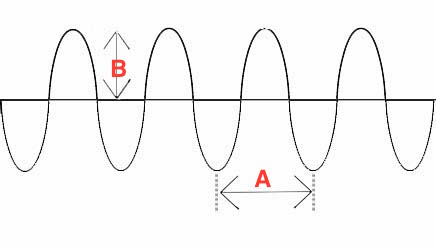
What property of the wave is represented by the letter "B"?
a)
amplitude
b)
crest
c)
trough
d)
wavelength
22.
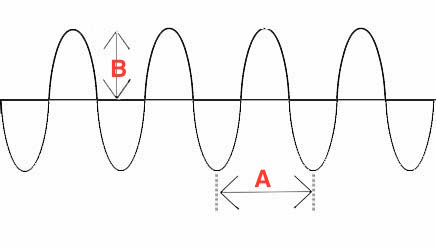
What property of this wave is represented by the letter "A"
a)
amplitude
b)
crest
c)
trough
d)
wavelength
23.

2. What property of a wave is represented by letter B?
a)
A. Wavelength
b)
B. Amplitude
c)
C. Speed
d)
D. Frequency
24.

3. What property of a wave is represented by letter C?
a)
A. Wavelength
b)
B. Amplitude
c)
C. Speed
d)
D. Frequency
25.

The _______ of a wave is how many waves pass a given point every second.
a)
Frequency
b)
Wavelength
c)
Amplitude
100 %

