
 Worksheets
Quiz on Alpha Decay
Total questions: 43
Worksheet time: 22mins
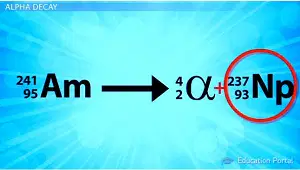
The general equation of alpha decay is shown. Which particle is emitted during an alpha decay?
a proton
a neutron
an electron
a helium nucleus

Which statement correctly compares strontium (Sr) and nitrogen (N) in the periodic table?
Strontium has a larger atomic radius and is less electronegative than nitrogen.
Strontium has a larger atomic radius and is more electronegative than nitrogen.
Strontium has a smaller atomic radius and is less electronegative than nitrogen.
Strontium has a smaller atomic radius and is more electronegative than nitrogen.
Atoms were thought to be the smallest unit of matter until J.J. Thomson discovered the electron in 1897. What is the most likely reason that atomic theory was not completely discarded after Thomson made his discovery?
The existence of subatomic particles did not change how scientists viewed the atom.
The concept of the atom was still valid, so the theory was updated rather than replaced.
The concept of the subatomic particles was not accepted by leading scientists at the time.
The existence of subatomic particles only changed how scientists viewed radioactive atoms.
What was Dalton missing from his explanation of atoms that all scientific explanations need?
models of atoms to show other scientists
evidence to support his explanations
a description of how atoms form
a hypothesis to explain his interpretation
The first atomic model was developed by
Niels Bohr
Marie Curie
Albert Einstein
Stephen Hawking
Which statement is true about the energy released in nuclear fusion compared to nuclear fission?
Fusion releases less energy than fission.
Fusion releases more energy than fission.
Neither fusion nor fission releases energy.
Fusion and fission release the same amount of energy.
An atom is a small building block that forms matter. Many different models of an atom have been made over the years. Which of the following is NOT a reason why so many models of the atom have been made?
The atom has changed over the years.
New information led to new explanations.
Scientists questioned each other's work.
New equipment allowed for new discoveries.
What is true about the metals in groups 1A, 2A, and 3A?
They gain electrons when they form ions.
They all have ions with a 1+ charge.
They all have ions with a 1- charge.
They lose electrons when they form ions.
Which of the following happens to the atomic radii when moving from sodium to chlorine on the periodic table?
It increases due to the shielding effect.
It decreases due to an increased number of protons.
It increases due to an increase in electronegativity.
It decreases due to increased metallic character.
Which formula represents a polar molecule?
N₂
CO₂
BF₃
NH₃
For its mass, water has a relatively low vapor pressure, which is attributed to the additional intermolecular forces from
ionic bonding
hydrogen bonding
dispersion bonding
covalent bonding
A 100.0 g tube of sunscreen contains 1.15% titanium dioxide (TiO₂) by mass. The molar masses of titanium and oxygen are shown in the table. What is the percent mass of titanium in the sunscreen?
0.689%
0.383%
The equation shows a balanced chemical reaction. N₂ + 3 H₂ → 2NH₃ If 4.00 moles of nitrogen react with 9.00 moles of hydrogen, according to the reaction above, what mass of ammonia is produced?
6.00 g NH₃
34.0 g NH₃
102 g NH₃
136 g NH₃
Solving stoichiometry problems enables one to
decide if a reaction is possible.
discover new elements.
predict the amounts of products formed.
eliminate all toxic chemicals.
To determine the molar mass of an element, one must know the element's
Avogadro number.
atomic number.
number of isotopes.
average atomic mass.
The equation shows a partial chemical reaction. ZnBr₂ + AgNO₃ → ? What is the completed and balanced equation for this reaction?
ZnBr₂ + AgNO₃ → ZnAg + Br₂NO₃
ZnBr₂ + AgNO₃ → ZnNO₃ + AgBr₂
ZnBr₂ + 2AgNO₃ → Zn(NO₃)₂ + 2 AgBr
ZnBr₂ + AgNO₃ → Zn(NO₃)₂ + AgBr
What determines the amount of products formed in a chemical reaction?
the amount of the excess reactant
the amount of the limiting reactant
the first reactant in the chemical equation
the last reactant in the chemical equation
Distilled white vinegar is a solution of acetic acid and water. If the molar mass of acetic acid is 60.052 g/mol, how many grams of acetic acid are contained in 500 mL( 0.5L) of a 0.839-M solution?
0.101 grams
6.99 grams
25.2 grams
50.4 grams
A bottle of contact rinsing solution contains 4.50 g NaCl and 500 mL (0.5L) water. If the molar mass of sodium chloride is 58.44 g/mol, what is the molarity of the solution?
0.154 M
0.526 M
7.70 M
9.00 M
If 75 ml (0.075L) of 0.50 M of NaOH reacts with HCl, how many moles of NaOH did it take to neutralize the acid?
0.038 mol NaOH
0.013 mol NaOH
0.125 mol NaOH
0.050 mol NaOH
The chemical equation shows how hydrogen gas reacts with iodine gas to form hydrogen iodide. Initially, one mole of hydrogen gas is reacted with one mole of iodide gas at standard pressure and room temperature. The reaction reaches an equilibrium. Which change could be made to decrease the amount of iodide gas at equilibrium?
H2 + I2 + heat = 2 HI
increasing the pressure of the system
removing hydrogen gas from the system
increasing the temperature of the system
adding more hydrogen iodide gas to the system
Lithium chloride is formed by the reaction shown below. HCl(aq) + LiOH(aq) → H₂O(l) + LiCl(aq) The reaction is best described as
oxidation-reduction.
neutralization.
synthesis.
decomposition.
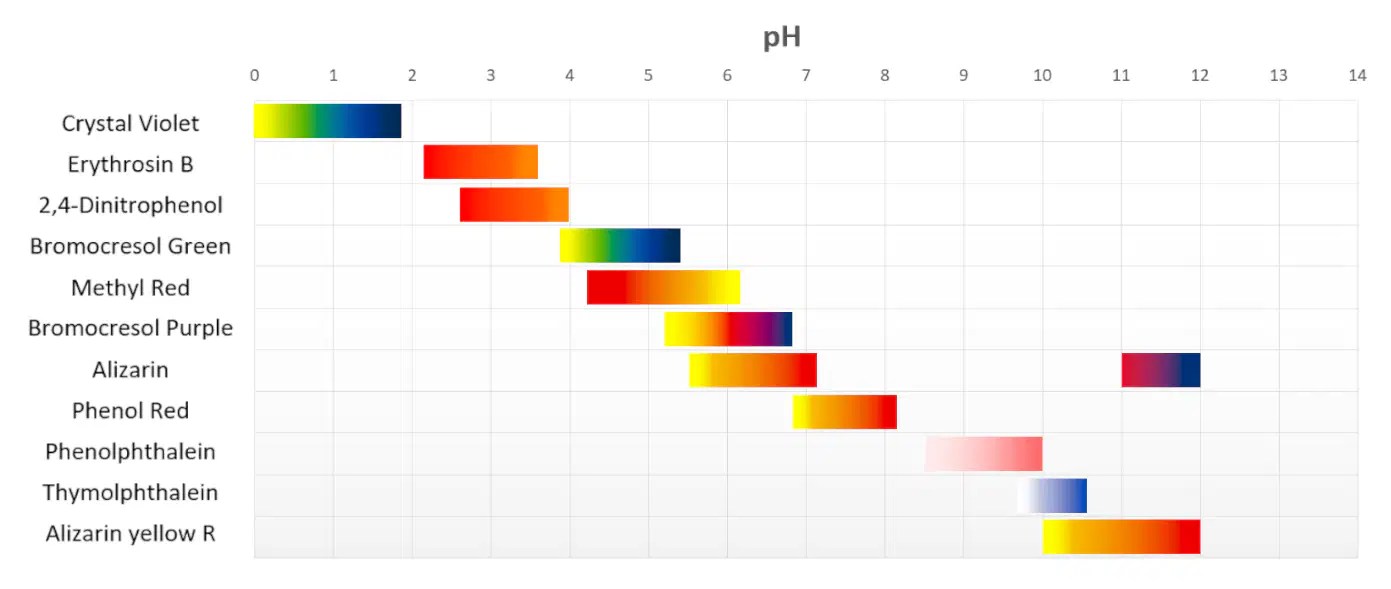
The graph shows pH indicators and the pH range that they indicate. A titration experiment reaches its end point at pH = 4.4. Which pH indicator would be BEST to use in this titration?
Methyl red, because the indicator will start to change from red to orange at the end point of the titration
Bromocresol purple, because the indicator will start to change from yellow to brown at the end point of the titration
Methyl orange, because the indicator will start to change from orange to yellow at the end point of the titration
Bromocresol green, because the indicator will start to change from yellow to green at the end point of the titration
A student wants to investigate how antacids, such as milk of magnesia, Mg(OH)₂, react with stomach acid. She uses hydrochloric acid, HCl, to mimic stomach acid. To a beaker of distilled water on a magnetic stirrer table, she adds 25 mL Mg(OH)₂ and 5 mL of a liquid pH indicator. Next, she adds HCl to the beaker and the solution changes colors. As time passes and the solution in the beaker continues to be stirred, the color changes again. Which statement best explains the color changes throughout the investigation?
The hydroxide ions from Mg(OH)₂ bond with the hydrogen ions from HCl to neutralize the solution.
The solution has more hydrogen ions from HCl than hydroxide ions from Mg(OH)₂, which makes the solution more acidic.
The hydroxide ions from HCl bond with the hydrogen ions from Mg(OH)₂ to neutralize the solution.
The solution has more hydrogen ions from Mg(OH)₂ than the hydroxide ions from HCl, which makes the solution more acidic.
Which of the following factors does NOT affect the rate of reaction?
container size
reactant phases
reactant amounts
container temperature
How many grams of HCl are present in 0.70 L of a 0.33 M HCl solution?( molar mass HCl=36.5g/mol)
0.47 g
0.54 g
2.1 g
8.4 g
What is the molarity of a solution containing 7.00 moles of solute in 625 mL(0.625L) of solution?
0.0112 M
4.38 M
11.2 M
4380.0 M
What happens in a reaction when the concentration of reactants is increased?
The reaction rate is faster.
The reaction rate is generally slower.
The reaction rate is not affected.
The activated complex does not form.
The chart below details four samples of oxygen gas. According to the chart, which sample is most soluble in water?
Low pressure( 1 atm), high temperature( 50 degree)
low temperature (25 degree), low pressure( 1 atm)
High pressure( 2 atm), low temperature(25 degree)
none of the above
Lydia plans to perform an experiment by placing the 65°C rock in a container of water that is 23°C. After 1 minute, she will remove the rock and measure the temperature of the water in the container and the temperature of the rock. Which statement BEST predicts her results?
The temperature of the water will remain the same, but the temperature of the rock will increase.
The temperature of the water will increase, and the temperature of the rock will decrease.
The temperature of the water will decrease, and the temperature of the rock will decrease.
The temperature of the water will remain the same, and the temperature of the rock will decrease.
Read the passage - 'Heating and Cooling' - and answer the question below: Using the specific heats of the rock and the water, Lydia calculates that the final temperature of the water and the rock will be 28°C. After she lets the rock sit in the water for 15 minutes, the temperature of the water and the rock are both 26°C. Which statement BEST describes why Lydia's calculation and the temperature of the water and rock after 15 minutes are not the same?
More thermal energy was absorbed by the water than expected.
More thermal energy was absorbed by the rock than expected.
Some of the thermal energy was transferred to the surroundings.
Some of the thermal energy was absorbed from the surroundings.
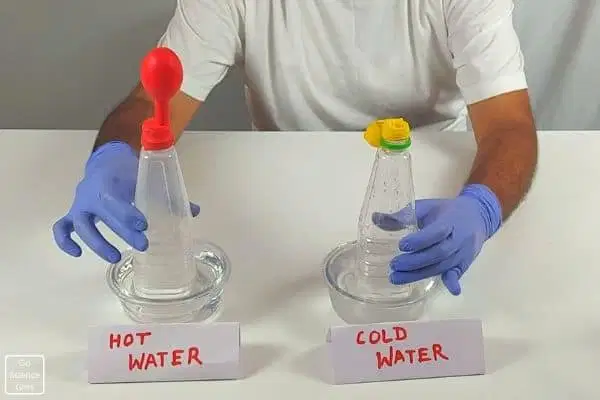
A student models the behavior of a gas when heated and cooled by using a flask, water, and a balloon. The student first fills the flask with 50 mL of water and then secures a balloon to the top of it. The flask is then placed on a hotplate and heated. Next, the student transfers the flask of hot water to a cooler filled with ice. The flask is left to cool. Which relationship is BEST shown in this model?
The volume of a gas changes proportionally to the temperature of the gas, given that the amount of gas and pressure of the gas remain constant.
The quantity of a gas changes proportionally to the temperature of the gas, given that the volume of gas and pressure of the gas remain constant.
The temperature of the gas changes proportionally to the pressure of the gas, given that the amount of gas and the volume of the gas remain constant.
The volume of the gas changes proportionally to the pressure of the gas, given that the amount of gas and the temperature of the gas remain constant.
According to the kinetic-molecular theory, which of the following best describes the behavior of gas particles?
Particles of a gas repel each other and collide.
Particles of a gas attract each other, but do not collide.
Particles of a gas do not attract or repel each other, but they do collide.
Particles of a gas do not attract, repel, or collide with each other.
A child gets a helium-filled balloon. She then takes the balloon outside into the cold air. She notices that balloon deflates a bit. What most likely caused this to happen?
The air pressure inside the store was higher than the air pressure outside.
The cold air outside allowed some of the helium atoms to escape from the balloon.
The speed of the helium atoms decreased outside, causing the pressure in the balloon to decrease.
The air molecules outside were moving faster than the helium atoms, putting pressure on the outside surface of the balloon.
Surface tension is a property of
liquids, only.
solids, only.
gases and solids.
gases and liquids.
According to the kinetic theory of gases, which assumption is correct?
Gas particles strongly attract each other.
Energy may be transferred between colliding particles.
Gas particles travel in curved paths.
The volume of gas particles prevents random motion.
If helium occupies a volume of 2.15 L at a pressure of 58.0 kPa and a temperature of 25.0°C, what is the gas volume at STP( 0oC and 101.3kPa) ? Hint: remember to convert oC to K by adding 273
1.13 L
1.35 L
3.44 L
4.10 L
Viscosity is a property of
solids, only.
liquids, only.
gases and solids.
gases and liquids.
Which state of matter has the MOST molecular motion?
gas
liquid
solid
plasma
Which of these results from the particles of gases being farther apart than the particles of liquids?
Gases can be compressed more easily than liquids.
Liquids can be compressed more easily than gases.
Liquids fill the volume of their containers but gases do not.
Gases take the shape of their containers but liquids do not.
What type of bonding occurs between barium and oxygen?
covalent bonding
molecular bonding
ionic bonding
hydrogen bonding
To determine the molar mass of an element, you must know
the atomic number
the average atomic mass
the Avogadro's number
isotopic nember
What determines the amount of products formed?
the amount of reactants
the first reactant
the last reactant
the limiting reagent

