
Font size
 Worksheets
Manifest Destiny & American Progress
Total questions: 74
Worksheet time: 38mins
What was the “mission” of the United States in the 1840’s known as?
The Monroe Doctrine
Manifest Destiny
The Trail of Tears
The Roosevelt Corollary
Believers in Manifest Destiny thought that we should spread American values West. What was meant by “American values” at that time?
Democracy & Christianity
Monarchy & Catholicism
Mormonism
Communism
Which one of the following best explains why many individuals and families supported the idea of Manifest Destiny?
They wanted new opportunity for land and a better life.
They were extremely patriotic.
They were hostile to the European powers of the day.
They wanted to spread slavery.
Believers in Manifest Destiny thought that ________ had given Americans “permission” to own North America from “Sea to shining Sea”.
The President
The US Constitution
Mrs. Fox-Manno
God

The name of the lady featured in the American Progress painting is _________.
Lady Liberty
Columbia
America
Dolley Madison

According to the painting by John Gast, who benefited from Manifest Destiny?
Native Americans
Enslaved people
American pioneers like miners and farmers
Wildlife such as bison/buffalo & anything with fur

According to the painting, who was hurt by Manifest Destiny?
Native Americans
Enslaved people
American pioneers like miners & farmers
Wildlife such as bison/buffalo & anything with fur

As seen in the painting, what made the trip West faster, easier, safer, and cheaper? It also made it so that common people could make the trip.
The Telegraph
The School Book
The Transcontinental Railroad
The Oregon Trail
What was a significant consequence of Manifest Destiny for Native American populations?
Increased trade opportunities
Forced relocation to reservations and loss of land
Gaining new territories
Establishment of new alliances


What all did Lewis & Clark bring back from their expedition of the Louisiana Purchase? Select all that apply.
scientific information of land & environment
slaves
samples of plants and animals
information about Native Americans

What was the main goal of the Lewis & Clark expedition?
bring back Native Americans that lived in this territory
prevent Spain from claiming all the land
find gold and riches
explore the land acquired by the Louisiana Purchase
What were 3 reasons why pioneers started to move west?
cheap farmland
find gold & riches
religious persecution
new homes

What happened to the size of the United States because of the Louisiana Purchase?
it got smaller
it stayed the same
it grew a small amount
it doubled in size
Why did the United States need more land?
to test new farming methods out west
to gain control over the land to the west
to force the French to leave North America
to make room for their growing population
What was the main goal of the Lewis and Clark expedition?
to meet and trade with the Native Americans
To explore and map out the land west of the Mississippi River
To pan for gold in the rivers
to map out a trail through the Appalachian Mountains
The United States government forced many Native American tribes to relocate to different areas called Indian Reservations so that…
white settlers could move on the land
they wanted to turn the land into National parks
They could build cabins as rest stops in the mountains
they could sell the land to Mexico
The most popular route people travelled along to move west was?
The Trail of Tears
The Oregon Trail
The Mississippi Expedition
The Rocky Mountain Trail
Lewis and Clark were the first to reach the ______________ by land?
Atlantic Ocean
Gulf of Mexico
Hudson River
Pacific Ocean
Who helped Lewis & Clark on their expedition?
James Monroe
Sacajawea
Thomas Jefferson
Napoleon


What job did most people have who moved west?
shop keepers
blacksmiths
lawyers
farmers
What was the main idea of Manifest Destiny?
that the Native Americans owed the Americans something
that it was the God-given right for Americans to take the land
that people should go west and strike it rich
that the railroad should connect the entire country
What did the Homestead Act encourage/offer the settlers to go west?
free train rides west
free land in the west
free homes in the west
free wifi in the west
Which land acquisition was peaceful?
Louisiana Purchase
Texas
Mexican Cession
None of the above
Which statement is TRUE?
Americans and Native Americans never fought each other.
Americans moved Native Americans to reservations.
Native Americans wanted to live on reservations.
Native American leaders offered advice to the U.S. presidents
Which trail did the '49ers' use?
The Mormon Trail
The California Trail
The Oregon Trail
The Santa Fe Trail
This trail was used for a group of people who wanted to practice their religion in peace.
The Mormon Trail
The California Trail
The Oregon Trail
The Santa Fe Trail
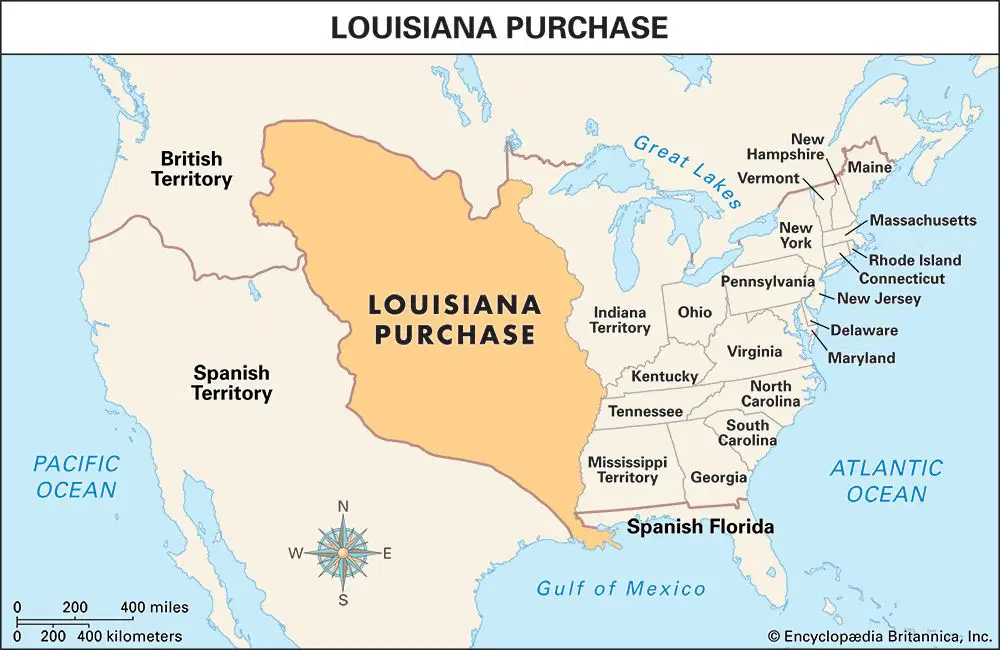
When did westward expansion begin?
1803
1819
1845
1872
Who coined the phrase 'Manifest Destiny'?
John O'Sullivan
James K. Polk
John Gast
John Louis

What does the term 'Manifest Destiny' mean?
America's right to expand westward
America's right to expand eastward
America's right to expand in all directions
America's right to remain stagnant

What did the phrase 'allotted by providence' mean in the context of Manifest Destiny?
Given by God or a higher power
Given by the government
Given by the Native Americans
Given by the settlers
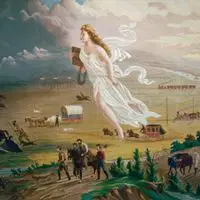
Who is the woman depicted in the painting 'American Progress'?
Columbia
Britannica
John Gast
Canada

What did the artist John Gast portray in the painting 'American Progress'?
The American perspective of westward expansion
Accurate representation of westward expansion
Negative impact of westward expansion
Positive impact of westward expansion
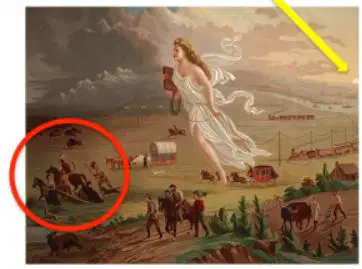
What were some negative impacts of Manifest Destiny?
Pushing American Indian nations from their homelands
Establishing homesteads and creating a new life
Improving communication and modern development
Expanding slavery into the west


Which of the following was NOT a way America gained more land out West?
Made treaties with other countries
Purchased land from other countries
Changed laws to the U.S. Constitution
Fought wars with other countries
Which piece of land was purchased (bought) by the United States from France in 1803?
California
Louisiana
Mexico
Florida
What was the nickname for the group of people who went to California in search for gold?
Forty- Niners
Men of Destiny
Mountain Men
Mormons

Which of the following objects was NOT included in the painting "American Progress" this week?
Railroad Trains
Buffalo Herds
Mountains
Factories

In the painting, "American Progress", which group of people look frightened and seem to be running away?
Farmers
Miners
Pioneers
Native Americans
What state did the Mormons (religious group) finally settle in?
Arizona
Utah
New Mexico
Oregon

Which country did America go to war with to get more land out West?
Great Britain
Spain
Mexico
France
What did the artist John Gast portray in his painting 'American Progress'?
Biased perspective of westward expansion
Accurate representation of westward expansion
Negative impact of westward expansion
Positive impact of westward expansion

