
NEW
Font size
 Worksheets
Population Dynamics Review
Total questions: 20
Worksheet time: 20mins
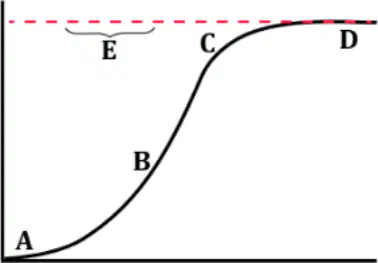
Which of the following represents the carrying capacity?
A
B
C
D
E
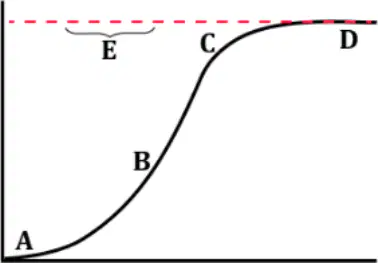
Which of the following represents a population in exponential growth?
A
B
C
D
E
Which of the following is a density-independent factor that could impact a population of sea turtles in a marine ecosystem?
A sudden drop in ocean temperature due to a cold current.
An increase in the number of predators such as sharks in the area.
A disease outbreak among the sea turtle population.
Competition for nesting sites with other marine species.
What is the difference between primary and secondary succession?
Secondary succession occurs when a volcanic eruption occurs.
Primary succession starts with bare rock and secondary succession starts with soil.
Primary succession happens after a storm takes place and there is still soil.
Through primary and secondary succession, evolution of animals occurs.
How do changes in prey population affect predator numbers?
Predator numbers increase with more prey
Predator numbers decrease with more prey
Predator numbers remain constant regardless of prey
Predator numbers decrease as prey decrease
What does the term 'carrying capacity' refer to in an ecological context?
the amount of resources an ecosystem can produce
the maximum number of individuals an environment can sustain
the total biomass of an ecosystem
the minimum number of species needed for ecosystem stability
Which substance found in the soil sample provides the best piece of evidence for soil containing living organisms?
Minerals
Air
Water
Organic Matter
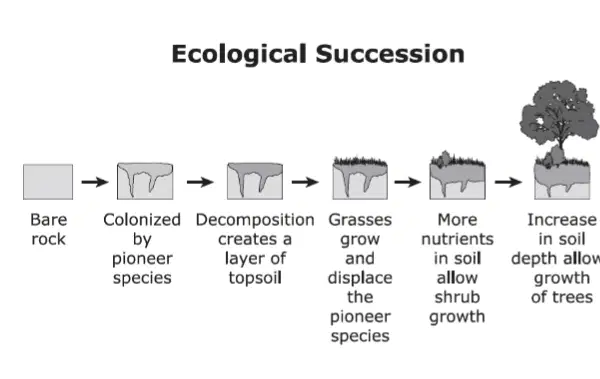
Which natural event could initiate the type of ecological succession shown in the diagram?
Glacial retreat exposing bare rock
Hurricane causing tree fall
Earthquake creating landslides
Forest fire clearing vegetation
An abiotic or biotic condition which impacts the size of the population.
Limiting Factor
Carrying Capacity
Logistic Growth
Exponential Growth

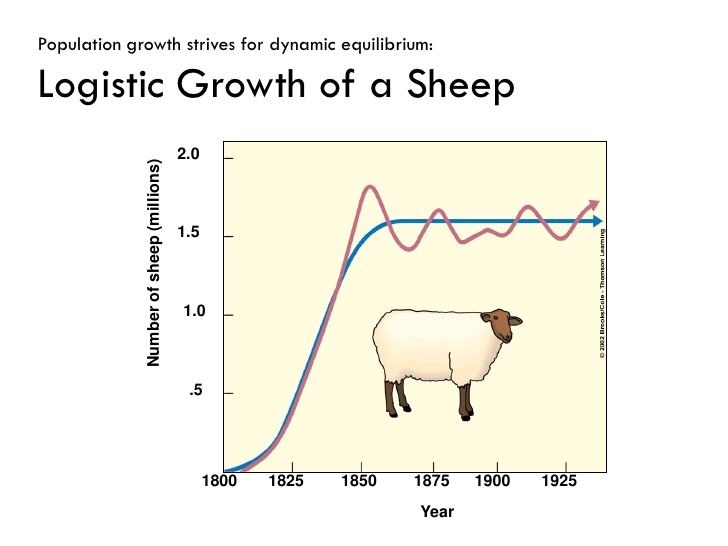
Which of the following describes what is happening in the graph?
A population increases but then becomes stable due to limiting factors.
A population of increases but then fluctuates due to limiting factors..
A population of increases then decreases due to limiting factors.
A population increases and continues to increase due to limiting factors.
1.0 million
Lichens → Shrubs → Grasses → Trees
Lichens → tree → shrubs→Grasses
Grasses → Lichens → Shrubs → Trees
Lichens → Grasses → Shrubs → Trees


What keeps a population from growing beyond the ability of the environment to support it?
Environmental resistance
Limiting Factors
Speciation
Evolution

What happens if a population grows past its carrying capacity?
The population keeps growing
The population starts to die off
The entire species will go extinct
The carrying capacity just increases


Which type of limiting factor is influenced by the size of the population and often involves competition for resources?
Density Independent
Density Dependent
Which type of limiting factor can impact a population regardless of its density, such as a hurricane?
Density Independent
Density Dependent

What does ecological succession describe?
A gradual process of change and replacement in a community.
The increase in the number of trees in a forest.
The daily cycle of sunlight and darkness.
The process of photosynthesis in plants.

