
 Worksheets
25-26 Ceramics
Total questions: 60
Worksheet time: 30mins
This term refers to the three (3) building methods using only the hands and simple tools- not the potter's wheel.
Wedging
Throwing
Score and Slip
Handbuilding
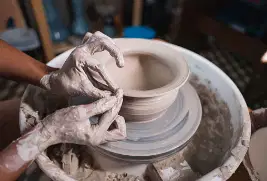
The term used for creating pottery using the potter’s wheel.
Wedging
Throwing
Score and Slip
Coil
Throwing clay down on the floor 20 times to remove air pockets, make clay more consistent & align kaolinite minerals.
Throwing
Wedging
Score and Slip
Handbuilding
One of 3 methods of shaping clay by inserting the thumb of 1 hand into the clay and pressing lightly w/ thumb & fingers.
Pinch
Coil
Slab
Throwing
Building ceramic forms by rolling thin ropes of clay and joining them w/ fingers or a tool.
Pinch
Slab
Coil
Wedge
Term for pressed or rolled flat sections of clay
Pinch
Coil
Throwing
Slab
Liquid clay, about the consistency of thick cream, used as a sort of "glue"
Elmer's Glue
Slip
Wedge
Wood Glue
Method of joining two pieces of clay together. First, by roughening the surface, then by adding clay “glue”
Score and Slip
Score and Slab
Wedge and Slab
Slip and Slab

What is wrong with this pinch pot?
They pushed down too far in the beginning
They had long finger nails while pinching
Nothing is wrong with it
They didn't push down far enough in the beginning.
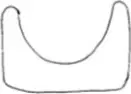
What is wrong with this pinch pot?
A) They had long finger nails while pinching
B) Nothing is wrong with it
C) They didn't push down far enough in the beginning
D) They set it on the table while pinching.
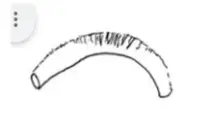
What is wrong with this coil?
Too thick
Too Dry
Too thin
Nothing is wrong with it.
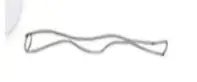
What is wrong with this coil?
Too dry
Uneven pressure while rolling, It is a "flat tire"
Too wet
Too thick
When referring to the “Stages of Clay” this is the term for clay that is light grey in color, and soft to the touch.
Greenware
Bisqueware
Wet Clay
Glazeware
When referring to the “Stages of Clay” this is the term for clay that is dark grey in color, and holds its shape.
Greenware
Bisqueware
Leather
Glazeware
When referring to the “Stages of Clay” this is the term for clay that is light grey, dry clay, room temp., and brittle.
Greenware
Bisqueware
Leather
Glazeware
A subtractive method of working in clay that involves removing or taking away clay from a solid form.
Modeling
Stretching
Carving
Throwing
An additive method of working in clay that involves adding and shaping/molding the clay form.
Modeling
Stretching
Carving
Throwing
Bottom part of the lid (hint: looks like french fries) uses clay strips to keep the lid from sliding off.
A) Body
B) Foot
C) Inside
D) Flanged Edge
Term for surface impressions/patterns used to create a design or rough appearance, often used to create value changes.
A) Slip
B) Texture
C) Bisque
D) Paint
A glass-like surface coating for ceramics that is used to decorate and seal the pores of the fired clay.
A) Paint
B) Slip
C) Glaze
D) Antique Technique
21 - Quiz: Applying a dark color paint, & wiping it off the project. Dark color stays in the texture areas to enhance the texture.
A) Paint
B) Slip
C) Glaze
D) Antique Technique
Term for the PROCESS of heating the pottery to a specific temp. (1800 degrees) to bring about a change in the clay.
Ironing
Firing
Stoving
Microwaving
Term for an oven-like DEVICE that heats up to 1800-2000 degrees or more.
Kiln
Oven
Stove
Microwave
Clay that has been fired once (without glaze) and is white in color, is known as....
Kilnware
Bisqueware
Ovenware
Firedware
Term for a second firing, with glaze applied
Kilnware
Glazeware
Ovenware
Firedware
Term for the opening at the top of a vase/cylinder
Rim
Foot
Body
Inside
Term for the main, middle part of the vase/cylinder. It is usually the largest part.
A) Rim
B) Foot
C) Body
D) Inside
Term for the part of the vase/cylinder that meets the floor/table.
A) Rim
B) Foot
C) Body
D) Inside
Another word for Flexibility.
Plasticity
Playdohy
Leather
Kaolinite
Mineral that make clay bendable
Kaolinite
Carbonite
Graphite
Leather
Rough clay found at the parent rock
Residual
Sedimentary
Mud
Sand Clay
Smooth clay found away from the parent rock, formed through wind or water (Dark Grey in Newark)
Residual
Sedimentary
Mud
Sand Clay
Clay is derived from (comes from)...
Minerals and Oil
graphite & sculptey® material
graphite & paper pulp material
Granite and Organic Material
Why is it important to rinse the project before glazing?
Why is it important to rinse the project before glazing?
The water make the pores of the clay “sticky”
Saturates the pores of the clay
Removes the fine layer of bisque dust
Why is it important to NOT glaze the bottom of a piece?
The glass surface will slide off of a table
It will create an uneven bottom to the project
The project will permanently stick to the kiln shelf
It will become too hot when placed in a microwave
Why is it important to rinse the brush between colors?
A) Dry glaze will ruin the bristles of the brush
B) Keeps the bristles soft and flexible
C) Glaze is an eye irritant, and must be safely disposed of
D) Mixing the minerals will ruin the entire bottle of glaze.
How many separate coats or layers of glaze are recommended on a piece?
2
1
4
200
The most important step of wheel throwing involves getting the clay into perfect rotational symmetry at high speed.
A) Centering
B) Pull bottom flat & pull walls up
C) Push Thumbs In
D) "Liftering"
The second (2nd) main wheel-throwing step is to:
A) Centering
B) Pull bottom flat & pull walls up
C) Push Thumbs In
D) "Liftering"
The third (3rd) main wheel-throwing step is to:
A) Centering
B) Pull bottom flat & pull walls up
C) Push Thumbs In
D) "Liftering"
Fast or Slow Speed?...Centering
Fast Speed
Slow Speed
Fast or Slow Speed?...Push Thumbs In
Fast Speed
Slow Speed
Fast or Slow Speed?...Pulling Walls Up
Fast Speed
Slow Speed
As a safety precaution for throwing on the wheel, students were asked to
Wear a Helmut
Tie hair back
Remove expensive footwear
Wear Shoes
As a safety precaution for throwing on the wheel, students were asked to
Cover their mouths
Remove Jewelry
Remove expensive footwear
Wear Shoes
As a safety precaution for throwing on the wheel, students were asked to:
Wear protective ear plugs
Keep Tools out of splashpan
Dress warm - the wheel spinning can cause wind-burn
Wear protective eyewear – safety goggles
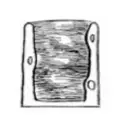
What is wrong with the cylinder pictured below?
It is not centered properly.
The clay has not been wedged properly.
The clay was too soft.
The wheel was rotating too slow.
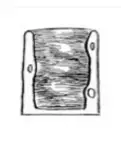
How can one fix the problem?
Center the clay next time.
Wedge the clay properly next time.
Speed the wheel up.
Slow the wheel down.

What is wrong with the cylinder pictured below?
The walls were pinched too thin.
The bottom was not pulled flat.
It is not centered properly.
The clay was too dry.
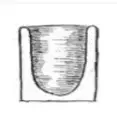
How can one fix the problem?
Center the clay next time.
Wedge the clay properly next time.
Don’t pinch the walls so thin next time.
Pull the bottom flat next time.
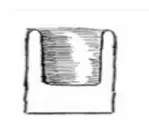
What is wrong with the cylinder pictured below?
The walls were pinched too thin.
The bottom was not pulled flat.
The bottom is too thick.
The bottom is too thin.
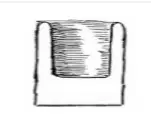
How can one fix the problem?
Press down farther, check bottom with needle tool.
Wedge the clay properly next time.
Don’t pinch the walls so thin next time.
Don’t press down so far.
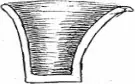
What is wrong with the cylinder pictured below?
It is not centered properly.
The clay has not been wedged properly.
Wheel was too fast/student pulled out instead of up.
The wheel was too slow/student pulled up instead of out.
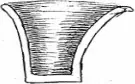
How can one fix the problem?
Center the clay next time.
Wedge the clay next time.
Slow the wheel down, pull straight upward.
Speed the wheel up, pull outward even more.
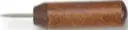
What is the name of this tool?
Loop Tool
Ribbon Tool
Needle Tool
Wire Tool
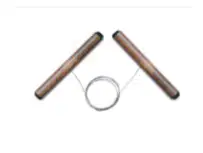
What is the name of this tool?
Loop Tool
Ribbon Tool
Needle Tool
Wire Tool
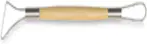
What is the name of this tool?
Loop Tool
Rib
Needle Tool
Wire Tool
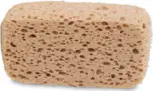
What is the name of this tool?
Loop Tool
Ribbon Tool
Needle Tool
Sponge
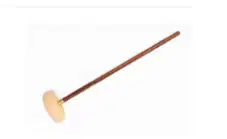
What is the name of this tool?
Sponge on a Stick
Stick on a Stick
Sponge on a Sponge
Stick on a Sponge
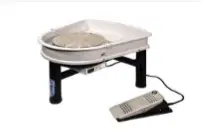
What is the name of this tool?
Horizontal Saw Press
Textile Spindle Machine
Potters Wheel
Textile Spindle Machine

