
NEW
Font size
 Worksheets
Quiz on Earth's Atmosphere
Total questions: 53
Worksheet time: 33mins
What is the primary function of Earth's atmosphere in relation to solar radiation?
Reflects solar radiation
Absorbs solar radiation
Amplifies solar radiation
Blocks solar radiation completely
Which of the following is a function of Earth's atmosphere?
Increases the size of meteors
Burns up meteors
Creates meteors
Cools down meteors
How does Earth's atmosphere contribute to the water cycle?
It prevents water from evaporating
It transports and recycles water
It stores water permanently
It eliminates water from the cycle
What role does Earth's atmosphere play in climate?
It creates extreme weather conditions
It moderates climate
It eliminates climate variations
It intensifies climate changes
What is the most abundant gas in the Earth's atmosphere?
Oxygen
Argon
Nitrogen
Carbon Dioxide
What percentage of the Earth's atmosphere is composed of oxygen?
78%
21%
1%
0.03%
Which gas is present in the smallest amount in the Earth's atmosphere among the main components listed?
Nitrogen
Oxygen
Argon
Carbon Dioxide
Which of the following is not a trace gas in the Earth's atmosphere?
Water vapor
Carbon dioxide
Methane
Oxygen
Which layer of the atmosphere is closest to Earth's surface?
Stratosphere
Mesosphere
Troposphere
Thermosphere
In which layer of the atmosphere does the maximum ozone concentration occur?
Troposphere
Stratosphere
Mesosphere
Thermosphere
Which layer of the atmosphere contains the ionosphere and exosphere?
Troposphere
Stratosphere
Mesosphere
Thermosphere
Where does weather occur in the Earth's atmosphere?
Stratosphere
Mesosphere
Troposphere
Thermosphere
How does temperature change with altitude in the troposphere?
Increases with altitude
Decreases with altitude
Remains constant
Fluctuates randomly
What happens to the temperature as altitude increases in the stratosphere?
Temperature decreases
Temperature remains constant
Temperature increases
Temperature fluctuates randomly
Which important layer is contained within the stratosphere?
Ionosphere
Ozone layer
Mesosphere
Exosphere
Why do planes typically fly in the stratosphere?
To avoid weather disturbances
To be closer to the ground
To reduce fuel consumption
To increase passenger comfort
What happens to the temperature as altitude increases in the mesosphere?
Temperature increases
Temperature remains constant
Temperature decreases
Temperature fluctuates
In which layer of the atmosphere do meteors typically burn up?
Troposphere
Stratosphere
Mesosphere
Exosphere
Which layer of the atmosphere is known for having very thin air and being very hot?
Troposphere
Stratosphere
Mesosphere
Thermosphere
At what altitude does the thermosphere begin?
0-10 km
10-50 km
50-90 km
90 km to space
Where do auroras typically occur?
Troposphere
Stratosphere
Mesosphere
Thermosphere
What marks the boundary between the troposphere and the stratosphere?
Mesosphere
Thermosphere
Tropopause
Ozone layer
What is Meteorology?
The study of rocks and minerals
The study of weather, climate, and atmosphere processes
The study of ocean currents
The study of plant life
What is the main difference between weather and climate?
Weather is constantly changing, while climate describes long-term patterns.
Weather is the same as climate.
Climate changes daily, while weather is stable.
Climate is only about temperature, while weather includes all atmospheric conditions.
Which of the following is an example of weather?
Seasons
Temperature
Weather patterns over time/years
Climate zones
What is an example of climate?
Humidity
Pressure
Seasons
Cloudiness
Which factor is not typically associated with weather?
Cloudiness
Humidity
Weather patterns over time/years
Pressure
What happens to cold air compared to warm air in terms of density?
Cold air is less dense than warm air.
Cold air is more dense than warm air.
Cold air and warm air have the same density.
Cold air becomes warmer and less dense.
What will happen to cold air in the atmosphere?
Cold air will rise.
Cold air will sink.
Cold air will remain stationary.
Cold air will evaporate.
What causes differences in air pressure on Earth?
The rotation of the Earth
The uneven heating of the Earth
The gravitational pull of the moon
The Earth's magnetic field
What happens to air in a low-pressure system?
Warm air rises
Cool air sinks
Air remains still
Air moves downward
What type of weather is typically associated with high-pressure systems?
Stormy weather
Fair weather
Cloudy weather
Rainy weather
Which of the following is a characteristic of low-pressure systems?
Clear skies
Clouds and precipitation
Dry conditions
Sunny weather
In a high-pressure system, what happens to the air?
Warm air rises
Cool air sinks and spreads
Air becomes turbulent
Air moves upward
What causes wind?
The movement of water molecules
The movement of air molecules
The movement of soil particles
The movement of light waves
What happens to cool, dense air in the atmosphere?
It rises, forcing warm air downward
It sinks, forcing warm, less dense air upward
It remains stationary
It evaporates
How does the atmosphere move air to balance temperature?
It moves cool air to the poles and warm air to the equator.
It moves warm air to the poles and cool air towards the equator.
It keeps warm air at the equator and cool air at the poles.
It mixes warm and cool air at the equator.
What happens to warm air as it rises at the equator and moves toward the poles?
It heats up
It cools
It remains the same temperature
It evaporates
The amount of water vapor in the air is known as ___.
Polarity
Dewpoint
Humidity
Relative Heating
On a weather station model, temperature is to be written in __.
F
C
Dry, cold air masses are ___.
cT
cP
mT
mP
Air masses that form over northern bodies of water are described as ___.
mT
cT
mP
cP
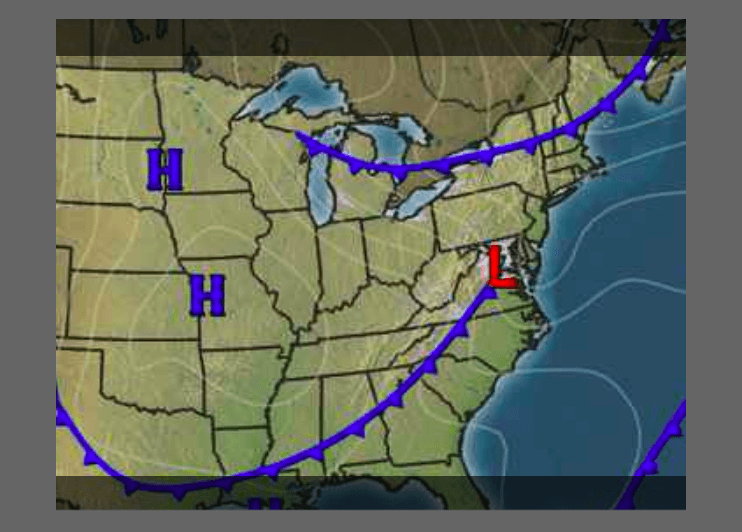
Name that symbol.
Cold Front
Warm Front
Stationary Front
Occluded Front

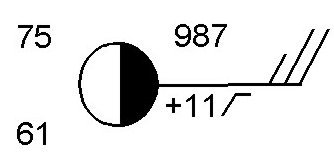

What is the barometric pressure for this station?
009.6 mb
909.6 mb
109.6 mb
1009.6 mb
096 mb

What is the barometric pressure?
997.8 mb
1097.8 mb
9997.8 mb
9978.0 mb
978

What is the wind direction?
NW
ESE
NNW
W

