
 Worksheets
Test 1 unit review
Total questions: 26
Worksheet time: 21mins
The major role of carbohydrates in the human diet is to:
form the membranes that surround mitochondria
act as a catalyst for cellular reactions
supply energy for the body
provide building blocks for amino acids
Meat tenderizer contains an enzyme that interacts with meat. If meat is coated with tenderizer and then placed in a refrigerator for a short time, how would the enzyme be affected?
it would be broken down
the activity would slow down
the shape would change
it would no longer act as an enzyme
A substance with a very high pH, such as drano (drain cleaner) would be considered a(n):
acid
base
buffer
catalyst
Why is it important to maintain a normal body temperature (37 degree Celsius in humans)?
Your enzymes function best at normal body temperature.
Essential chemical reactions may not occur if temperature is altered.
You may not be able to carry out life processes and thus maintain homeostasis.
All of above
Which group of organic compounds includes enzymes?
proteins
lipids
carbohydrates
nucleic acids
Enzymes influence chemical reactions in living systems by:
becoming part of the product after the reactions occur
combining with atmospheric gasses to form waste products
affecting the rate at which reactions occur
absorbing water during synthesis and digestion
Only small amounts of enzymes are required for reactions within cells because enzymes are:
fragile
reused
small molecules
constantly synthesized
Organic compounds are used as building blocks for
water, DNA, and starches
water, proteins, and oxygen
proteins, DNA, and carbon dioxide
proteins, starches, and fats
Which group consists entirely of organic molecules?
protein, oxygen, fat
protein, starch, fat
water, carbon dioxide, oxygen
water, starch, protein
The shape of a protein molecule directly determines its
movements through the cytoplasm
functions inside and outside of cells
roles in building water molecules
circulation throughout the body
The enzyme salivary amylase will act on starch but not on protein. This action illustrates that salivary amylase:
contains starch
is chemically specific
is not reusable
contains protein
DNA and RNA are examples of
nucleotides
nucleic acids
carbohydrates
proteins
Which substance is an inorganic molecule?
Starch
DNA
Water
Lipid
The active site of an enzyme will fit only a specific
catalyst
lipid
substrate
cholesterol
Shrimp that live in the cold waters off Alaska will die if introduced into warm water. One likely reason these shrimp do not survive is that enzymes in the shrimp
start to replicate
change shape
are composed of fat molecules that melt
break down into small starch molecules
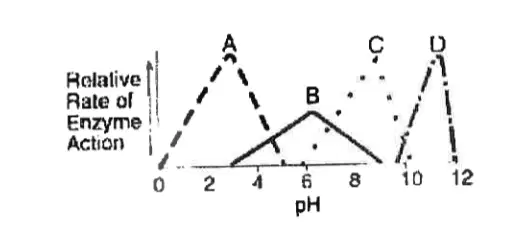
Base your answer to the question below on the graph. The graph shows the relative rates of action of four enzymes: A, B, C, and D. Which enzyme shows the greatest change in its rate of action with least change in pH?
A
B
C
D
The basic building blocks of a protein are
glucose molecules
hormones
amino acids
fats
Proteins, starch, and DNA are similar in that they are all
organic compounds
parts of genes
made of amino acids
made of simple sugars
The enzyme amylase will affect the breakdown of carbohydrates, but will not affect the breakdown of proteins. The ability of the enzyme molecule to interact with specific molecules is most directly determined by the
shape of the molecule involved
number of molecules involved
sequence of bases present in ATP
amount of glucose present in a cell
Which statement explains the importance of maintaining a constant internal environment to ensure proper enzyme functioning?
changes in pH and temperature will cause the enzyme reaction rate to be too fast
Temperature and pH determine amino acid sequences in enzymes.
Changes in pH will change the genetic instructions of enzymes.
Increasing the temperature and pH can alter the specific shape of enzymes
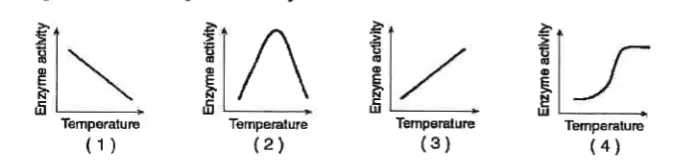
Enzymes have an optimal temperature at which they work best. Temperatures above and below this optimum will decrease enzymes activity. Which graph best illustrates the effect of temperature on enzyme activity?
Graph 1
Graph 2
Graph 3
Graph 4
A fully functioning enzyme molecule is arranged in a complex three-dimensional shape. This shape determines the
specific type of molecule it interacts with during a reaction
rate at which the enzyme breaks down during a reaction it regulates
pH of all body systems
temperature of the products of the reaction it regulates
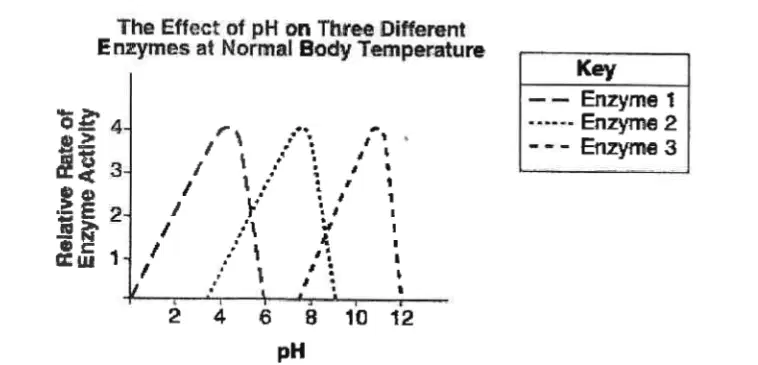
The graph below represents the effect of pH on three different enzymes at normal body temperature. The graph illustrates that enzymes 1, 2, and 3
are not affected by pH
work best at different pH levels
work best in an acidic environment
work best in a basic environment
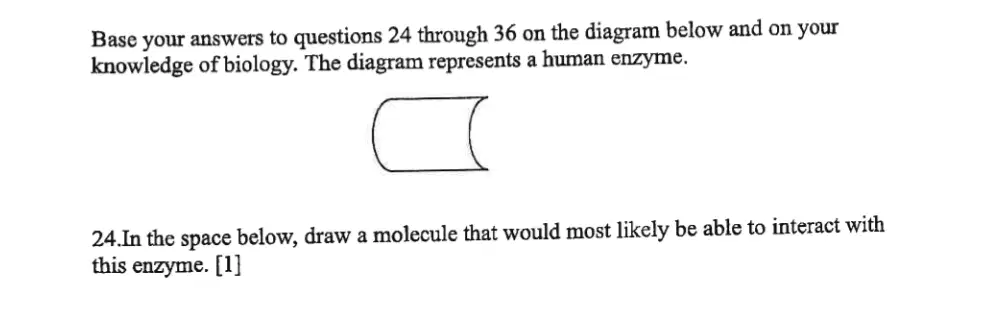
In the space below, draw a molecule that would most likely be able to interact with this enzyme.
Describe one role of enzymes in the human body.
A person has a high fever of 105°F. State one effect that this high fever would likely have on enzyme activity.

