
 Worksheets
Unit 5 kinetics
Total questions: 20
Worksheet time: 11mins
Define chemical kinetics
(a)
Determine the catalyst
Cl(g) + 03(g) ---> O2(g) + ClO(g)
ClO(g) + O(g) ---> O2 + Cl (g)
Cl(g)
O2(g)
O(g)
ClO(g)
Determine the rate law
NO(g) + O2(g) <--> NO3(g) Fast, Reversible
NO3(g) + NO(g) ---> 2NO2(g) Slow
Rate = k [NO2] [O2]
Rate = k
Rate = k [NO]^2[O2]
Rate = k [NO3] [NO]
Which of the following does NOT increase the rate of reaction
Presence of a catalyst
Increase in temp.
Increase in surface area
Decrease in concentration
4NH3 (g) + 5 O2 (g) ---> 4 NO2 (g) + 6 H20 (g)
In the reaction above the rate of disappearance of NH3 was equal to .64Ms^-1 at a certain moment in time. Which of the following is the rate of disappearance of O2 at the same point in time.
.64Ms^-1
.96Ms^-1
.51Ms^-1
.80Ms^-1
2 NO2(g) + F2(g) ---> 2NO2(g)
The rate for the reaction represented by the equation above is rate = k [NO2][F2]. Which of the following could be the first elementary step of a two-step mechanism for the reaction if the first step is slow and the second step is fast?
F2(g) -> 2 F(g)
NO2(g) + F2(g) -> NO2F(g) + F(g)
NO2(g) + F(g) -> NO2F(g)
2NO2(g) + F2 -> 2NO2F(g)
Suppose that a reaction is zero order with respect to A. If the initial value [A] is doubled, the initial reaction rate will _____
Stay the same
Increase
Decrease
Remain constant
Suppose that a reaction is second order with respect to A. If the initial value of [A] is doubled, the initial reaction rate will ______
Double
Triple
Remain constant
Quadruple
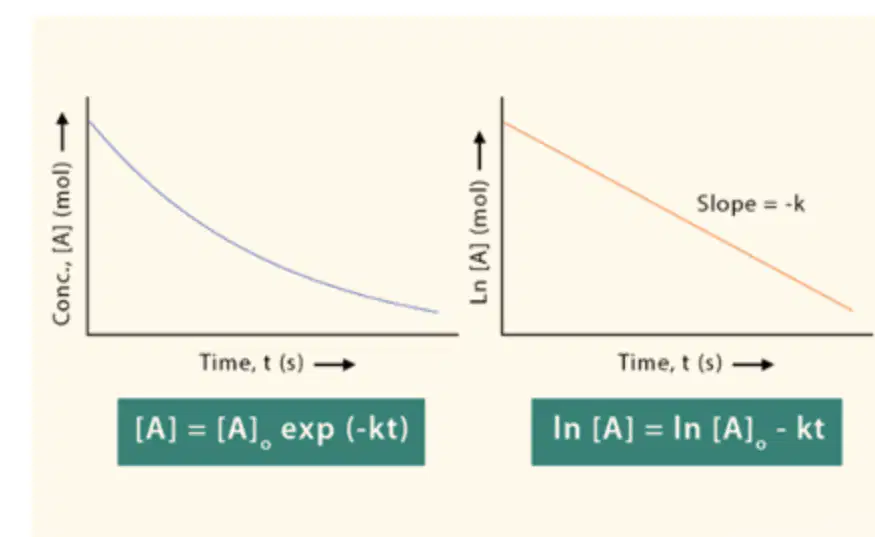
Based on these graphs what is the order of the reaction
not enough information
first order
second order
zeroth order
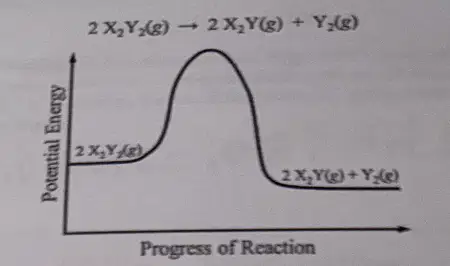
Which of the following represents the catalyzed version of the reaction above


Which of the following is the possible reaction mechanism for the reaction
Only mechanism 1 is consistent with the rate law
Only mechanism 2 is consistent with the rate law
Both mechanism 1 and mechanism 2 are consistent with the rate law
Neither mechanism 1 nor mechanism 2 is consistent with the rate law

Which of the following observation would support mechanism 1 but not mechanism 2
The reaction rate is independent of [X]
The reaction rate is independent of [Y2]
The reaction is exothermic
The reaction is second order overall
Which of the following best helps explain why an increase in temperature increase the rate of a chemical reaction?
At higher temperatures, reaction have a lower activation energy
At higher temperatures, reaction have a higher activation energy
At higher temperatures, every collision results in the formation of products
At higher temperatures, high-energy collision happen more frequency
If the rate law for a reaction is Rate=k[A]^2[B], what happens to the rate if [A] is doubled and [B] is tripled?
The rate increases by 6 times
The rate increases by 12 times
The rate increases by 5 times
The rate increases by 18 times
Which of the following is a correct explanation of an elementary step in a reaction mechanism?
It represents the overall reaction.
It describes a single molecular event leading to product formation.
It always involves a catalyst.
It always occurs slowly.
The half-life of a first-order reaction is 10 minutes. How much of the reactant remains after 30 minutes?
6.25%
25%
50%
12.5%
Which graph represents a zero-order reaction
A straight line when [A] vs. time is plotted.
A straight line when ln[A] vs. time is plotted.
A straight line when 1/[A] vs. time is plotted.
A curve that never levels off.
Given the mechanism:
Step 1: 2NO⇌N2O2 (fast, equilibrium)
Step 2: N2O2+H2→N2O+H2O (slow)
Step 3: N2O+H2→N2+H2O (fast)
Rate=k[N2O2][H2]
Rate=k[NO]^2[H2]
Rate=k[NO][H2]^2
Rate=k[NO][H2]
For a second-order reaction, the concentration of the reactant [A] decreases from 1.0 M to 0.5 M in 10 minutes. What is the rate constant kk?
0.1M^−1min^−1
0.3M^−1min^−1
0.2M^−1min^−1
0.4M^−1min^−1
A reaction has the rate law Rate=k[A]^2[B]. If the concentration of A is reduced by half and B is doubled, what happens to the rate?
Rate decreases by 4 times
Rate increases by 2 times
Rate decreases would stay the same
Rate decreases by 2 times

