
 Worksheets
District MOY Review - 8th Grade Science
Total questions: 110
Worksheet time: 1hrs 23mins

Three liquids and two solids are placed in a graduated cylinder. The substances arrange themselves in the cylinder according to their densities. Use the information to identify the liquids and solids in the graduated cylinder. start with the Most dense thing as substance 1, and continue from there.
Gold
Mercury
water
Gasoline
Cork

Calculate the density of the cube.
2 g/cm3
4 g/cm3
6 g/cm3
8 g/cm3

An irregularly shaped rock was lowered into a graduated cylinder holding a volume of water equal to 50 ml. The height of the water rose to 75 ml. If the mass of the stone was 250 g, what was its density?
15 g/mL
3.3 g/mL
10 g/mL
20 g/mL
a substance that consists of just one type of atom
element
a small particle that is a building block of matter
atom
a combination of two or more substances physically blended together
mixture
anything that has mass and takes up space
matter

Icing is a/an
element
heterogenous mixture
homogenous mixture
solution

Salsa is an example of a/an
compound
homogeneous mixture
heterogeneous mixture
solution

Mercury is a/an _.
element
heterogeneous mixture
homogeneous mixture
compound

This shape diagram represents a/an:
element
compound
homogeneous mixture
heterogeneous mixture
Which of the following is a pure substance?


Classify the image.
Mixture of compounds and elements
Mixture of compounds.
Mixture of elements.
Element

The shape diagram represents a
compound
homogeneous mixture
heterogeneous mixture
element
C3H5(NO3)3
C = 3, H = 5, N = 3, O = 9
C = 3, H = 5, N = 1, O = 9
C = 9, H = 15, N = 3, O = 9
C = 9, H = 15, N = 1, O = 3
Which one is the coefficient 4H2O?
4
H
2
O
How many Elements are in the compound C2H8O
2
3
1

How many Hydrogen (H) atoms in 3(NH₄)₂CrO₄?
4
2
8
24
C3H5(NO3)3
C = 3, H = 5, N = 3, O = 9
C = 3, H = 5, N = 1, O = 9
C = 9, H = 15, N = 3, O = 9
C = 9, H = 15, N = 1, O = 3
How many Hydrogen atoms are present in 4 MOLECULES of C6H4MgK5
4
8
16
1
How many TOTAL atoms are there in 3 MOLECULES of H2O
6
9
3
12
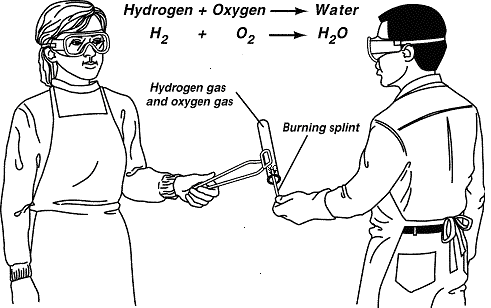
Al + O2 → 2Al2O3

Which is an example of a physical
change?
a candle burning
baking a cake
evaporating water
metal rusting

A green powder is heated & a gas is given off while it turns to a black solid. This describes
Physical Change
Chemical Change
Change in State
Change in Temperature
Manganese is shiny, conducts heat and electricity, and can be hammered into thin sheets. What is is?
Nonmetal
Metal
Metalloid
None of the above
This word is used to describe a substance that breaks apart easily and is weak and fragile
Conductivity
Ductile
Malleable
Brittle
Silicon has a dull, metallic luster, conducts heat well, and is brittle. What is it?
Nonmetal
Metal
Metalloid
None of the above

Where are the nonmetals located on the Periodic Table?
On the right
On the left
On the stairstep

Where are the metalloids located on the Periodic Table?
On the right
On the left
On the stairsteps
Gold is an element that is often used to make necklaces, rings, and other types of jewelry. What property of gold makes it useful in this way?
Gold is a conductor
Gold is an insulator
Gold is malleable
Gold has a high melting point
Use your Periodic Table to help you. Boron would be classified as a...
Metal
Nonmetal
Metalloid
Metals are shiny, good conductors, malleable, and ductile.
True
False
Metalloids have the same properties as
metals.
nonmetals.
neither, they are a combination of both.
Metals are mostly found on which side of the periodic table?
Left
Right
Copper is a common metal. Which of the following properties does this metal most likely have?
High conductivity, high malleability, and low luster
Low conductivity, low malleability, and low luster
High conductivity, high malleability, and high luster
Low conductivity, high malleability, and high luster


What characteristic is shown in the image?
Polarity
Hydrogen Bonds
Cohesion
Adhesion

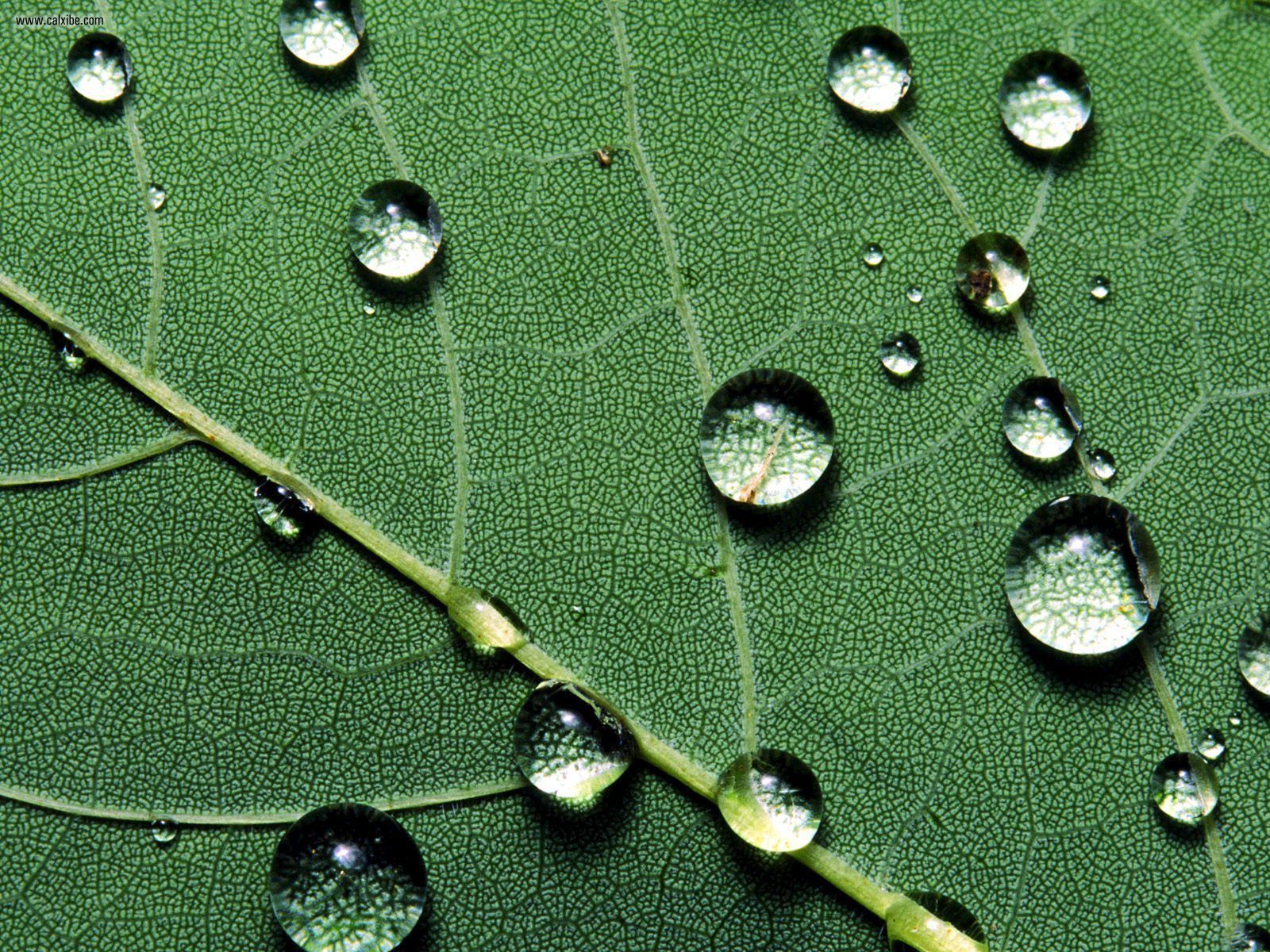
Refer to the picture of water sticking to a leaf; this is occurring because of:
Adhesion
Cohesion
Another name for an alkaline substance is a(n) ________.
Acid
Base
Covalent bond
Solution
A base is a substance
That releases OH- ions when dissolved in water
That releases H+ ions when dissolved in water
Does not release any ions when dissolved in water
None of the above
Water has a neutral because
it has more H+ ions than OH-
it has more OH- ions than H+
it does not produce any ions
it has an equal amount of H+ and OH- in solution


Speed = _______________
Distance + time
Distance – time
Distance x time
Distance / time
This occurs when an object speeds up, slows down, or changes direction.
Speed
Velocity
Acceleration
Another way to explain the speed and direction of a object would be to describe it’s ________
Speed
Velocity
Acceleration
Velocity = _______________
Speed – direction
Speed + direction
Speed x direction
Speed / direction
At what speed would a car have to move in order to travel 20 kilometers in 2 hours.
5 km/hr
10 km/hr
20 km/hr
40 km/hr
A car initially traveling at 8.0 meters per second doubles its speed while traveling in a northeast direction.
Students used a table to record the initial and final conditions for speed and velocity.
Which table is correct?


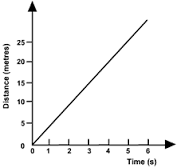
Which statement best describes the motion of the toy vehicle during the first 30 seconds of the investigation?
The vehicle was traveling at a constant speed
The vehicle was accelerating at a constant rate
The speed of the vehicle was increasing
The acceleration of the vehicle was increasing

Which statement best describes the cart?
The cart was stationary with a velocity of 0 m/s for the entire 7 seconds
The cart was stationary except for a short burst of acceleration of 0.5 m/s2
The cart moved at a constant velocity of 0.5 m/s for the entire 7 seconds
The cart accelerated at a constant rate of approximately 0.8 m/s2
Match the following
Speed
30 m/s
Velocity
30 m/s east
Acceleration
30 m/s2

The pickup truck has a changing velocity because the pickup truck -
can accelerate faster than the other two vehicles
is traveling in the opposite direction from the other two vehicles
is traveling on a curve in the road
needs a large amount of force to move

How will this object move?
It will not move
It will move in both directions
It will move to the right
It will move to the left
Shadell pushes a box 35 N to the right. Nazai pushes the box 25 N in the same direction. What is the net force?
60 N balanced to the right
10 N balanced to the right
60 N unbalanced to the right
10 N unbalanced to the right

What is net force?
10 N left
0 N
10 N right

Balanced or Unbalanced
(a)

What is the net force?
30 N left
25 N right
55 N right
5 N left
Which of the answer choices is not a characteristic of a balanced force?
no change in motion
moving at a constant speed
causes a change in motion
net force of zero

What is the net force?
0 balanced
900 N balanced right
900 N unbalanced right
0 unbalanced
What is the net force?
30 N left
25 N right
55 N right
5 N left
States that force equals mass x acceleration
Newtons 1st law
Newtons 2nd law
Newtons 3rd law
Claims if an object exerts a force on another object, the second object exerts a force of equal strenght in the opposite direction back towards the first object
Newtons 1st law
Newtons 2nd law
Newtons 3rd law
States an object at rest will remain at rest unless acted on by an unbalanced force
Newtons 1st law
Newtons 2nd law
Newtons 3rd law
A 1,000-kg truck barrels down a highway at 24 m/s2 with a force of 24,000 N.
Newtons 1st law
Newtons 2nd law
Newtons 3rd law
A trampoline pad launches a child upwards with a force equal to the downward force of the landing the moment before.
Newtons 1st law
Newtons 2nd law
Newtons 3rd law
(Using Fnet=ma), What net force is required to accelerate a car at a rate of 2 m/s2 if the car has a mass of 3,000 kg?
6,000 N
1,500 N
3,002 N
2,998 N
Maya was riding her 20 kg bike and she accelerated at 10 m/s2 to catch up with Noah and Elijah. What was the sum of all the force vectors acting on Maya's bike?
25 Newtons
20 Newtons
200 Newtons
10 Newtons

Jessica ran all the way from school to home going the same constant speed and never stopping.
Jessica waited around after school for her friend, and then they ran home together.
Jessica ran for a long time, then slowed down to walk the rest of her trip. Once she got home, she sat down on the couch.
Jessica walked for a while, stopped to sit on a bench in the park, and then ran the rest of the way home.


The Big Bang Theory explains…
Origins of the universe
The beginning of life
The law of gravity
Why the universe was created
A galaxy that is moving toward the Earth will show…
A decrease in brightness
A blue shift in the spectrum
An increase in light years
A red shift in the spectrum
What does the Big Bang Theory say?
The universe was created in its current location
The universe is collapsing and getting smaller
All of the matter in the universe is expanding from a tiny, dense point
Two galaxies collided causing a big bang
Which of the following is evidence of the Big Bang Theory?
The universe is getting smaller
Cavemen heard a loud bang at the
beginning of time
The universe is expanding
The universe isn’t moving
In redshift, the wavelengths of light become
Longer
Faster
Shorter
Bluer
The farther away a galaxy is, _________ is moving.
slower
faster
What is the universe?
All the substance in the solar system
All the substance in our galaxy
Everything that exists
The earth and moon together
Scientists have detected a cosmic microwave background radiation or CMBR. This is received from all parts of the universe and is thought to be the heat and light left over from the original explosion.
true
false
What does redshift tell us?
Red things get hotter
The object is moving towards us
The object is moving away from us
The object isn't moving away from us
Why is the light from distant galaxies red shifted?
They produce more red light than nearby galaxies
The longer wavelengths are filtered out by dust
Light in outer space is red
They are moving away from us
How are the stars on the HR diagram plotted?
Size & Density
Temperature & Luminosity
Age & Luminosity
Temperature & Size


Which star is considered a main sequence star?
Vega
Betelgeuse
Pollux
Van Maanan's Star

Which star is considered a giant star?
Mira
Zeta Arindani
Barnard's Star
Betelgeuse

Which star is considered a supergiant?
Sirius B
Sun
Betelgeuse
Van Maanan's Star

