
 Worksheets
Earth and Space practice Unit 8/9
Total questions: 37
Worksheet time: 19mins
The moon, the sun, and Earth have different physical characteristics. Which of these best describes a physical characteristic of the sun?
It is solid and has many layers.
It rotates on its axis every 24 hours.
It is mostly made of hydrogen and helium.
It is smaller and has less gravity than Earth or the moon.
One of the brightest objects in the night sky is a planet that is closer to the sun than Earth is. What is the name of this planet?
Mars
Saturn
Jupiter
Venus
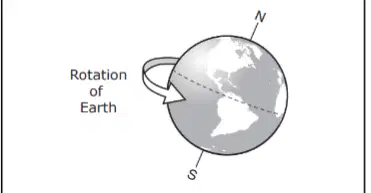
Which of these cycles is a direct result of Earth’s rotation?
Day and night
Moon phases
Rainfall and evaporation
Seasons
A shadow moves during the day because of-
Strong winds
The Moon’s gravity
Falling temperatures
The rotation of Earth

Which picture shows how the tree’s shadow most likely looked at 9:00 A.M.?
A
B
C
D
A student is looking for evidence that Earth is always rotating on its axis. Which of the following would provide the best evidence?
The different amount of rain that falls each day
The appearance of shadows changing throughout the day
The presence of other planets in the night sky
The different phases of the moon in a month
A student builds a model of the solar system that includes a sphere representing Earth. The sphere turns in a full circle on its axis. By using a model of Earth that spins on its axis, the student can best demonstrate —
the cycle of the four seasons
the aging of a star
the passing of a year
the cycle of day and night
Which statement best explains why the sun appears to move across the sky during the day?
The Earth is closest to the sun in the winter.
The Earth is revolving around the sun.
The Earth is tilted at 23.5 degrees.
The Earth is rotating on its axis.
Students make a solar system model on the playground. The school building represents the sun. They label round objects for each planet. Which planet should they place at the greatest distance from the school building?
Jupiter
Neptune
Mercury
Saturn
In the early 1600s, the astronomer Galileo used a telescope to make observations of Mercury and Venus. What are the positions of these planets in relation to the sun?
Mercury is the planet closest to the sun, and Venus is the 2nd planet from the sun.
Mercury is the 2nd planet from the sun, and Venus is the 3rd planet from the sun.
Venus is the planet closest to the sun, and Mercury is the 2nd planet from the sun.
Mercury is the 3rd planet from the sun, and Venus is the planet closest to the sun.

If this day continues to be sunny, what will most likely happen to the length of the shadow from 2 P.M. to 4 P.M.?
The length of the shadow will stay the same.
The length of the shadow will decrease and then increase.
The length of the shadow will increase.
The length of the shadow will decrease.
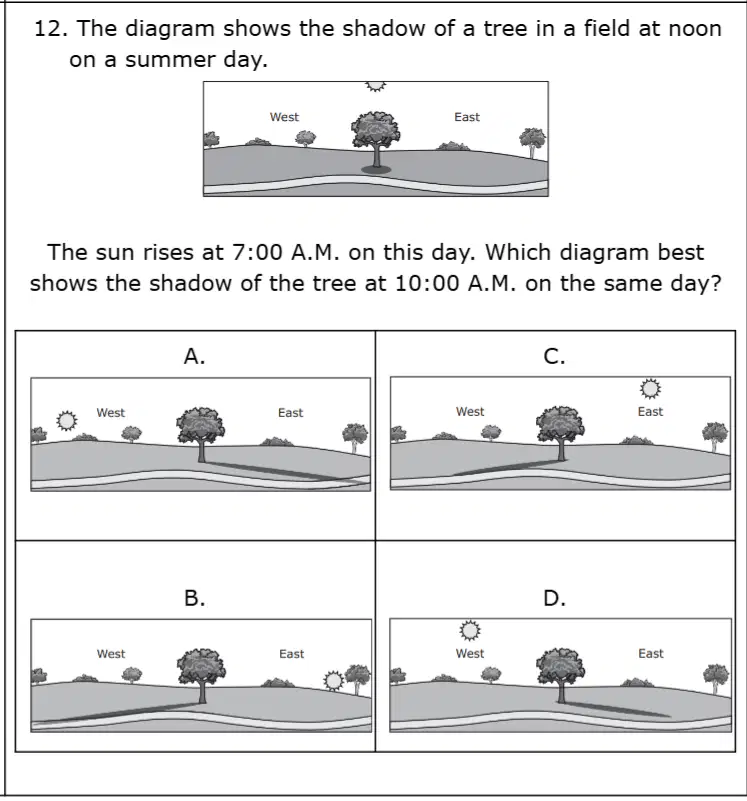
The diagram shows the shadow of a tree in a field at noon on a summer day. The sun rises at 7:00 A.M. on this day. Which diagram best shows the shadow of the tree at 10:00 A.M. on the same day?
A
B
C
D
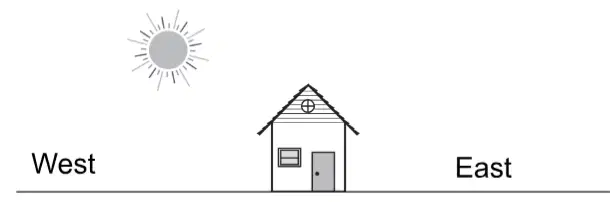
A teacher asks students to explain what they see in this picture. Four student explanations are shown in the box. Student 1: The sun will set in less than 6 hours. Student 2: The sun will reach the East horizon in less than 10 hrs. Student 3: The picture shows early morning. Student 4: The picture shows the location of the sun at noon. Which of the students gave a correct explanation?
A Student 1 only
B Students 2 and 4 only
C Student 2 only
D Students 1 and 3 only
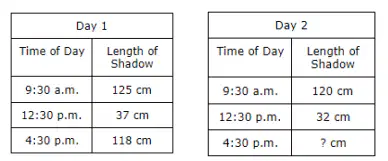
On Day 2 at 4:30 p.m., the shadow will-
be longer than the shadow at 12:30 p.m.
be shorter than the shadow at 12:30 p.m.
stay the same length as the shadow at 12:30 p.m.
be a different color than the shadow at 12:30 p.m.

A student draws diagrams of her house and the location of the Sun in the sky. Which diagram below does NOT correctly represent the location of the Sun at the time indicated?
a
b
c
d
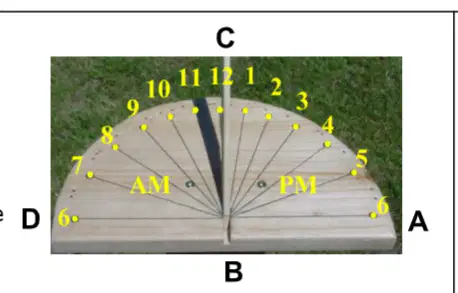
16. A student makes a sundial. The student takes a picture of the sundial at 11:00 A.M. Based on the student’s sundial, which letter is closest to the position of the sun when the pictures were taken?
A
B
C
D
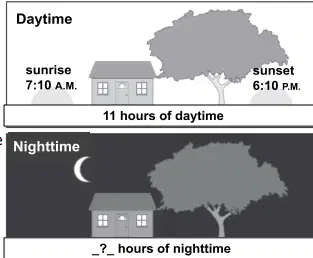
A student drew the following pictures to show the day-night cycle of Earth. Based on the pictures, how many hours should the student record on the nighttime picture to complete a day-night cycle?
A 11 hrs
B 12 hrs
C 13 hrs
D 24 hrs
Which of the following explains how water undergoes a change of state in one stage of the water cycle in order to move from the ocean’s surface into the air?
Liquid water that is heated by the sun becomes a gas and rises.
Gaseous water rises as it is cooled by the ocean.
Liquid water that is heated by the sun condenses into rain.
Gaseous water collects in drops of fog above the ocean’s surface.
Which of the following events in the water cycle is an example of solar energy being absorbed?
Water vapor condensing to form clouds
Water evaporating from the surface of an ocean
Rain freezing as it falls toward the ground
Clouds releasing precipitation over a mountain
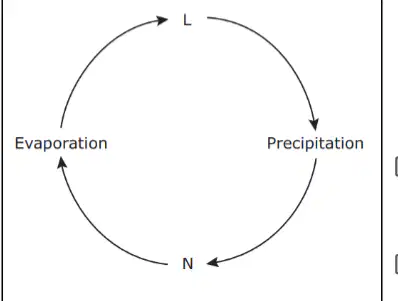
A diagram of the stages in the water cycle is shown below. Which process will happen when the sun interacts with the ocean?
Rain will fall only on the land
Water will not evaporate at nighttime
Salt water will become fresh water vapor
Precipitation will happen less often.
Which of the following explains how water undergoes a change of state in one stage of the water cycle in order to move from the ocean’s surface into the Air?
Liquid water that is heated by the sun becomes a gas and rises.
Gaseous water rises as it is cooled by the ocean.
Liquid water that is heated by the sun condenses into rain.
Gaseous water collects in drops of fog above the ocean’s surface.

The model shows where water can be found during different stages of the water cycle. What should be added to the diagram to better explain the water cycle?
Soil to trap water from runoff
The sun to provide energy for evaporation
Rocks to release thermal energy
Plants to provide oxygen in the atmosphere
Some scientists measured and recorded local rainfall amounts and water levels at several local lakes over the summer. They compared their measurements with data from the past 30 years. The scientists concluded that the area was drier this summer than in previous years. They plan to continue recording these measurements each summer for the next decade. What characteristic of the area are the scientists studying?
Climate, because they are making more than one type of measurement
Climate, because they are comparing rainfall amounts over a long period of time
Weather, because they are tracking changes only to their local environment
Weather, because they expect rainfall amounts and water levels to continue to decrease
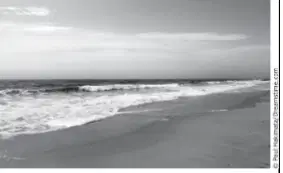
This photograph shows a beach on a partly sunny day. Which of the following is an interaction between the sun and the ocean that results in clouds forming near the beach?
Energy from the sun causes precipitation over the ocean.
Energy from the sun causes water to evaporate from the ocean.
Light from the sun reflects off the surface of the ocean.
Light from the sun decreases the amount of water vapor in the air over the ocean.

The picture shows a cumulonimbus cloud forming over an ocean. Which statement best explains how the sun and the ocean interact to form a cumulonimbus cloud?
Heat from the sun warms the ocean, causing water to evaporate. The water vapor then condenses to form a cumulonimbus cloud.
Heat from the sun causes clouds in the area to gather over the ocean and form one large cumulonimbus cloud.
Light from the sun shines on the ocean, causing water vapor to condense. The water then evaporates to form a cumulonimbus cloud.
Light from the sun causes ocean water to reflect water vapor into the air and gather over the ocean into a cumulonimbus cloud.
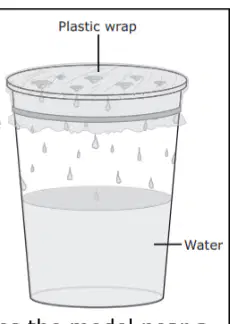
A student makes a model of the water cycle by using a cup, some water, and plastic wrap. After the student places the model near a sunny window, moisture forms on the inside of the plastic wrap. What change is the student most likely observing in this model?
Freezing
Condensation
The warming of air
The formation of clouds
A student researched data about the climate of McAllen, Tx. Which data should the student research?
The wind speed at different times of the day.
The amount of rainfall over several days.
The average wind speed and amount of rainfall over one month.
The average temperature and amount of rainfall over 30 yrs.
Each school year for 30 years, the amount of rain that fell at a school was measured and recorded. Tracking rainfall over a long period provides the most information about which characteristic of an area?
Climate
Temperature of one day
Weather
Type of soil
Which table correctly classifies statements about weather and climate?
Weather: Hail can form in thunderstorms that have strong winds. Climate: The high temperature for Tuesday was 28 °C.
Weather: There will be thunderstorms tomorrow in the afternoon. Climate: The month of February has had the coldest temperatures on record for thirty years.
Weather: August has the hottest temperatures each year. Climate: A cold front is expected next week.
Weather: The high temperature for March is usually around 20 °C. Climate: There are clear skies with no chance of rain for the next four days.
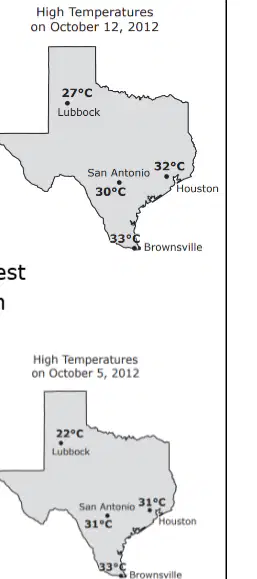
How many degrees Celsius did the high temperature increase in the city that had the greatest change in high temperature?
0
5
10
15
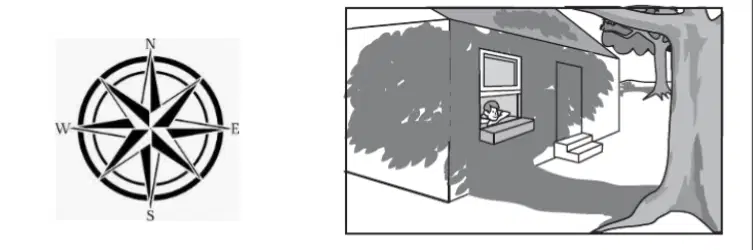
31. Observe the picture of the tree, its shadow, and the compass. What can be claimed about the position of the Sun in the sky and the time of day in the picture?
The Sun is in the east, and it is morning.
The Sun is in the west, and it is evening.
The Sun is directly overhead, and it is noon.
The Sun is in the south, and it is afternoon.
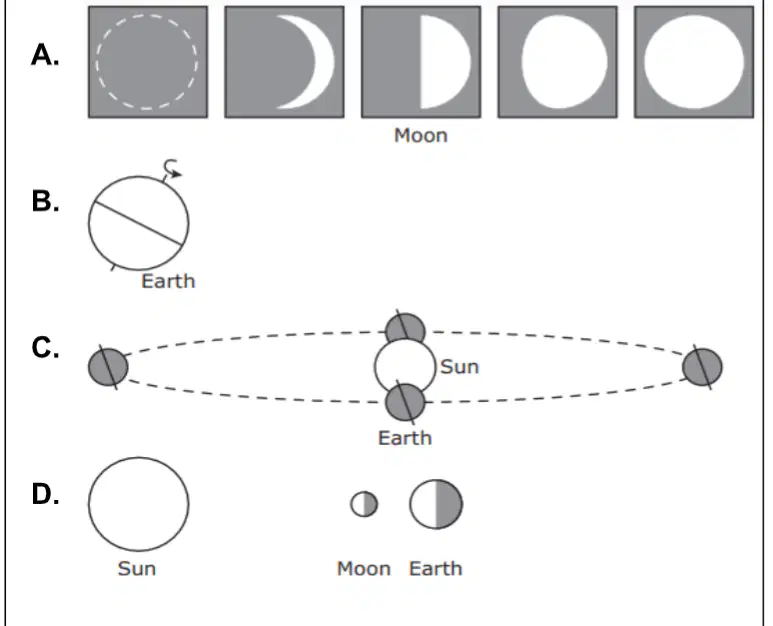
Which of these best explains why the sun appears to move across the sky each day?
a
b
c
d
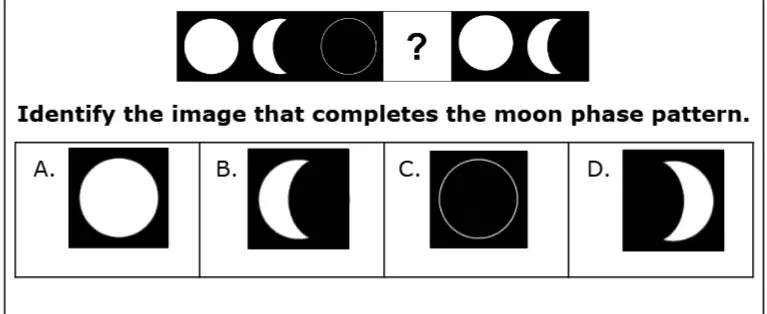
A student used the model below to show how the moon phases change over time. Identify the image that completes the moon phase pattern.
A.
B.
C.
D.

The image below shows a lunar cycle. What is a conclusion you can draw from this table? The lunar cycle from full moon to the next full moon takes approximately--
one day
one week
one month
one year
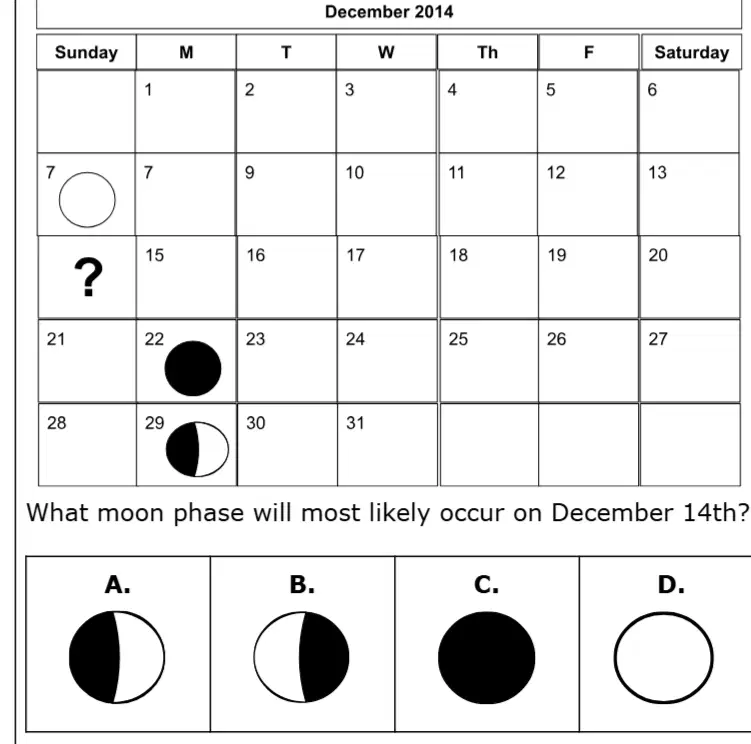
A student created the moon phase calendar below and needs to add a moon phase for December 14th. What moon phase will most likely occur on December 14th?
a
b
c
d
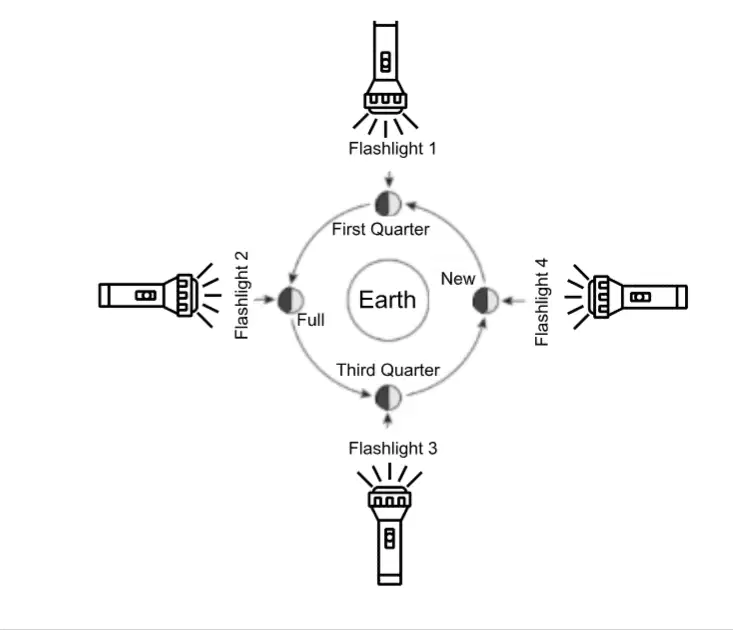
A student built the model below that shows 4 phases of the moon as it revolves around Earth. In order for this model to be correct, where should the student shine the flashlight on the model? Circle ONE flashlight that is in the correct position to make this model correct.
Flashlight 1
Flashlight 2
Flashlight 3
Flashlight 4

Based on the diagram, which lunar phase will occur directly after X?
a
b
c
d

