
 Worksheets
Pedigrees & Dihybrid Crosses
Total questions: 26
Worksheet time: 2hrs 45mins
For a Pedigree, Match the following...
Male symbol
Square
Female Symbol
Circle
Affected Individual
Shape Filled
Individual NOT affected
Shape Not filled


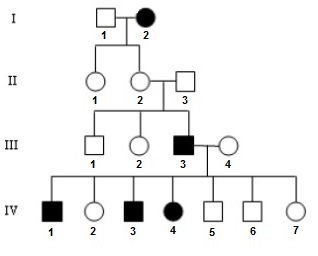


This is a pedigree that traces blue eyes, which is a recessive trait. While brown is dominant. What is the phenotype and genotype of the mother in generation 1?
Brown eyes
Blue eyes
BB
bb
Bb

If this pedigree is tracing a recessive disorder, what is the genotype of individual II-3?
heterozygous
This is a pedigree that traces freckles, which is a dominant trait. What is the genotype of the father in generation 1?
Aa
AA
aa

Cystic Fibrosis is a recessive trait. Which genotype(s) will NOT have cystic fibrosis?
CC
Cc
cc

Cystic Fibrosis is a recessive trait. What is the genotype of Bill?
CC
Cc
cc

This pedigree is tracing straight thumbs, which are dominant. What is the genotype and phenotype of II-2?
TT
Tt
tt
straight thumb
not straight thumb
This pedigree is tracing straight thumbs, which are dominant. What is the genotype and phenotype of II-5?
TT
Tt
tt
straight thumb
hitchhiker's thumb
This pedigree shows family members that have Tay Sachs, a recessive disease. What is II-3's genotype?
GG
Gg
gg
This pedigree shows family members that have Tay Sachs, a recessive disease. What is IV-1's genotype?
GG
Gg
gg
This pedigree shows family members that have Tay Sachs, a recessive disease. Would the carriers have the disease?
Yes because they would have one recessive allele
Yes because they would have two recessive alleles
No because they would have one dominant allele

What goes in box 15
aabb
AABB
aaBB
AAbb

What is the genotype for a pea plant heterozygous for round seeds (R), and homozygous recessive for green seeds (y)?
What is the genotype for a pea plant homozygous for round seeds (R), and heterozygous for yellow seeds?
RrYy
RRyy
RRYy
rryy
If you have a parent who has GgBb as their genotype, what are the possible alleles they could donate to their gametes (outcome of foil)
GB, GB, gb, gb
GB, Gb, gB, gb
GG, BB, gg, bb
Gb, Gb, Gb, GB
A white mouse with red eyes is crossed with a black mouse with brown eyes. The white mouse is recessive for both of its traits. The black mouse is dominant for both of its traits.
This cross would be
BBEE x bbee
BBEe x BbEe
BbEE x BbEe
BBee x BBEE

What are the possible gametes that can be formed from these alleles? FOIL!

A way to predict genetic probability using two different
sets of alleles on two different chromosomes.
Co-Dominance
Incomplete Dominance
Monohybrid Cross
Dihybrid Cross

