
Font size
 Worksheets
AMDM Unit 4 Test
Total questions: 20
Worksheet time: 43mins
Sophia is comparing two investment options for a 10-year period:
Option 1: A savings account that compounds interest annually at a rate of 6%.
Option 2: A certificate of deposit that offers a fixed return of $500 per year.
Based on these options, which function represents the value of the savings account after x years if the initial investment is $1,000?
y=1000(1+0.06)^x
y=1000+500x
y=1000(1+0.06x)
y=500x
Sophia is comparing two investment options for a 10-year period:
Option 1: A savings account that compounds interest annually at a rate of 6%.
Option 2: A certificate of deposit that offers a fixed return of $500 per year.
Which of the following correctly describes the comparison between the two investments after 10 years?
The certificate of deposit will always have a higher total value.
The savings account grows faster and will eventually surpass the certificate of deposit.
Both investments will have the same total value after 10 years.
The savings account grows linearly, while the certificate of deposit grows exponentially.
What type of function best models the depreciation of a car's value over time?
Exponential
Linear
Quadratic
Sinusoidal
Which of the following interest types involves earning interest on both the initial principal and the previously earned interest?
Simple interest
Compound interest
Continuous interest
Periodic interest
What does the "A" represent in the compound interest formula A=P(1+r/n)^(nt)?
Amount of interest earned
Final balance
Initial deposit
Number of periods
If interest is compounded monthly, how many compounding periods are there in one year?
12
6
365
52
What is the key difference between simple interest and compound interest?
Simple interest adds interest to the principal; compound interest adds interest to the previous balance.
Simple interest adds interest to the principal only once; compound interest adds interest multiple times.
Simple interest depends on compounding frequency; compound interest does not.
None of the above.
Identify the interest rate if an account earning $2,000 grows to $2,420 in 4 years with simple interest.
5%
6%
7%
8%
What formula should be used to calculate the value of an account with interest compounded continuously?
A=P(1+r)^t
A=P(1+r/n)^(nt)
A=Pe^rt
A=P+Prt
Which investment would have a larger balance after 5 years?
Option 1 - 4% compounded monthly
Option 2 - 3.9% compounded daily.
When should you use the continuously compounding interest formula instead of the standard compounding formula?
A) When interest is compounded multiple times a year.
B) When interest is compounded daily.
C) When interest compounds at every possible moment.
D) When calculating the future value of a simple interest account.
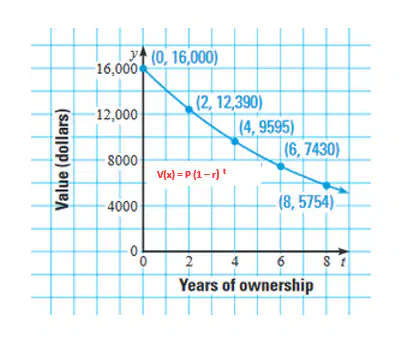
You purchase a car for $16,000. The car's value depreciates 12% for each year of ownership. After how many years of ownership is the value of the car about $14,000?
1 year
2 years
3 years
4 years
The formula below can be used to determine the total amount of money in a savings account. What was the initial amount of money deposited in the account?
A=3250e0.062⋅8
(a)
Jay'den earned $475 from mowing lawns last summer. He deposited this money in an account that pays an interest rate of 3.8% compounded annually.
What will be his balance after 15 year?
$827.52
$831.10
$839.45
$846.80
How much would Zion earn on a deposit of $10,000 one year at 5.12% compounded daily?
$512.00
$525.30
$10,523.30
$10,512.00
Emily's parents put $1,500 in her bank account for college tuition. At an interest rate of 8.25% compounded semi-annually, what will be the balance after 3 years?
$2,273.50
$1,514.08
$2,040.23
$1,911.70
If $25,000 is deposited into a new account that earns 2% interest compounded quarterly, how much money will be in the acount in 15 years? Round answer to the nearest cent (2 decimal places).
(a)
On her 18th birthday, Shannon deposited $500 into an account that earns 4.7% interest compounded continuously. What will the account balance be on her 65th birthday? Round answer to the nearest cent (2 decimal places).
(a)

