
 Worksheets
unit 113 powerpoint 8
Total questions: 35
Worksheet time: 18mins
What are the key stages in the rainwater cycle?
Evaporation, Condensation, Precipitation
Filtration, Collection, Distribution
Absorption, Transpiration, Infiltration
Sublimation, Deposition, Freezing
Which of the following is an underground source of water?
River
Lake
Artesian well
Ocean
What are the typical properties of water from various sources?
Colorless, Odorless, Tasteless
Salty, Colored, Sweet
Bitter, Thick, Sticky
Opaque, Fragrant, Spicy
What is the scientific name for the rainwater cycle?
Water cycle
Hydrological cycle
Evaporation cycle
Atmospheric cycle
What is the more common name for the hydrological cycle?
Water exchange cycle
Rainwater cycle
Cloud cycle
Precipitation cycle
In the rainwater cycle, where is water continually exchanged?
Between the ocean and the sky
Between the atmosphere, Earth's surface, ground, and plants
Between rivers and lakes
Between clouds and mountains
What is evaporation in the context of the rainwater cycle?
When water molecules condense and fall as rain.
When water molecules move apart.
When water freezes into ice.
When water is absorbed by plants.
What is precipitation in the context of the rainwater cycle?
When water molecules move apart.
When water molecules condense and fall as rain.
When water is absorbed by the ground.
When water evaporates from oceans.
What is one of the responsibilities of BES engineers regarding cold water systems?
Design and install heating systems
Advise on electrical safety
Design, install, test, and maintain cold water systems
Manage waste disposal

Which activity uses the highest percentage of cold water according to the chart?
Flushing toilets
Bathing and showering
Washing clothes
Cooking and drinking
What percentage of cold water is used for washing dishes?
12.2%
8.3%
11.4%
5.6%
Why is it important for BES engineers to advise customers on good usage of cold water?
To increase water bills
To ensure efficient and sustainable use
To promote the sale of water systems
To reduce the need for maintenance
What are the two main sources of water mentioned in the document?
Surface sources and rainwater
Underground sources and desalination
Surface sources and underground sources
Rainwater and desalination
Which of the following is an example of a surface source of water?
Wells
Artesian wells
Rivers and streams
Springs
Which of the following is an example of an underground source of water?
Upland surface water
Artificial reservoirs
Rivers
Artesian wells

Which of the following is a source of surface water?
Oceans
Lakes
Glaciers
Groundwater

Which of the following is NOT a source of surface water?
Reservoirs
Canals
Rivers
Aquifers
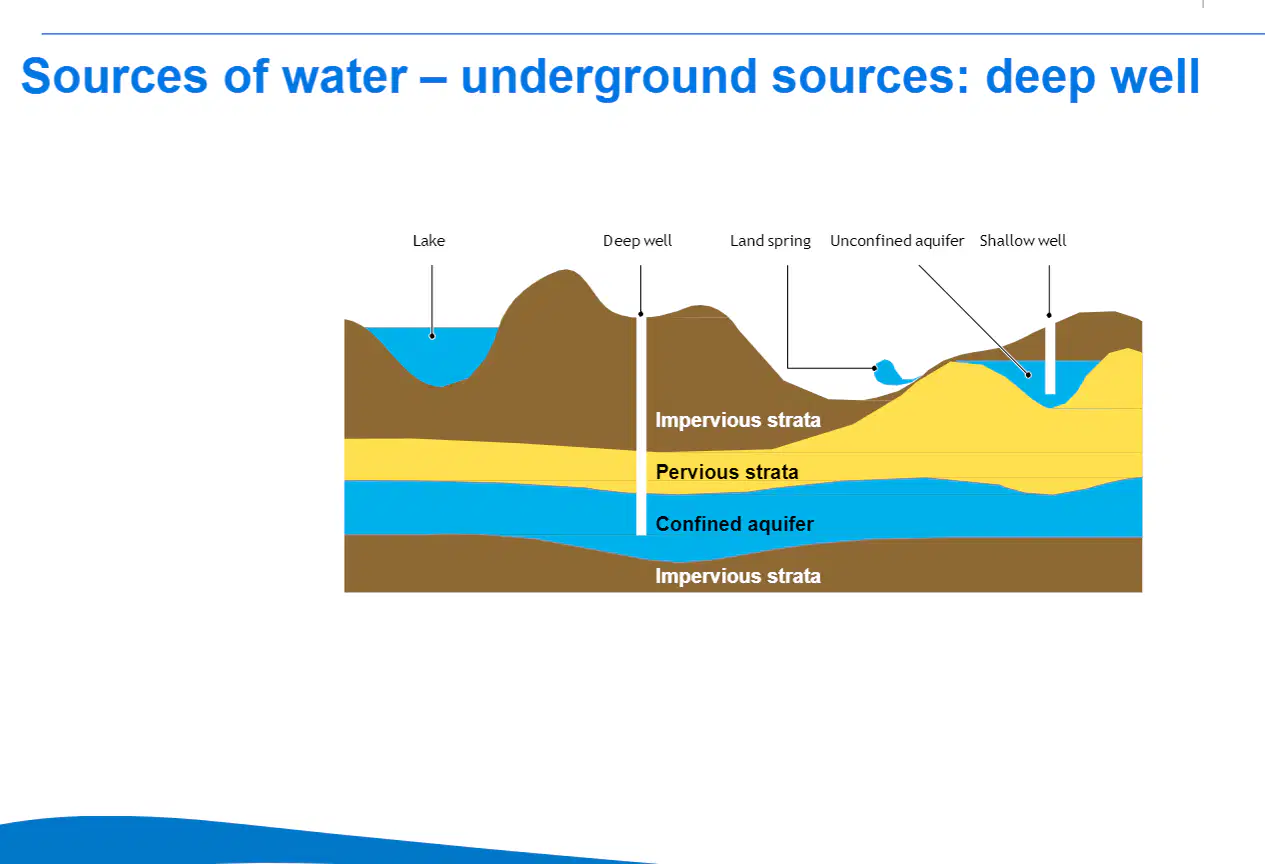
What is a deep well primarily used for?
Extracting water from a confined aquifer
Collecting rainwater
Storing surface water
Diverting river water
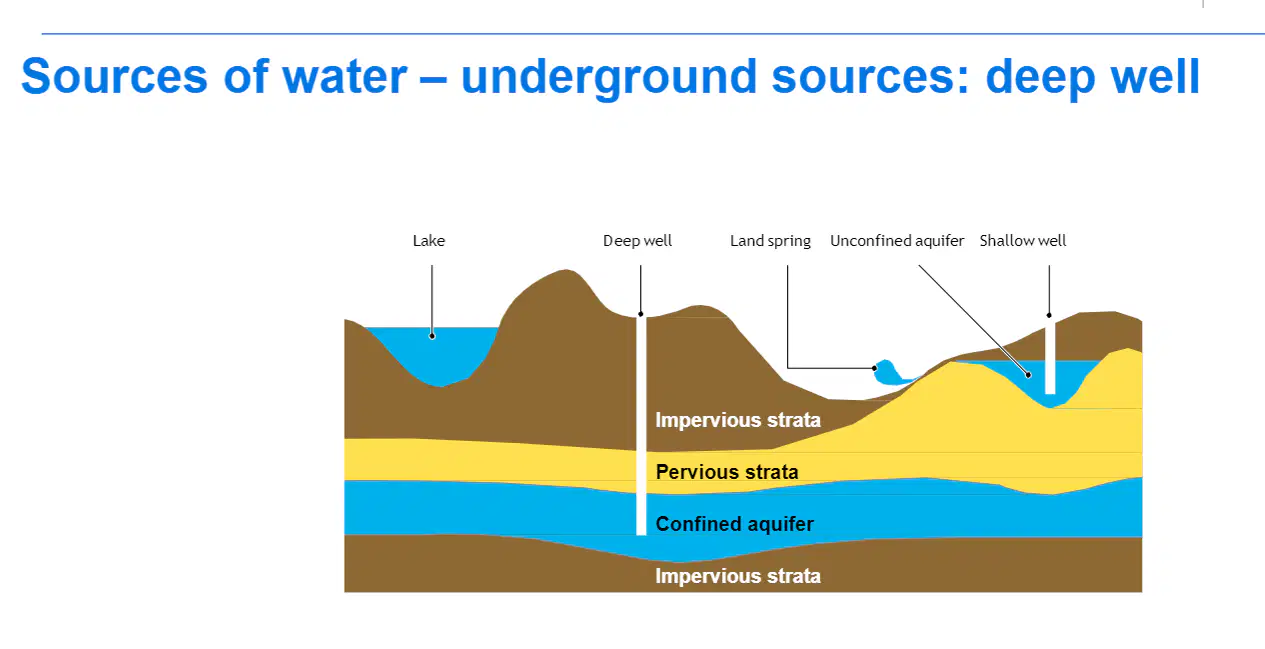
Which type of strata is impermeable to water?
Impervious strata
Pervious strata
Confined aquifer
Unconfined aquifer
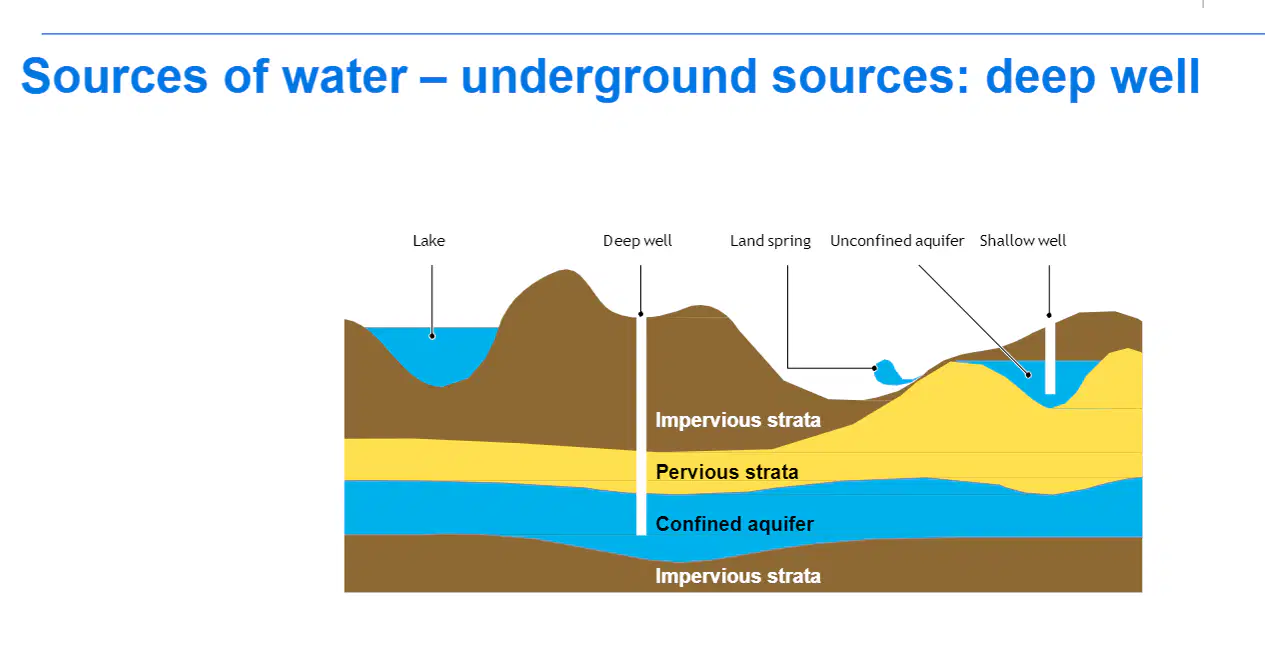
What is the main difference between a shallow well and a deep well?
Depth of water extraction
Type of water extracted
Location of the well
Method of construction
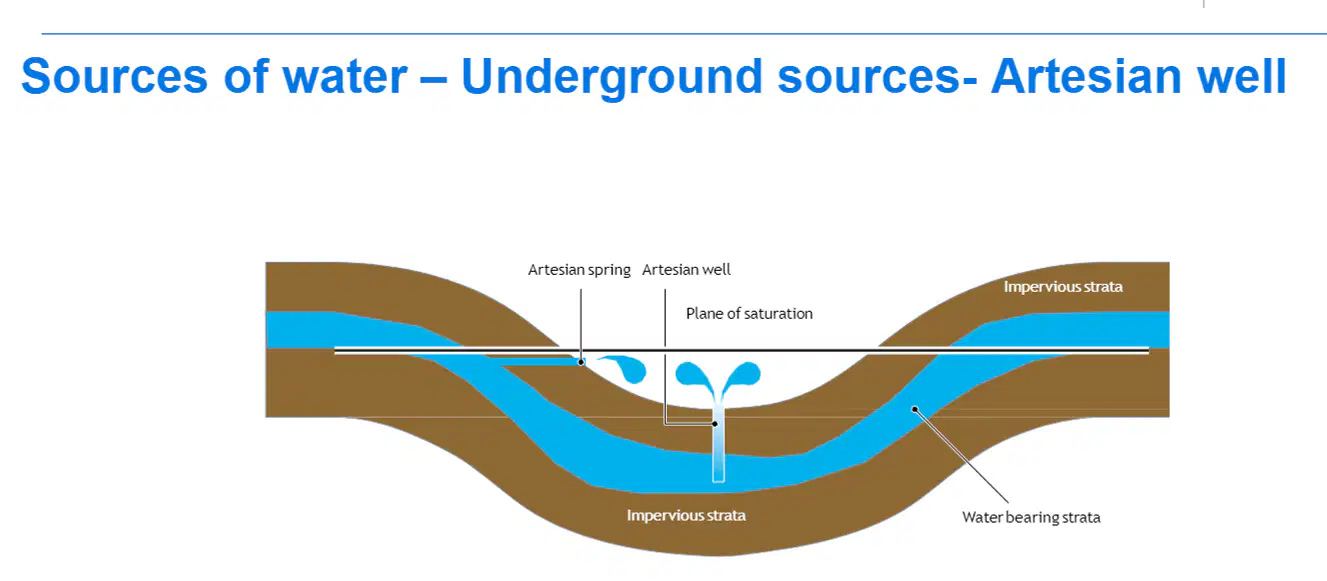
What is an artesian well?
A well where water is pumped to the surface
A well where water flows to the surface naturally due to pressure
A well that requires manual extraction of water
A well that is only found in desert areas
What is the role of impervious strata in an artesian well?
It allows water to flow freely
It prevents water from escaping
It absorbs water
It filters impurities from water
Which of the following is a characteristic of water-bearing strata?
It is impermeable to water
It contains water under pressure
It is always dry
It is found only above ground
What is the main reason deep wells and bore holes require only sterilisation treatment?
They are naturally filtered
They are chemically treated
They are usually polluted
They are stored in service reservoirs
Which of the following is known as potable water?
Water from rivers
Water from lakes
Wholesome water
Untreated water
What is a common treatment process for water from rivers, lakes, and reservoirs?
Only sterilisation
Straining, filtering, and chemical treatment
Natural filtering
No treatment needed
Which of the following companies is responsible for managing water resources in Wales?
Dŵr Cymru Welsh Water (DCWW)
Thames Water
Yorkshire Water
United Utilities
Approximately what percentage of water in Wales originates from surface water?
50%
75%
95%
100%
Which of the following is NOT a water company managing resources in Wales?
Hafren Dyfrdwy (HD)
Severn Trent Water
Albion Water
Anglian Water
What happens to water when it leaves the cloud as rain, hail, or snow?
It becomes highly acidic.
It is almost pure and contains very few impurities.
It immediately becomes hard water.
It turns into a solid form.
What does water absorb as it falls to the ground to form a weak solution of carbonic acid?
Oxygen
Nitrogen
Carbon dioxide
Sulphur dioxide
What can sulphur trioxide in the atmosphere cause when absorbed by water?
Strong hydrochloric acid
Weak sulphuric acid
Strong nitric acid
Weak acetic acid
What happens to hard water when it is heated above 65°C?
It gains more calcium.
It loses its calcium.
It becomes softer.
It evaporates completely.
What is one problem caused by limescale buildup in plumbing systems?
It improves heat transfer.
It reduces water pressure.
It insulates the water from the heat source.
It prevents water from boiling.
What is the term used when limescale causes localized boiling in heating systems?
Scaling
Boiling point
Kettling
Bubbling

