wayground logo

Free Printable Worksheets

NEW

Font size

S
M
L
XL
Worksheets

Classwork12-11

Total questions: 16

Worksheet time: 34mins

Name
Class
Date
1.
Why do elements bond?
a)
To be friends
b)
To create a new element
c)
To become stable
2.
How are covalent bonds formed?
a)
Sharing of electrons
b)
Transfer of electrons
3.
How are ionic bonds formed?
a)
Transfer of electrons
b)
Sharing of electrons
4.
Atoms are most stable when their outer shell is complete.
a)
true
b)
false
5.
Noble gases will form chemical bonds with other elements
a)
True
b)
False
c)
Sometimes
6.

The octet rules states that most elements want to have _____ valence electrons.

a)

2

b)

4

c)

6

d)

8

7.

How many valence electrons does Oxygen (O) have?

a)

6

b)

8

c)

15

d)

16

8.

What type of bonding does this picture show?

a)

Ionic

b)

Covalent

9.

Why don't noble gases form bonds?

a)

They all have a full octet

b)

Noble gases do form bonds

c)

They only bond when with eachother

d)

none of these answers are correct

10.

During a chemical reaction, atoms can

a)

be destroyed to form a new substance

b)

be created to form a new substance

c)

be rearranged to form a new substance

11.

What is a coefficient?

a)

Number behind molecule (does not apply)

b)

Number in front of molecule (applies to whole thing)

c)

Applies to the element it follows

12.

We balance equations to show...

a)

Change

b)

Reactants

c)

Products

d)

Conservation of mass

13.
What elements generally make an ionic bond?
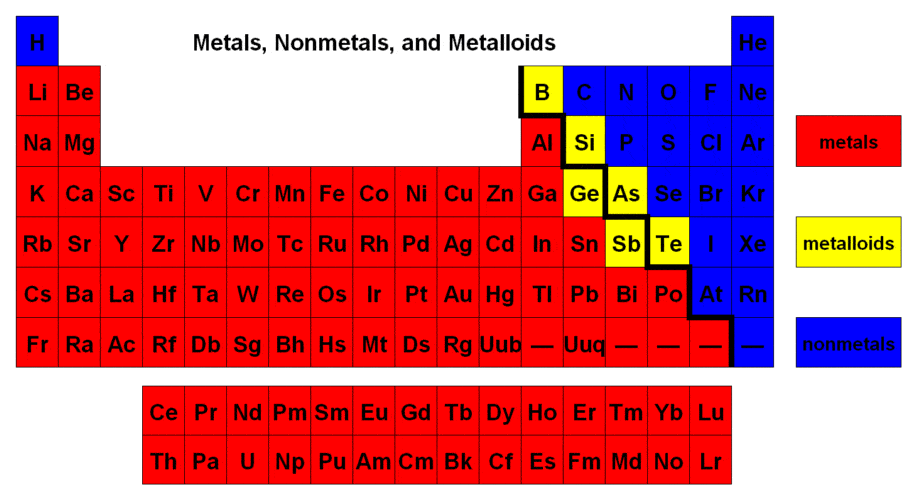
a)
metal and nonmetal
b)
2 or more nonmetals
c)
metal
d)
none of the above
14.

Which substance contains bonds that involve a sharing of electrons from one atom to another?

a)

CuO

b)

NH3

c)

KBr

d)

FeCl2

15.
What is the chemical formula for dinitrogen trioxide?
a)
N2O3
b)
NO2
c)
N3O
d)
N2O4
16.
P2O5
a)
phosphorus oxide
b)
phosphorus (II) oxide
c)
diphosphorus pentoxide
d)
phosphorus pentoxide