
 Worksheets
HMH Solar System Quiz 7.9A
Total questions: 25
Worksheet time: 15mins
Which statements below correctly describe an object located in our solar system? Select TWO correct answers.
The Sun is the star at the center of our solar system. Its gravity holds our solar system together.
The solar system has ten planets. The four closest to the Sun are rocky and have a moon, while the six outer planets are made of gases and have no moons.
The solar system only contains the Sun and eight planets. Comets, meteors, and asteroids are not a part of the solar system.
Jupiter is one planet in the solar system. It has many moons and a very large mass.
Earth is one planet in the solar system. It is the only object in the solar system that has water in any form.
What movements are involved in the relationship between the Earth and Sun?
The Sun rotates around the Earth as it revolves to cause day and night.
The Sun revolves around the Earth as it rotates to cause day and night.
The Earth rotates around the Sun as it revolves to cause day and night.
The Earth revolves around the Sun as it rotates to cause day and night.
Galileo Galilei made an essential discovery in the history of science in 1610 using a simple hand-held telescope he made with two lenses held by a tube. The telescope improved on previous technology and allowed Galileo to see more objects in the night sky. Galileo observed a known planet each night for several months. He noticed four points of light that seemed to be orbiting the planet. These four points of light were the first objects discovered to be orbiting another planet other than Earth. The discovery of these objects, now known as the Galilean moons, led to the understanding that everything does not revolve around the Earth, including the Sun. What planet was Galileo observing when he discovered the Galilean moons?
Jupiter
Saturn
Uranus
Neptune
Which of the following best describes meteors?
Solids with irregular shapes, some of which are larger than Pluto, that mostly orbit the Sun between the orbits of Mars and Venus
Solids that range in size from dust to small rocks that are scattered throughout the solar system, often due to the breakup of comets, that burn in a brief bright display when they enter Earth's atmosphere
Solids made of rock and ice with very elliptical orbits that originate beyond the orbit of Neptune and release gas and dust in a bright display that can last weeks when they pass close to the Sun
Solids that orbit many planets in our solar system, many of which are asteroids or comets that have been caught by the gravitational pull of the more massive planet they orbit
Which statement below accurately describes the movement of objects in our solar system?
The Sun revolves around the planets, and moons rotate around planets.
The planets revolve around the Sun, and moons revolve around the planets.
The planets rotate around the Sun, and moons revolve around the planets.
The moons rotate around planets, and planets revolve around the Sun.
Which of the following represents characteristics of the four planets farthest from the Sun?
Smaller planets
Gas giants
Rocky (terrestrial) planets
3 or less moons
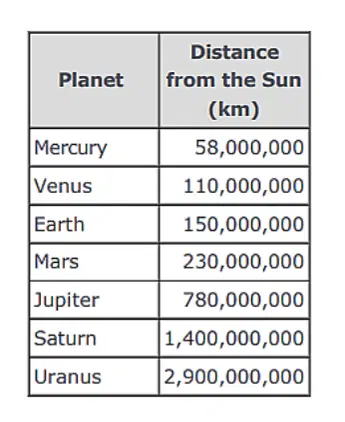
Identify the planet on the chart above that would most likely be the coldest. Explain your answer.
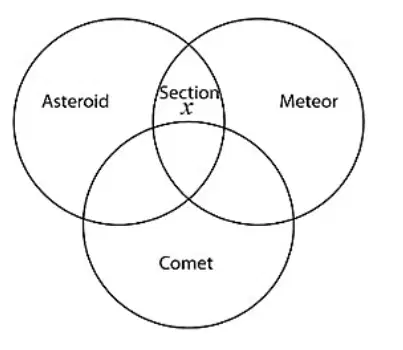
"Made mostly of ice," fits best under which heading in the above Venn diagram?
Asteroid
Meteor
Comet
Section X
Which of the following represents characteristics of the four planets closest to the Sun?
Larger planets
Gas giants
Rocky (terrestrial) planets
4 or more moons
Which of the following accurately describes the orbital path of most planets in our solar system?
The orbital path is in a perfect circle.
The orbital path is in an ellipse, but looks almost circular.
The orbital path is in a large elliptical shape.
The orbital path varies greatly from planet to planet.
All of the planets in our solar system have about the same —
mass
diameter
shape
composition
Mars is very similar to the Earth. Which of the following statements describes a property of the Earth, but NOT a property of Mars?
An abundance of liquid water is located on the planet.
One or more moons orbit the planet.
The planet is constantly in motion.
The orbital path is predictable.
Scientists observed a rocky, rotating object orbiting in space. It was 250 km wide. The rocky object was located several times farther away from the Sun than the Earth. The object is most likely —
Venus
the Moon
Mars
an asteroid
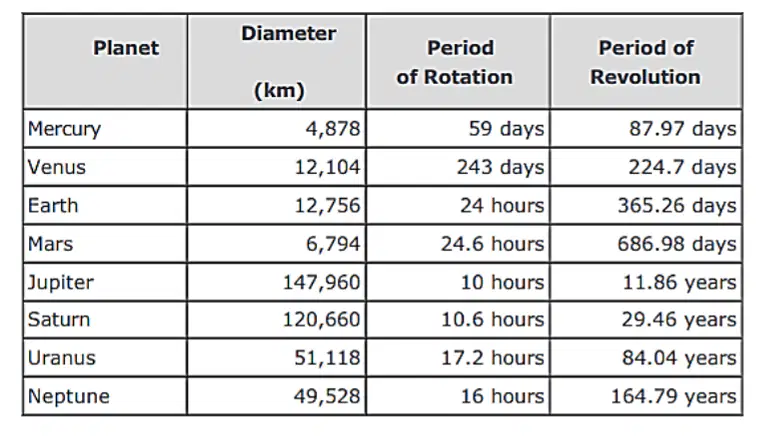
Why does it take Neptune so long to revolve around the Sun?
The Sun is applying large amounts of gravity on the planet, slowing it down.
Neptune has a large diameter causing the planet to be less aerodynamic, slowing it down.
Neptune is such a long distance away that it has a large orbital path.
Neptune is rotating fast for its size, and the energy of its orbit is being transferred into rotational speed.
Complete the sentence to describe the motion of the planets as they orbit the Sun. Type one word into each box. The planets ______ around the Sun while they ______ on their axes.
(a)
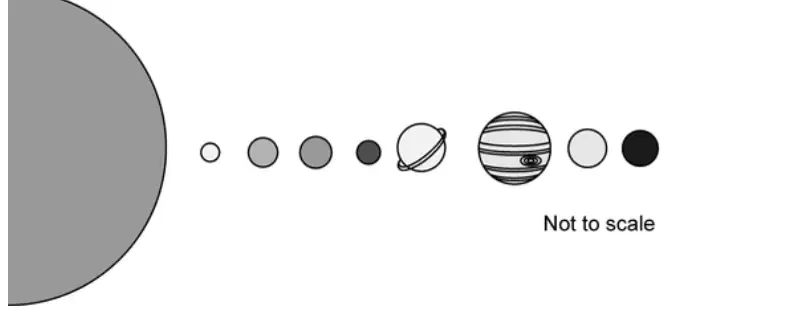
Ethan made the model below to show Earth's solar system. What mistake did Ethan make in his model?
He switched the position of the inner and outer planets.
He should have made Earth bigger than the planets next to it.
He switched the positions of Saturn and Jupiter.
He put the wrong number of planets in the diagram.
Earth is —
the closest planet to the Sun and is filled with gas.
an outer planet that can have life.
an inner planet that can have life.
the closest planet to Saturn and has rings around it.

The table below shows the planets of the solar system, their distance from the Sun, and their mean temperature.
As distance from the Sun decreases, mean temperature decreases, then increases.
As distance from the Sun increases, mean temperature increases, then decreases.
As distance from the Sun decreases, mean temperature decreases.
As distance from the Sun increases, mean temperature decreases.
A meteorite is a solid piece of debris from an asteroid or comet that traveled from outer space to reach Earth's surface. There, it turns a rusty, reddish-brown color over time. Based on this information, which of the following can be concluded about the physical composition of the asteroid or comet that this meteorite came from?
It contains gold.
It contains glass.
It contains sand.
It contains iron.
Meteoroids are small chunks of rock, or a combination of rock and iron, that —
heat up due to friction when they enter Earth's atmosphere and create a visible streak of light across the sky.
never enter Earth's atmosphere and are mostly found orbiting in an elliptical pattern between Saturn and Jupiter.
never pass into or near any of the inner planets.
reflect light from the Sun as they enter Earth's atmosphere.
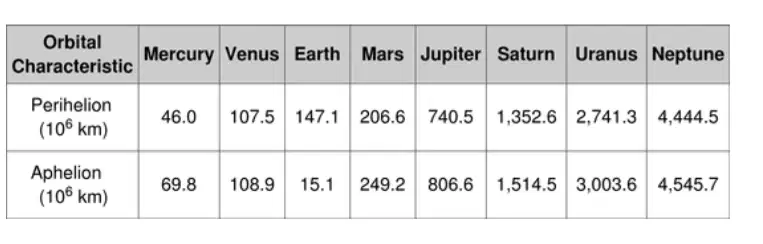
The table below shows the perihelion and aphelion of the planets in Earth's solar system. The perihelion is the point in a planet's orbit when the planet is closest to the Sun. The aphelion is the point in a planet's orbit when the planet is farthest from the Sun. Using the table, which of the following best describes the shape of the orbits of the planets in Earth's solar system?
Circular, only
Elliptical and circular
Circular and triangular
Elliptical, only
Which of the following is not a characteristic of Neptune?
It is one of the windiest places in the solar system.
It is an inner planet.
Its atmosphere is mainly hydrogen and helium.
It has multiple moons.
Which of the following is not a characteristic of Venus?
It is a much larger planet than Earth.
It contains mountains, volcanoes, craters, and highland regions.
It is the second closest planet to the Sun.
Its surface is hard to study because it has clouds of sulfuric acid.
Uranus is —
an outer planet that has only one moon.
a gas giant that rotates on its side.
a mass of hydrogen and helium that has visible rings.
an inner planet that has no known solid surface.
Which planet is closest to the Sun and has extreme fluctuations in temperature due to its thin atmosphere?
Saturn
Uranus
Mercury
Venus

