wayground logo

Free Printable Worksheets

Font size

S
M
L
XL
Worksheets

2nd Nine Weeks Study Guide

Total questions: 25

Worksheet time: 15mins
Name
Class
Date
1.
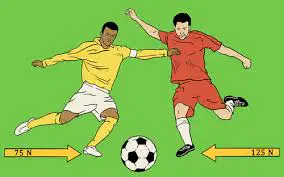
3. 8 N to the left , and 4 N to the right. Find the net force. Is this force balanced?
a)
12 N Right, No
b)
12 N Right, Yes
c)
4 N Left, No
d)
4 N Left , Yes
2.
4. What is force?
a)
A push exerted on an object
b)
A pull exerted on an object
c)
Nothing
d)
A push or pull exerted on an object
3.
5. With unbalanced forces, the object will move in the direction of the _______ force.
a)
larger
b)
smaller
c)
same
d)
equal
4.
6. The force that pulls things toward earth.
a)
Speed
b)
Gravity
c)
Motion
d)
Friction
5.
8. What famous scientist was the SI units of Force named after?
a)
Galileo Galilei
b)
Charles Darwin
c)
Albert Einstein
d)
Isaac Newton
6.
10. __________ is the sum of all forces acting on an object. It is capable of accelerating a mass.
a)
Velocity
b)
Gravity
c)
Net force
d)
Distance
7.
11. What is the unit of measurement for force?
a)
Seconds (s)
b)
Kilograms (kg)
c)
Newtons (N)
d)
Miles (mi)
8.
12. You are carrying a lunch tray when you bump into the edge of a table. Although the tray did not tip, your milk falls off of the front of the tray.
a)
Newton´s 1st Law of Motion
b)
Newton´s 2nd Law of Motion
c)
Newton´s 3rd Law of Motion
d)
All the above
9.
13. A swimmer pushes water back with her arms but her body moves forward.
a)
Newton´s Second Law
b)
Newton´s Third Law
c)
Newton´s First Law
d)
None of the above
10.
14. What is Newtons 1st law of motion?
a)
Force= Mass multiplied by acceleration
b)
Law of gravity
c)
For every action there is a equal and opposite re-action.
d)
An object at rest stays at rest unless acted on an unbalanced force.
11.
15. Mass is a measure of an object's inertia. Objects with greater mass have a greater inertia; objects with less mass have less inertia.
a)
True
b)
False
12.
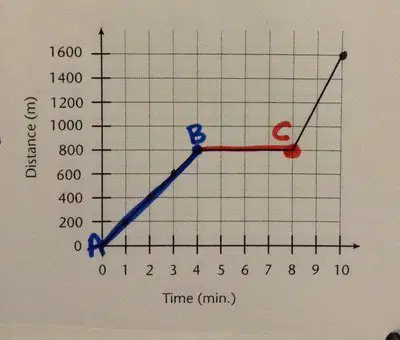
18. The graph shows Ashley riding her bike to Maria's house. What was occurring from point B to point C?
a)
She was increasing her speed.
b)
She stopped for 4 minutes
c)
She was decreasing in speed
d)
Option 4
13.
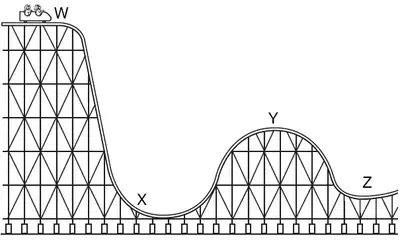
19. At which point is potential energy greatest?
a)
Z
b)
Y
c)
X
d)
W
14.
20. Energy is the ability to do _____________ or cause change.
a)
work
b)
experiments
c)
rest
d)
science
15.
21. A basketball is being held in the hands of a player.
a)
Potential
b)
Sound
c)
Kinetic
d)
Thermal
16.
25. When you are holding a book, energy is stored between the book and Earth; this type of energy is called ________ potential energy.
a)
Potential
b)
Kinetic
c)
Gravity
d)
Elastic
17.
Explain what happens to the potential energy of a rock as it falls off the side of a cliff.
a)
The kinetic energy decreases as the potential energy increases.
b)
The kinetic energy decreases as the potential energy decreases.
c)
The potential energy decreases as the kinetic energy increases.
d)
The potential energy decreases as the kinetic energy decreases. 
18.
Which point has greatest kinetic energy?
a)
A
b)
B
c)
C
d)
none
19.

which box has more acceleration?

a)

top

b)

bottom

20.
Which of the following is an example of friction that is helpful?
a)
Brakes used on a bike
b)
Tires from a car on the road
c)
Tread on the bottom of your shoes
d)
All are examples that are helpful
21.
How would the absence of friction affect a marble traveling on a long, straight path?
a)
The marble’s speed would decrease.
b)
The marble’s speed would increase.
c)
The marble would stop immediately. 
d)
The marble would remain at constant speed.
22.
Rougher surfaces have ...
a)
greater friction
b)
less friction
c)
the same level of friction
23.
How does friction affect speed?
a)
more friction decreases speed
b)
more friction increases speed
c)
less friction decreases speed
d)
less friction doesn't affect speed
24.

A contact force is from

a)

objects physically touching

b)

far apart objects

c)

not touching object

d)

always a pull

25.

A ball rolls down from the top of a grassy hill, reaches the bottom of the hill, continues to roll, and then starts to slow down and comes to a stop. What forces caused this ball's motion?

a)

Frictional force caused the ball to roll down the hill, but air resistance caused the ball to slow down and stop.

b)

Magnetic force caused the ball to roll down the hill, but gravity caused the ball to slow down and stop.

c)

The force of the hill caused the ball to roll down it, but gravity caused the ball to slow down and stop.

d)

Gravity caused the ball to roll down the hill, but frictional force caused the ball to slow down and stop.