
 Worksheets
Net+ 3.3 Switch Port Config OBQ
Total questions: 26
Worksheet time: 13mins

What does link aggregation mean?
Combining multiple network links into a single logical channel
Separating a single network link into multiple channels
Increasing the speed of a single network link
Decreasing the speed of a network link.

Fill in the blank: From the host end, link aggregation can also be called ______.
A) Port aggregation
B) NIC teaming
C) EtherChannel
D) Bonding
What is one of the benefits of link aggregation?
Increased latency
Redundancy
Decreased bandwidth
Higher cost
Link aggregation is typically implemented using the IEEE 802.3ad/802.1ax standard. Fill in the blank: The protocol used to detect configuration errors in link aggregation is called ________.
A) LACP
B) TCP
C) UDP
D) HTTP
What is the maximum length of a standard Ethernet frame, excluding the preamble?
1,518 bytes
1,500 bytes
9,216 bytes
1,000 bytes
A jumbo frame supports a data payload of up to ______ bytes.
1,518
1,500
9,216
9,018

What is the primary purpose of the Spanning Tree Protocol (STP)?
To increase network speed
To organize bridges or switches into a hierarchy and block loops
To provide internet access
To encrypt data
In the Spanning Tree Protocol, which switch is selected as the root?
The switch with the highest ID
The switch with the lowest ID
The switch with the most ports
The switch with the fastest speed
What is the role of the designated port (DP) in a network with three bridges?
To block traffic
To connect to the root bridge
To act as a backup
To forward traffic directly.
In a network with three bridges, the root port (RP) is used to ______.
block traffic
connect back to the root bridge
forward traffic directly
act as a backup
What is the purpose of setting the priority value in Spanning Tree Protocol?
To determine the root bridge
To increase bandwidth
To decrease latency
To enhance security
In the Spanning Tree Protocol, the 'Learning' state is responsible for ______.
Dropping all frames
Listening for BPDUs
Discovering network topology and building the MAC address table
Forwarding frames.
What is the behavior of a port in the 'Forwarding' state?
Forwards frames and learns MACs
Does not forward frames or learn MACs
Only forwards frames
Only learns MACs
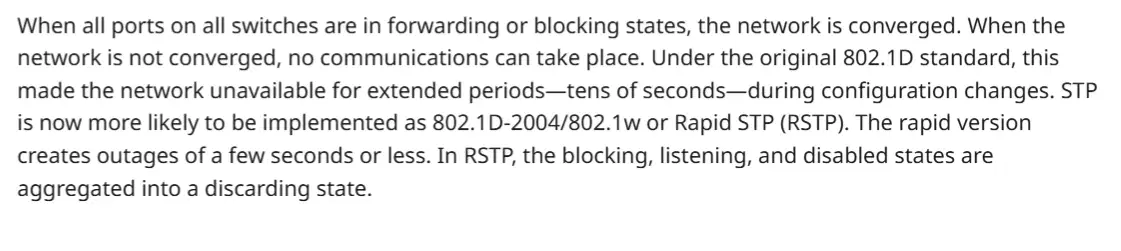
In the Spanning Tree Protocol, when all ports are in forwarding or blocking states, the network is ________.
Converged
Disconnected
Unstable
Looping
Which type of network cable is known for its high-speed data transfer and is commonly used in data centers?
Coaxial Cable
Fiber Optic Cable
Twisted Pair Cable
Ethernet Cable
The _______ cable is typically used for cable television and internet services.
Coaxial
Fiber Optic
Twisted Pair
Ethernet
What is Power over Ethernet (PoE) used for?
Supplying electrical power over data cables
Transmitting data wirelessly
Enhancing video quality
Increasing internet speed
Fill in the blank: According to the IEEE standard 802.3af, power is supplied as 350mA@48V and limited to ____.
15.4 W
30 W
60 W
90 W
Which of the following technologies can allow multiple networks to traverse a switch?
A. VLAN
B. VRRP
C. VPN
D. DHCP
What does STP stand for and what is its main function in a network?
Simple Transfer Protocol; it enhances data transfer rates.
Spanning Tree Protocol; it prevents traffic loops by calculating paths that avoid potential loops.
Secure Transmission Protocol; it encrypts data packets.
Switching Transfer Protocol; it manages the routing of data packets.
What does RSTP stand for?
Rapid Spanning Tree Protocol
Reliable Spanning Tree Protocol
Reduced Spanning Tree Protocol
Routing Spanning Tree Protocol
What is the main function of the Spanning Tree Protocol (STP) in a network?
To increase bandwidth by using all available paths
To prevent loops in a network by creating a loop-free logical topology
To prioritize traffic based on MAC addresses
To encrypt data for secure transmission
Which of the following is a characteristic of the Spanning Tree Protocol (STP)?
It uses a distance-vector algorithm
It allows for multiple active paths between switches
It elects a root bridge to prevent loops
It requires manual configuration of all paths
Which of the following is NOT a technology used to improve or replace STP?
RSTP (Rapid Spanning Tree Protocol)
TRILL (Transparent Interconnection of Lots and Links)
SPB (Shortest Path Bridging)
MPLS (Multiprotocol Label Switching)
What is the primary benefit of redundancy in network switch paths?
It increases the data transfer speed.
It allows data to travel through multiple switches, reducing vulnerability to hardware malfunctions.
It simplifies network configuration.
It reduces the cost of network maintenance.

