
 Worksheets
Fall Semester Review
Total questions: 82
Worksheet time: 43mins
What was the position of the U.S. during the Napoleonic Wars?
Allied with France
Allied with Great Britain
Neutral
Opposed both
In what year did the British begin impressing U.S. sailors and forcing them to work in the British navy?
1803
1812
1776
1798
In which year was Thomas Jefferson re-elected as President?
1800
1804
1808
1812
What challenge did these actions pose to the United States?
Economic prosperity
Neutrality at sea
Territorial expansion
Military alliance
In which year did the U.S. declare war on Great Britain?
1812
1776
1865
1914
How did the Monroe Doctrine contradict statements in George Washington's farewell address?
Washington was against issuing doctrines of any kind
Washington believed America should stay out of foreign affairs but the Monroe Doctrine took a stance on foreign involvement in Latin America
Washington stated that America should colonize Latin America and the Monroe Doctrine warned to stay out of Latin America
Washington signed the Adams-Onis treaty and the Monroe Doctrine made it invalid
Which of the following precedents did President Washington set?
He decided to not run for a third term
He decided to pay all of our debts
He named well known people as governors in many states
He decided to move the capitol to Boston
How did Britain and France violate the neutrality of American ships?
they forced Americans to trade their ships for supplies
they seized American ships and cargo
the refused to trade with America
they destroyed American ships
Which action contributed to the beginning of the War of 1812?
impressment of American sailors into the British navy
attacks on American ships by the Barbary Coast pirates
seizure of American ships by the Spanish navy
violations of American fishing rights on the Great Lakes
In what year was the Louisiana Purchase?
1775
1803
1821
1845
During the Early Republic period, why were some Americans in favor of protective tariffs?
Businesses in northern states thought it would help them compete with European imports
it would allow Southern plantation owners to borrow money from banks
the federal government could then lower the income tax rates
it would enable Americans to buy foreign products
Established a line 36 30 as a boundary between slave and free states
McCulloch vs. Maryland
Mudslinging
Missouri Compromise
Interstate Commerce
What was the Supreme Court case that established Judicial Review?
McCullough v. Maryland
Dred Scott v. Sandford
Gibbons v. Ogden
Marbury v. Madison
What was the main purpose of the Embargo Act of 1807?
To establish a new alliance with Spain
To increase trade with European nations
To expand American territory westward
To punish Britain and France for interfering with American shipping
Which treaty ended the War of 1812?
Treaty of Paris
Treaty of Tordesillas
Treaty of Ghent
Treaty of Versailles
Who was the President of the United States during the War of 1812?
George Washington
Thomas Jefferson
James Madison
John Adams
What was the primary motivation for European nations to engage in colonization during the Age of Exploration?
To establish religious freedom
To acquire new territories and resources
To spread democracy
To create new alliances
Which colony was the first to be established among the 13 colonies?
New York
Massachusetts
Georgia
Virginia
What was the primary economic activity in the Southern colonies?
Fishing
Shipbuilding
Agriculture
Textile manufacturing
Which colony was founded as a haven for English Catholics?
Pennsylvania
Maryland
Connecticut
Rhode Island

Why did England, France, and Spain want to establish colonies in the New World?
to avoid sailing around the horn of Africa
to strengthen their economy through mercantilism
believed the Native Americans would become powerful allies
felt that Native American religions would benefit Europeans

The ___________ colony was in search for religious freedom
Jamestown
Plymouth
Plymouth colony was settled in
Texas
Massachusetts
Virginia
California
Define Mayflower Compact
First elected representative government in the colonies
First written constitution in the colonies; granted men rights
First social contract written in the colonies; established self-government
set of rules for self-governance established by the Pilgrims and other English settlers who traveled to the New World on the Mayflower
US Constitution
English Common Laws
Mayflower Compact
House of Burgesses

Which colony is this?
Virginia
Pennsylvania
Maryland
Georgia

Which colony is this?
Connecticut
New Hampshire
Rhode Island
North Carolina

Which colony is this?
South Carolina
New York
New Jersey
Georgia

Which colony is this?
Georgia
Virginia
New York
Connecticut
Three main reasons English men and women came to the new world
Gifts, Land and Family
God, Gold and Glory
Land grants, Loans and love
Kings, Queens and Parliment
1. True or False: The French were the Patriots' greatest ally during the American Revolution
True
False
2. The last MAJOR battle of the American Revolution was the __________.
Battle of Bunker Hill
Battle of Trenton
Battle of Yorktown
Battle of Lexington
- What is considered the first battle of the American Revolution?
Lexington and Concord
Trenton
Bunker Hill
Yorktown
Common Sense was written by
Thomas Jefferson
John Locke
George Washington
Thomas Paine
Who was the main author of the Declaration of Independence?
Thomas Jefferson
George Washington
Ben Franklin
John Adams
This treaty formally ended the American Revolution
Treaty of Ghent
Treaty of Boston
Treaty of Paris of 1783
What was one purpose of the Declaration of Independence?
to establish a framework for government
to express reasons for limiting immigration
to state the reasons for the colonies to separate from England
to list arguments for women’s suffrage
Alexander Hamilton's economic plan was designed to —
help build the national economy
encourage British imports
prevent congressional control of interstate commerce
strengthen the powers of state governments
Why did President George Washington caution Americans against forming alliances with foreign nations in his Farewell Address?
He feared trade with Latin America would be harmed.
He was troubled that France might establish colonies in the Americas.
He worried that the nation might later be dragged into a foreign war.
He sought to protect America's Western frontier.

What conclusion can best be drawn from the information in this chart?
Political parties usually agree on most issues.
The Federalists opposed most tariffs.
The Democratic-Republicans favored a strong national bank.
Political parties often have differing visions of the nation's future.
Which statement is true of the Louisiana Purchase in 1803?
It extended the nation's boundary to the Pacific Ocean.
It removed the Spanish from North America.
It doubled the size of the United States.
It banned the expansion of slavery in the western territories.
The Embargo Act and the War of 1812 were similar in that both events dealt with a conflict involving the —
British kidnapping of American sailors
emergence of manufacturing in the Northeast
launch of a protective tariff on British imports
decisions of the U.S. Supreme Court
A major reason Thomas Jefferson supported the purchase of the Louisiana Territory in 1803 was that it —
gave the United States ownership of Florida
allowed the United States to gain control of California
gave the United States control of the Mississippi River
removed the Spanish from North America
Washington's Proclamation of Neutrality (1793), Jefferson's Embargo Act (1807), and the Monroe Doctrine (1823) were all efforts to —
avoid political conflicts with European nations
directly support European revolutions
aid Great Britain in its war against France
promote military alliances
The decision in Marbury v. Madison (1803) was important because it —
upheld the constitutionality of the National Bank
restricted Congress's power to use the "elastic clause"
permitted the federal government to regulate interstate commerce
established the Supreme Court's power to judge the constitutonality of laws
What power did the U.S. Supreme Court establish in Marbury v. Madison?
judicial review
hearing appeals from lower federal courts
deciding cases involving two or more states
judicial independence through lifetime tenure
Taxes on imports or foreign goods in order to protect home industries
Protective Tariff

The right to vote
the practice of rewarding political backers with government jobs
veto
assimilate
spoils system
secession
the route the Cherokees and other Native Americans took during their forced migration from the southeast United States to Oklahoma
inflation
Trail of Tears
doctrine of nullification
treason
a law that ended the U.S. government's earlier policy of respecting the rights of Native Americans to remain on their land
Indian Removal Act
Trail of Tears
Tariff of Abomination
Jacksonian Democracy
A refusal to buy or use goods and services
blockade
boycott
mutiny
petition
A group of people who have the power to make laws
legislature
patriots
lawyers
minutemen
A change in, or addition to a constitution or law
annexation
amendment
compromise
ratification
The first written laws of the United States that divided power between national and state governments
Constitution
Bill of Rights
Articles of Confederation
Preamble
A system that allows each branch of government to limit the power of the other branches
checks and balances
separation of powers
limited government
popular sovereignty
Personal liberties and privileges
Popular Sovereignty
Republicanism
Individual Rights
Separation of Powers
Written contract issued by a government to establish a colony
joint stock company
contract
charter
mercantilism
Puritans and Pilgrims were from which colonial region?
Middle Colonies
New England Colonies
Southern Colonies
What natural feature was the westward boundary of the 13 colonies?
Mississippi River
Atlantic Ocean
Appalachian Mountains
Rocky Mountains
The Declaration of Independence states that all people are born with certain rights. Which rights are included?
life, liberty, and property
right to elect leaders to represent the people
life, liberty, and the pursuit of happiness
life, liberty, and safety
Which of the following can be considered a cause of the American Revolution?
Olive Branch Petition
French & Indian War
Declaration of Independence
Boston Tea Party
Founder of the Federalist Party
Thomas Jefferson
Alexander Hamilton
James Madison
George Washington
What was a major disagreement between Federalist & anti-Federalist?
how the president should be elected
how territories should become states
how much power state governments should retain
how to enforce laws
The first ten amendment of the Constitution
Bill of Rights
Preamble
Conclusion
Introduction
How did the Northwest Ordinance influence the expansion of the United States?
It made slavery illegal in all future territories the United States might gain.
It created rules for how new states could join the country.
It allowed American Indians to become full citizens of the United States.
It gave women the right to vote in U.S. territories.
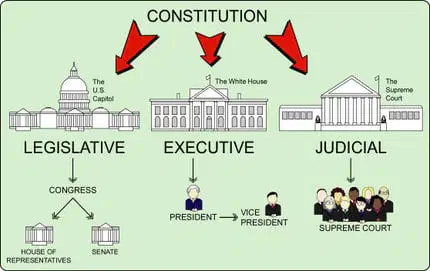
Each branch of the U.S. government has its own jobs describes which democratic principle?
unalienable rights
popular sovereignty
separation of powers
Which phrase describes popular sovereignty?
the people have the power
the people are controlled by the monarchy
the people do not have the right to vote

After many weaknesses were realized in America's first written plan of government, Articles of Confederation, which document was written and ratified (approved) to become the supreme law of the U.S.?
Treaty of Paris 1783
The Declaration of Independence
The U.S. Constitution
What was the purpose of the Pilgrim's Mayflower Compact in 1620?
To set up rules for self-governance established once the Pilgrims landed at Plymouth
To promote good feelings between the Pilgrims and the Native Americans
To create a treaty between France and England.
The Great Compromise establishes a bicameral legislature
Constitution
American Revolution
New Republic
Reform
The 1st amendment protects which of the following?
Freedom from unreasonable searches and seizures.
Freedom of religion, speech, press assembly and petition.
Right to trial by jury.
No quartering of soldiers.
The 2nd amendment protects which of the following rights?
Right to keep and bear arms.
Rights of accused persons (speedy and public trial).
Powers reserved to the states.
Other rights of the people.
The 3rd amendment protects which of the following rights?
Right of a trial by jury.
Freedom of religion, speech, press, assembly and petition.
No quartering of soldiers.
Right to keep and bear arms.
The 4th amendment protects which of the following rights?
Powers reserved to the states.
Freedom from unreasonable searches and seizures.
Freedom from excessive bail, cruel and unusual punishments.
Right to due process of law, freedom from self-incrimination, and double jeopardy.
The 5th amendment protects which of the following rights?
Right to due process of law, freedom from self-incrimination, and double jeopardy.
Rights of accused persons (speedy and public trial).
Other rights of the people.
Right to keep and bear arms.
The 6th amendment protects which of the following rights?
No quartering of soldiers.
Right to due process of law, freedom from self-incrimination, and double jeopardy.
Powers reserved to the states.
Rights of accused persons (speedy and public trial).
The 7th amendment protects which of the following rights?
Right of trial by jury.
Freedom from cruel and unusual punishment.
Rights of accused person (speedy and public trial).
No quartering of soldiers.
The 8th amendment protects which of the following rights?
No quartering of soldiers.
Powers reserved to the states.
Freedom from unreasonable searches and seizures.
Freedom from excessive bail, cruel and unusual punishments.
The 9th amendment protects which of the following rights?
Right of trial by jury.
No quartering of soldiers.
Freedom from excessive bail, cruel and unusual punishments.
Other rights of the people.
The 10th amendment protects which of the following rights?
Freedom from excessive bail, cruel and unusual punishments.
Right to due process of law, freedom from self-incrimination, and double jeopardy.
Powers reserved to the states.
Right of trial by jury.

