wayground logo

Free Printable Worksheets

NEW

Font size

S
M
L
XL
Worksheets

🎄❄️Reading Terms❄️🎄

Total questions: 51

Worksheet time: 2hrs 56mins

Name
Class
Date
1.

What are the titles of a section called?

a)

Key Vocabulary

b)

Headings and subheadings

c)

Pictures

d)

Captions

2.

The words under a picture, chart, or graphic that explains what it is about.

a)

Heading

b)

Subheading

c)

Caption

d)

Chart

3.

What provides a visual to help the reader connect with the information?

a)

Heading

b)

Bold Words

c)

Caption

d)

Chart and Pictures

4.

A picture with words used to help the reader “see” the information is called a --

a)

Diagram

b)

Headings

c)

Chart

d)

Key Vocabulary

5.

These are expert words that are important to understand the specific topic of the text. (May be in Bold, Underlined, or defined at the side or bottom of the text.)

a)

Headings/ Subheadings

b)

Key Vocabulary Words

c)

Pictures

d)

Charts

6.

How can text features help us?

a)

It can help us write an expository essay.

b)

It gives us the title of a selection.

c)

It shows the reader pictures related to the topic.

d)

It can help us better comprehend what is in the text.

7.

This feature explains what the illustration/photograph is--

a)

Glossary

b)

Index

c)

Table of contents

d)

Caption

8.

Key Vocabulary (important words) are usually in...

a)

Circled

b)

Bold print

c)

in the table of contents

d)

lowercase words

9.

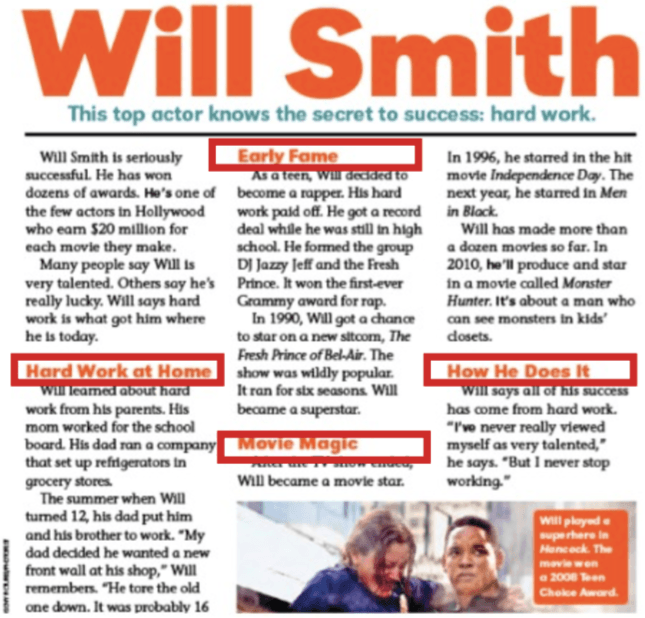
What is the arrow pointing to?

a)

Caption

b)

Picture

c)

Index

d)

Heading

10.
True/False: We should ALWAYS look at the text features.
a)
True
b)
False
11.
What helps us know exactly what something looks like?
a)
Map
b)
Caption
c)
Picture
d)
Heading
12.

What is the arrow pointing to?

a)

Heading

b)

Picture

c)

Caption

d)

Bold Word

13.

What is the purpose of subheadings?

a)

To help the reader understand the author’s opinion

b)

To help the reader visualize the information

c)

To help the reader find the main ideas in each section

d)

To help the reader place events in order

14.
This is an example of ____________ text feature? 
a)
Index
b)
Table of contents
c)
Glossary
d)
Diagram
15.
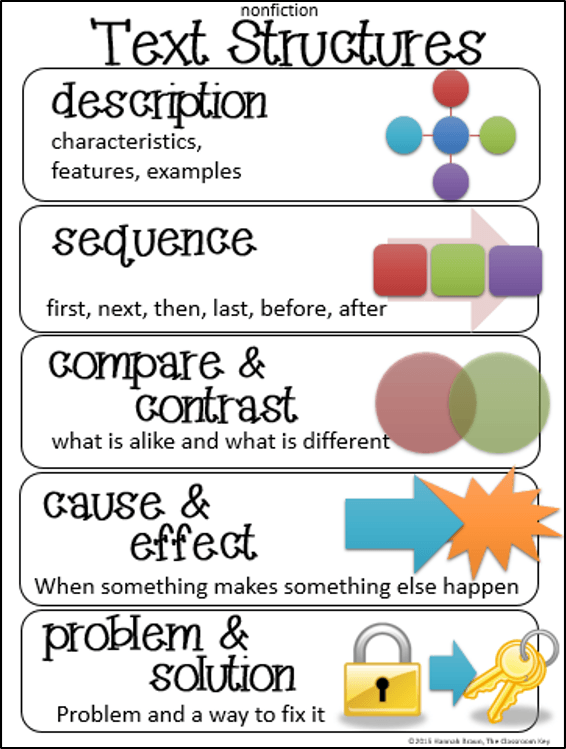
Ice-cream is a delicious frozen treat that comes in a many different colors and flavors. Two of my favorite flavors are strawberry and chocolate. Though both of these flavors are delicious, strawberry may contain pieces of fruit while chocolate usually will not. Chocolate comes from a cacao bean, while strawberry is picked as a fruit.  Even though more chocolate ice-cream is sold across the country annually than strawberry, each flavor tastes great inside of a milk shake. 
a)
description
b)
problem & solution
c)
cause & effect
d)
compare & contrast
16.
What text structure explains why something happened or explains the effects of something?
a)
Compare or Contrast
b)
Problem or Solution
c)
Cause or Effect
d)
Sequence
17.
When you are finding similarities and differences within in a text, what text structure is this format?
a)
Cause and Effect
b)
Problem and Solution
c)
Sequence
d)
Compare and Contrast
18.
The text structure that describes the order steps occurred is called_______.
a)
Cause and Effect
b)
Sequence
c)
Compare and Contrast
d)
Problem and Siolution
19.
We have celebrated Independence Day with a fireworks show on the first Saturday of July ever since our town was incorporated in 1963. This celebration has brought together the old and the young alike in a mutual display of patriotism and national pride. We regret to inform you that due to problems with the budget, there will be no fireworks show this year... unless we can raise the $20,000 to pay for the show. You can help by donating your old knickknacks. We are having a charity garage sale this Saturday and all proceeds will go toward the fireworks show. If you do not have any knickknacks, we will also accept money, printer cartridges, and old cell phones. Together, we can keep these hard times from becoming bad times. 
a)
description
b)
compare & contrast
c)
problem & solution
d)
cause & effect
20.
Ray forgot to charge his iPad. As a result, his iPad was dead the next day. 
What is the Cause? What is the Effect? 
a)
Cause: Ray's iPad was dead.
Effect: Ray forgot to charge his iPad.
b)
Cause: Ray forgot to charge his iPad.
Effect: Ray's iPad was dead.
21.
Which text structure has signal words:
-first
-now
-later
-(actual dates)
a)
Comparison
b)
Problem/Solution
c)
Chronological
d)
Cause and Effect
22.
Which text structure includes signal words:
-both
-alike
-different
-yet
a)
problem and solution
b)
cause and effect
c)
comparison
d)
sequence
23.
The author describes a topic by listing characteristics and examples.
a)
Chronological
b)
Cause and Effect
c)
Problem and Solution
d)
Description
24.

Makes a non-human seem human.

a)

imagery

b)

personification

c)

repetition

25.

Words that end with the same sound.

a)

simile

b)

rhyme

c)

rhythm

26.

Sounds like the noise or action.

a)

onomatopoeia

b)

alliteration

c)

rhythm

27.

The musical quality or beat.

a)

rhyme

b)

rhythm

c)

onomatopoeia

28.

Repeating beginning sounds.

a)

alliteration

b)

personification

c)

repetition

29.

To repeat sounds, words or phrases.

a)

alliteration

b)

metaphor

c)

repetition

30.

Compare two different things.

a)

imagery

b)

metaphor

c)

simile

31.

Compare two different things using "like" or "as".

a)

imagery

b)

metaphor

c)

simile

32.

A vivid description using the five senses.

a)

metaphor

b)

imagery

c)

personification

33.

All poems have to rhyme.

a)

true

b)

false

34.
Why do we use the RACE strategy.
a)
To get a good grade.
b)
To find the answer.
c)
To help us read.
d)
To completely answering Questions about a reading.
35.
When can we use the RACE strategy.
a)
When your answering open ended questions that need evidence.
b)
When we need help.
c)
When we need to use it because my teacher said so
d)
NEVER
36.
How does the RACE strategy help us in reading.
a)
The RACE strategy helps us organize our short answers to ensure all parts of a question are answered.
b)
It helps us answer the question.
c)
It helps us by making us understand the answer.
d)
It gives us the answer.
37.
What does the R in RACE stand for?
a)
Restate the question.
b)
Answer the question. 
c)
Explain/Expand the question.
d)
Cite Evidence
38.
What does the A in RACE stand for?
a)
Read the question. 
b)
Answer the question. 
c)
Read it more then once.
d)
Annotate
39.
What does the C in RACE stand for?
a)
Answer the question.
b)
Cite the evidence 
c)
Explain how you got your answer. 
d)
Restate the question
40.
What does the E in RACE stand for?
a)
Cite the answer. 
b)
Show how you got your answer.
c)
Explain/Expand the question. 
d)
Answer the question
41.

Which of the following is an example of theme?

a)

Cinderella was thoughtful and kind.

b)

Jack risked his life to save Jane.

c)

Don't judge people by outward appearances.

d)

Happiness

42.

Which is an example of theme?

a)

One person can make a difference.

b)

Missy knew she would always be grateful.

c)

The donkey was stubborn and did not change.

d)

Sir John became famous for slaying the dragon.

43.

Which is an example of theme?

a)

Connor overcame his obstacles with his mindset.

b)

Risa took a bad situation and made the most of it.

c)

People's decisions are often an indication of their true character.

d)

Jack is a follower.

44.

What is theme?

a)

message about life that the author expresses

b)

the time, location, and mood of a story

c)

sequence of events

d)

the main events

45.

Which is an example of theme?

a)

Inequality

b)

Hope

c)

Justice

d)

Your past does not define you.

46.

What does theme add to a story?

a)

A sense of location.

b)

An important message.

c)

Motivation for the characters.

d)

Dialogue for the characters.

47.

the most important or central thought of a paragraph or larger section of text, which tells the reader what the text is about

a)

cause

b)

main idea

c)

setting

d)

theme

48.

life lesson, meaning, or moral of a story or a poem

a)

effect

b)

main idea

c)

mood

d)

theme

49.

the time and place of a story

a)

effect

b)

setting

c)

theme

d)

contrast

50.
Can you infer what has happened in this picture?
a)
airing out stinky feet
b)
foot fungus
c)
ant bite
d)
sunburn and blister
51.
Inferencing means ________.
a)
a. understanding exactly what the text says
b)
b. using logic to read between the lines
c)
c. determining what's a fact and what's an opinion
d)
d. using word parts to decode an unknown word