
 Worksheets
Skeletal and Muscular Systems
Total questions: 20
Worksheet time: 11mins
What are the basic functions of the Skeletal System?
Support movement defense control
Protection alignment growth support
Support movement protection storage
Support blood supply ligament tendon
Defense blood vessel from foreign object
These following statements are the functions of human skeleton, except . . .
Producing Red blood cells
To protect internal organs
An active movement device
To store minerals such as calcium and phosphorus
A place for muscle attachment
The correct relation between skeleton and muscle is . . .
Skeleton is an active movement device while muscle is a passive movement device.
Skeleton move the muscle.
Skeleton can move without muscle
Skeleton is a passive movement device while muscle is an active movement device
Both Skeleton and muscle is an active movement device
Based on their shape and structure bones are classified into 3 types, they are …
Spheres Bones, Line Segments Bones, and Curves Bones.
Long Bones, Flat Bones, and Irregular Bones.
Spheres Bones, Long Bones, and Irregular Bones.
Flat Bones, Irregular Bones, and Line Segment Bones.
Curves Bones, Irregular Bones, and Long Bones.
The location of Long Bones in our body is …
Femur, Patella and Cranium.
Cranium, Scapulla and Ribs cage
Tibia, Fibula and Metatarsal
Fibula, Humerus and Carpals.
Patella, Cranium and Tibia
There are 3 types of joints based on movement, it is …
Synarthrosis, Diarthrosis, Hyperthrosis.
Hyperthrosis, Anathrosis, Synarthrosis.
Diarthrosis, Hyperthrosis, Anathrosis.
Hyperthrosis, Anathrosis, Amphiarthrosis.
Synarthrosis, Amphiarthrosis, Diarthrosis
A type of joint that has limited mobility, or slight motion is called …
Synarthrosis
Diarthrosis
Anathrosis
Amphiarthrosis
Hyperthrosis
How many bones are in adult body?
260 Bones
206 Bones
216 Bones
360 Bones
306 Bones
The elbow (the connection Humerus, Radius and Ulna) can be considered 2 types of joints, what are those joints?
Pivot and Saddle
Saddle and Plane
Ball and Socket, and Pivot
Pivot and Hinge
Hinge and Condyloid
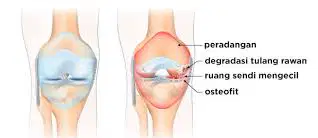
The picture above shows degenerative joint and destruction of cartilage by inflammation of a joint due to deterioration of the cartilage at the end caps of the contacted bones, that called …
Osteoarthritis
Bone cancer
Rheumatoid arthritis
Osteoporosis
Paget's disease

What type of joint is this?
(a)

What type of joint is labeled letter C?
Hinge joint
Ball-and-socket joint
Fixed-immovable joint
Gliding joint
Pivot joint
What type of joint is labeled letter E?
Hinge joint
Ball-and-socket joint
Fixed-immovable joint
Gliding joint
Pivot joint
______________ is a tissue that is more flexible than bone and that protects the ends of bones and keeps them from rubbing together.
marrow
cartilage
joint
ligament
___________________ fills bone cavities and the spaces in spongy bone
cartilage
tendon
ligament
marrow


