wayground logo

Free Printable Worksheets

Font size

S
M
L
XL
Worksheets

Chem '24-'25 Semester 1 Review

Total questions: 175

Worksheet time: 3hrs 27mins

Name
Class
Date
1.
How many sig. fig. are in the number below:
350.540
a)
4
b)
5
c)
6
d)
7
2.
How many sig. fig. are in the number below:
0.0005
a)
1
b)
2
c)
3
d)
4
3.
How many Significant Figures in the number below?
4,500
a)
3
b)
4
c)
2
d)
1
4.

What is the length?

a)

7

b)

7.7

c)

7.70

d)

7.700

5.

What is the volume?

a)

50

b)

45

c)

45.0

d)

40.5

6.

WHAT IS THE LENGTH?

a)

29

b)

29.2

c)

29.20

d)

30

7.
a)

Student A

b)

Student B

c)

Student C

d)

Cannot be determined

8.
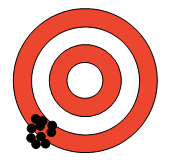
This bullseye demonstrates...
a)
High Accuracy & High Precision
b)
High Accuracy & Low Precision
c)
Low Accuracy & High Precision
d)
Low Accuracy & Low Precision
9.

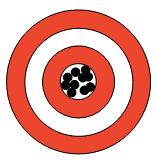
This bullseye demonstrates...

a)

High Accuracy & High Precision

b)

High Accuracy & Low Precision

c)

Low Accuracy & High Precision

d)

Low Accuracy & Low Precision

10.

(a)   is a measure of how close measurements come to each other when they are made in the same way.

11.

How close a measurement is to the accepted value is called (a)   .

12.

what is an example of a chemical change? choose all that apply!

a)

eggs when heat applied to it

b)

when it stays the same / nothing changes you can reverse it.

c)

when metal applies to rust

d)

when your roasting a marshmellow.

13.
Which statement best describes why baking a cake is an example of a chemical change?
a)
The process takes place in an oven.
b)
The process requires heat energy.
c)
The process cannot be reversed.
d)
The process can be repeated.
14.
Stanley left an ice cube on his kitchen counter. An hour later, Stanley observed that the ice cube melted. Which statement best describes this change?
a)
Ice melting is a physical change because a new substance is created.
b)
Ice melting is a chemical change because a new substance is created.
c)
Ice melting is a chemical change because it may be reversed.
d)
Ice melting is a physical change because it may be reversed.
15.
Which of the following is NOT an example of a physical change?
a)
crumpled paper
b)
pencil sharpening
c)
shrunken clothing
d)
sour milk
16.

A property that is observed without making changes to the substance.

a)

Chemical Reaction

b)

Chemical Property

c)

Physical Property

d)

Physical Reaction

17.

Flammability is a ________ property.

a)

Physical

b)

Chemical

18.

Which equation would you use to calculate density?

a)

Mass divided by Volume

b)

Volume divided by Mass

c)

Mass multiplied by Volume

d)

Mass plus Volume

19.

Which liquid has a density of 3g/mL?

a)

W

b)

X

c)

Y

d)

Z

20.
Frank has a paper clip. It has a mass of 9g and a volume of 3cm3. What is its density?
a)
3 g/cm3
b)
1/3 g/cm3
c)
27 g/cm3
d)
39 g/cm3
21.

Copper - Cu

a)

Element

b)

Compound

c)

Homogeneous Mixture

d)

Heterogeneous Mixture

22.

Chalk - CaCO3

a)

Element

b)

Compound

c)

Homogeneous Mixture

d)

Heterogeneous Mixture

23.

Water - H2O

a)

Element

b)

Compound

c)

Homogeneous Mixture

d)

Heterogeneous Mixture

24.

Sugar (sucrose) ----C6H22O11

a)

Element

b)

Compound

c)

Mixture

25.

Match the following

a)
1.

single element

b)
2.

single compound

c)
3.

mixture of elements

d)
4.

mixture of compounds

e)
5.

mixture of elements and compounds

26.

What does this illustrate?

a)

Elements

b)

Compunds

c)

Mixture of Elements and Compunds

d)

Mixture of Compounds

27.

Brass is a metal that is bright red and gold. It is formed by combining, not chemically, two elements, zinc and copper. Based on the information, how would brass be classified?

a)

an element

b)

compound

c)

mixture

d)

suspension

28.

Which state of matter has both definite shape and definite volume?

a)

Solid

b)

Liquid

c)

Gas

d)

Plasma

29.

Which state of matter has no definite shape and no definite volume?

(a)  

30.

Has definite volume , but No definite shape.

a)

solid

b)

liquid

c)

gas

31.

Which set of properties, intensive or extensive, are based on the size of a sample?

a)

intensive

b)

extensive

32.

What kind of physical property is this? Color

a)

intensive

b)

extensive

33.

What kind of physical property is this? Density

a)

intensive

b)

extensive

34.

What kind of physical property is this? Volume

a)

intensive

b)

extensive

35.

What kind of physical property is this? Mass

a)

intensive

b)

extensive

36.

How is the number of neutrons of an atom calculated

a)

Mass Number - Atomic Number

b)

Electrons + Protons

c)

Mass Number + Electrons

d)

Protons - Electrons

37.

The nucleus of an atom contains

a)

protons and electrons

b)

protons and neutrons

c)

electrons and neutrons

d)

protons, electrons, and neutrons

38.

Typically in an atom, which two subatomic particles are equal in number?

a)

protons and neutrons

b)

all subatomic particles are equal in number

c)

neutrons and electrons

d)

protons and electrons

39.

Neutral particles (those that have no charge) are

a)

negatrons

b)

electrons

c)

neutrons

d)

protons

40.

What is the center of an atom called?

a)

The headquarters

b)

The centrometer

c)

The hypothesis

d)

The nucleus

41.

How many protons are in Zirconium (Zr) ?

a)

40

b)

91

c)

30

d)

65

42.

What is atomic mass? It is the average

a)

number of electrons and protons

b)

number of neutrons

c)

number of protons and neutrons

d)

number of protons

43.
An element's identity is determined by the number of
a)
electrons.
b)
protons.
c)
neutrons.
d)

nucleus.

44.
The number of protons is equal to 
a)

atomic number

b)

atomic mass

c)

nucleus

45.

What does the number 84 in the name krypton-84 represent?

a)

the mass number

b)

the sum of the protons and electrons

c)

twice the number of protons

d)

the atomic number

46.

How do the isotopes hydrogen-1 and hydrogen-2 differ?

a)

Hydrogen-2 has two protons; hydrogen-1 has one.

b)

Hydrogen-2 has one neutron; hydrogen-1 has none.

c)

Hydrogen-2 has one more electron than hydrogen-1.

d)

Hydrogen-2 has one proton; hydrogen-1 has none.

47.

Isotopes of the same element have different ____.

a)

numbers of protons

b)

numbers of neutrons

c)

atomic numbers

d)

numbers of electrons

48.
Isotopes have different numbers of
a)
protons
b)
neutrons
c)
electron
d)
properties
49.
24.1% of all the isotopes of a an element have a mass of 75.23 amu, 48.7% have a mass of 74.61 amu, and 27.2% have a mass of 75.20 amu.
What is the average mass of this element?
a)
74.92 amu
b)
24.97 amu
c)
75.01 amu
d)
74.51 amu
50.

Compute the average atomic mass for this element.

a)
27.977
b)
28.09
c)
28.976
d)
The average mass cannot be determined from provided information.
51.
If X is the symbol for an element, which of the following two symbols represent    isotopes of the same element?  
I. 7735X  II. 7733X  III. 8137X  IV. 8135 X
a)
I and II
b)
III and IV
c)
I and IV
d)
I and III
52.

The hyphen notation of an atom of calcium with 20 protons, 20 electrons, and 22 neutrons is

a)

calcium - 20

b)

calcium - 40

c)

calcium - 62

d)

calcium - 42

53.

An ion with a positive charge is called a...?

a)

cation

b)

anion

54.

An ion with a negative charge is called a...?

a)

cation

b)

anion

55.
Ions are: 
a)
atoms with a positive or negative charge
b)
atoms with no charge
c)
atoms with ONLY a positive charge
d)
atoms with ONLY a negative charge
56.

If a Magnesium atom loses 2 electrons what will be its’ charge?

a)

0

b)

+2

c)

-2

d)

12

57.

If a Sulfur atom gains 2 electrons what will be its' charge?

a)

0

b)

+2

c)

-2

d)

16

58.

What do short wavelength waves have?

a)

high frequency

b)

low frequency

c)

low energy

d)

long wavelengths

59.

the lowest energy state of an atom

a)

ground state

b)

excited state

c)

normal state

d)

hyper state

60.

a state of an atom when it has a higher potential energy than its ground state

a)

ground state

b)

excited state

c)

quantum

d)

energy

61.

In the visible light spectrum, red light has a greater frequency than violet light.

a)

True

b)

False

62.

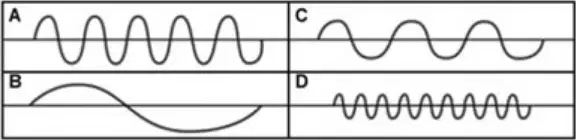
Which diagram shows a wave with the highest frequency?

a)

A

b)

B

c)

C

d)

D

63.
High frequency waves have _________ wavelengths.
a)
varying
b)
long
c)
the same
d)
short
64.
The shortest wavelength in visible light is______.
a)
violet
b)
red
c)
blue
d)
yellow
65.

Which drawing represents the process by which an emission line is formed? [Emission means that energy is being "emitted" or released by the atom.]

a)

A

b)

B

c)

C

d)

D

66.
Emission of light from an atom occurs when an electron
a)
drops from a higher to a lower energy level.
b)
   jumps from a lower to a higher energy level.   
c)
   moves within its atomic orbital.
d)
falls into the nucleus.
67.
For an electron to change from ground state to an excited stated it must...
a)
Absorb energy
b)
Release energy
68.

Which of the following electron jumps would be responsible for the MOST energetic light emitted?

a)

5th to the 2nd energy level

b)

3rd to the 2nd energy level

69.

If an electron moves from n=4 to n=2 it ____

a)

absorbs energy

b)

releases energy

70.
As you move down the periodic table atoms get bigger.  This is because ____________.
a)
The atoms have more mass.
b)
The atoms have more protons.
c)
The atoms have more energy levels
d)
The atoms have more nuetrons
71.
As you move across the periodic table atoms tend to get smaller because, ______________.
a)
the atoms have more mass.
b)
the atoms have less mass
c)
the atoms have more protons.
d)
the atoms have less electrons.
72.
Which of the following will have a larger radius than Zinc?
a)
Gallium
b)
Aluminum
c)
Magnesium
d)
Strontium
73.
Order the following in increasing atomic radii: 
Ra, Be, Ca, Rb, H
a)
Ra, Be, Rb, H, Ca
b)
Rb, H, Ca, Be, Ra
c)
Ra, Rb, Ca, Be, H
d)
H, Be, Ca, Rb, Ra
74.
The more protons there are, the  ____ .
a)
Weaker the pull
b)
Smaller the electrons
c)
Stronger the pull
d)
The bigger the electrons
75.

What is ionization energy?

a)

The energy released when an electron is added to an atom.

b)

The energy required to add an electron to an atom or ion.

c)

The energy required to split an atom into smaller particles.

d)

The energy required to remove an electron from an atom or ion.

76.

In which direction does ionization energy generally increase on the periodic table?

a)

From right to left

b)

From left to right

c)

It remains constant across the periodic table

d)

From top to bottom

77.

What is the trend of ionization energy as you move from left to right across a period?

a)

Remains constant

b)

Increases

c)

Decreases

d)

Fluctuates

78.

What is the trend of ionization energy as you move from top to bottom down a group?

a)

Decreases

b)

Remains constant

c)

Fluctuates

d)

Increases

79.

Across a period, Ionization energy ____a____

Down a group, ionisation energy ____b_____

a)

a : increase

b: decrease

b)

a : increase

b: increase

c)

a : decrease

b: decrease

80.
Put the following in order of increasing ionization energy:Neon, Lithium, Carbon
a)
Lithium, Carbon, Neon
b)
Carbon, Lithium, Neon
c)
Neon, Carbon, Lithium
d)
Lithium, Neon, Carbon
81.

What is the trend of electronegativity across a period in the periodic table?

a)

remains constant

b)

decreases

c)

fluctuates

d)

increases

82.

What is the trend of electronegativity down a group in the periodic table?

a)

remains constant

b)

decreases

c)

increases

d)

fluctuates

83.
Choose the set that goes from lowest to highest electronegativity?
a)
Cu, Mg, Sr, Ca
b)
F, Cl, Br, Si
c)
Cs, Rb, Ca, Mg
d)
Zn, Cd, Ag, Cu
84.
What is a valence electron?
a)
an electron that is found in the outermost shell of an atom. 
b)
an electron found in the innermost shell of an atom.
c)
an electron found in the middle shell.
85.

Which of these is correct?

a)
b)
c)
86.
Elements in the same column of the periodic table always have the same # of _______ as one another.
a)
Protons
b)
Neutrons
c)
Electrons
d)
Valence Electrons
87.
________ are the COLUMNS on the periodic table and are organized by similar properties.
a)
Classifications
b)
Groups
c)
Periods
d)
Elements
88.
_______ are the ROWS on the periodic table.
a)
Families
b)
Groups
c)
Periods
d)
Elements
89.
Elements that are between metals and nonmetals, and have characteristics of both are called?
a)
Metals
b)
Metalloids
c)
Nonmetals
d)
Halogens
90.
The location of _____________ is group 15; period 3.
a)
N (Nitrogen)
b)
K (Potassium)
c)
P (Phosphorus)
d)
C (Carbon)
91.
Elements that are shiny and conduct heat and electricity are called:
a)
Nonmetals
b)
Metals
c)
Halogens
d)
Metalloids
92.

USE THE PERIODIC TABLE

Find the element that has 3 Valence Electrons and 2 energy levels.

a)

Magnesium - Mg

b)

Lithium - Li

c)

Aluminum - Al

d)

Boron - B

93.
What atom matches this electron configuration?
1s2s2p3s2
a)
Neon
b)
Magnesium
c)
Aluminum
d)
Potassium
94.
What is this element? 
1s22s22p63s23p6
4s23d104p6
a)
Argon
b)
Krypton
c)
Selenium
d)
Bromide
95.
What atom matches this electron configuration?
[Xe] 6s2 4f14 5d9
a)
Mercury
b)
Gold
c)
Platinum
d)
Thallium
96.
What is the shorthand electron configuration for Sulfur atom?
a)
[Ar] 3p4
b)
[He] 3s23p4
c)
[Ne] 3s23p4
d)
[Na] 3s23p3
97.
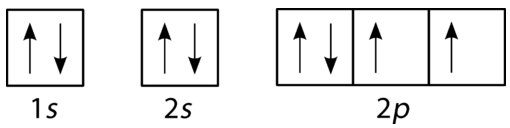
This orbital diagram represents:  
a)
C
b)
B
c)
N
d)
O
98.
 The diagram above represents two electrons with 
a)
a. opposite spins.
b)
 b. the same spin.
c)
c. different energies.
d)
d. different energy levels.
99.
What is incorrect about this orbital diagram?
a)
Both arrows in the 2p box should be pointing up
b)
There is nothing incorrect with this diagram
c)
In the there should only be 1 orbital in the first 2p box and one in the 2nd 2p box
d)
All the arrows should be pointing up.
100.

Which element is represented by this orbital notation?

a)

carbon

b)

nitrogen

c)

oxygen

d)

fluorine

101.
Which electron configuration belongs to Chlorine (Cl)?
a)
1s2s2p3s3p5
b)
1s2s2p3s3p6
c)
1s2s2p3s3p7
102.
As you move down a group, atomic radius increases because - 
a)
you add more and more neutrons
b)
you add more and more protons
c)
you add more and more shells (energy levels)
d)
you add more atomic mass
103.
As you move across the periodic table from left to right, the atomic radius decreases.  This is because - 
a)
the number of protons increases, so attraction to electrons increases
b)
the number of energy levels increases
c)
the number of electrons increases
d)
the atomic mass increases
104.
The element with the smallest ionization energy in Period 6 is - 
a)
Rn
b)
Cs
c)
Os
d)
Tm
105.
What is the name of family I
a)
Alkaline Earth Metals
b)
Boron Family
c)
Alkali Metals
d)
Halogen Family
106.
Which element is a metalloid?
a)
S
b)
Br
c)
As
d)
Au
107.
Noble gases are characterized by...
a)
High reactivity
b)
Being solid at room temperature
c)
Low ionization energy
d)
Full valence shell of electrons
108.
The Alkaline Earth Metals are also know as Group # _____, as they are very reactive with water, but less so than Group 1.
a)
2
b)
3
c)
4
d)
5
109.
This group has the most reactive nonmetals because they have 7 valence electrons. Also known as Group 17, these are simply known as _______________.
a)
the Transition Metals
b)
the Halogens
c)
the Alkali Metals
d)
the Noble Gases
110.
This group of non-metal elements do not bond with any other elements, and since they are completely non-reactive, they never form compounds. Also known as Group 18, these are the _______________.
a)
Noble Gases
b)
Halogens
c)
Hydrogen
d)
Alkaline Earth Metals
111.

In Alpha decay what particle is emitted?

a)

Helium (He)

b)

Electron (e-)

c)

Energy (Photon)

112.

In Beta negative decay what particle is emitted?

a)

Helium (He)

b)

Electron (e-)

c)

Energy (Photon)

113.

What is the most dangerous form of radioactive decay?

a)

Alpha

b)

Beta

c)

Gamma

114.

Which form of radiation can be stopped by something as thin as a sheet of paper?

a)

Alpha

b)

Beta

c)

Gamma

115.

Identify the missing variable in the following reaction.

a)
b)
c)
116.

Identify the missing variable in the following reaction.

a)
b)
c)
117.

Identify the missing variable in the following reaction.

a)
b)
c)
118.

Identify the missing variable in the following reaction.

a)
b)
c)

d)

119.

is the amount of time it takes for half of the atoms of an unstable isotope to decay.

(a)  

120.
What is Half-life?
a)
The amount of time it takes for some of the nuclei in a sample of the isotope to decay
b)
The amount of time it takes for half the electrons in a sample of the isotope to decay
c)
The amount of time it takes for half the nuclei in a sample of the isotope to decay
d)
the amount of time it takes to double the nuclei in a sample of the isotope to decay
121.
The half-life of Zn-71 is 2.4 minutes. If one had 100.0 g at the beginning, how many grams would be left after 7.2 minutes has elapsed?
a)
100.0g
b)
50.0g
c)
12.5g
d)
8.5g
122.
 Fermium-253 has a half-life of 0.334 seconds. A radioactive sample is considered to be completely decayed after 10 half-lives. How much time will elapse for this sample to be considered gone?
a)
0.334 seconds
b)
3.34 seconds
c)
1.77 seconds
d)
13.4 seconds
123.
The half life of iodine-131 is 8.040 days. What percentage of an iodine-131 sample will remain after 40.20 days?
a)
312.5%
b)
31.25%
c)
.3125%
d)
3.125%
124.
The half-life of strontium-90 is 25 years. How much strontium-90 will remain after 100 years if the initial amount is 4.0 g?
a)
3.0g
b)
0.25mg
c)
0.3g
d)
0.25g
125.

emitted helium nucleus

a)

positron

b)

radioactivity

c)

alpha particle

d)

gamma radiation

e)

beta particle

126.
Has the highest penetrating power.  Can penetrate our body.  Even several cm thick of lead or several meters thick of concrete cannot stop all of it.
a)
Alpha
b)
Beta
c)
Gamma
127.

Which of the below are isotopes?

a)
b)
c)
d)
128.

What is a half-life?

a)

How long it takes for the mass of a radioactive sample to double

b)

The amount of time if takes for half of a radioactive sample to decay.

c)

A nucleus that is half the size of a radioactive nucleus

d)

A type of radioactive decay

129.
How are covalent bonds explained?
a)
When one atom takes the other atom's electron
b)
When the atom shares an electron with an another atom
c)
When the two nucleus merge
d)
When the neutrons leave the nucleus
130.

What is the reason why Noble gases are so stable?

a)

They have an even number of electrons

b)

They have no electrons

c)

They have a fulfilled the octet rule

d)

They bond with other atoms

131.
A polar bond is one that
a)
Has an electronegativity difference greater than 0.7
b)

Has an electronegativity difference greater than 0.4

c)

Has an electronegativity difference less that 0.4

d)
Has an electronegativity difference less than 0.7
132.

Valence electrons are transferred

a)

Ionic bonds

b)

Covalent bonds

133.

Valence electrons are shared

a)

Ionic bonds

b)

Covalent bonds

134.

Conducts electricity well when dissolved in water

a)

Ionic compounds

b)

Covalent compounds

135.

Generally high melting & boiling points

a)

Ionic compounds

b)

Covalent compounds

136.

Generally low melting and boiling points

a)

Ionic compounds

b)

Covalent compounds

137.

Does NOT conduct electricity

a)

Ionic compounds

b)

Covalent compounds

138.
A covalent bond in which electrons are shared unequally is:
a)
polar
b)
a double bond
c)
ionic
d)
polyatomic
139.
The desire for an element to have 8 atoms around it is called 
a)
Octet Rule
b)
Resonance
c)
Ionization energy
d)
Electronegativity
140.

The lines indicate ____________________.

a)

lone pairs

b)

bond pairs

141.

Which type of IMF is responsible for the attraction pictured above?

a)

Dipole-Dipole Interaction

b)

Ion-Dipole Interaction

c)

Hydrogen Bonds

d)

Covalent Bond

e)

Ionic Bond

142.

________________________ have the strongest intermolecular forces of attraction.

a)

Dipole- Dipole

b)

Dispersion

c)

Hydrogen Bonds

143.
Choose the correct shape for this molecule:
a)
Trigonal planar
b)
Trigonal pyramidal
c)
Tetrahedral
d)
Linear
144.
Choose the correct shape for this molecule:
a)
Bent
b)
Trigonal pyramidal
c)
Trigonal planar
d)
Linear
145.
Choose the correct shape for this molecule:
a)
Trigonal planar
b)
Trigonal pyramidal
c)
Bent
d)
Tetrahedral
146.
Choose the correct shape for this molecule:
a)
Bent
b)
Linear
c)
Tetrahedral
d)
Trigonal pyramidal
147.

What is the shape of a molecule with 2 bond pairs and 2 lone pairs?

a)

Linear

b)

Bent

c)

Trigonal planar

d)

Tetrahedral

148.

What is the shape of a molecule with 3 bond pairs and 1 lone pair?

a)

Trigonal pyramidal

b)

Bent

c)

Trigonal planar

d)

Tetrahedral

149.

Compare the effects of hydrogen bonding and London dispersion forces on molecular polarity.

a)

Hydrogen bonding results in stronger molecular polarity than London dispersion forces.

b)

Both hydrogen bonding and London dispersion forces affect molecular polarity similarly.

c)

London dispersion forces result in stronger molecular polarity than hydrogen bonding.

d)

London dispersion forces do not affect molecular polarity.

150.
What is the name of N2O3
a)
Nitrogen trioxide
b)
Dinitrogen oxide
c)
Dinitrogen trioxide
d)
Nitrogen oxide
151.
What is the chemical formula for Tetrasulfur pentoxide?
a)
SO
b)
S4O
c)
S4O5
d)
S5O4
152.
What is the name of C3Cl?
a)
Carbon octachloride
b)
Tricarbon octachloride
c)
Carbon trichloride
d)
Octacarbon trichloride
153.
What is the chemical formula for Nitrogen triiodide?
a)
NI
b)
N3I
c)
NI3
d)
None of these
154.
Which of the following is NOT an ionic compound:
a)
CaO
b)
NaOH
c)
BaCl2
d)
Br2
155.

Which following is a covalent compound?

a)
SO2
b)
K2O
c)
CaO
d)
BeO
156.

If there are lone pairs on the central atom the MOLECULAR polarity is

a)

Polar

b)

Nonpolar

157.

If all the electrons around the central atom are the same and there is a lone pair on the central atom the molecular polarity is:

a)

Polar

b)

Nonpolar

158.

If there are no lone pairs on the central atom and all the atoms around the central atom are the same the molecular polarity will be:

a)

Polar

b)

Nonpolar

159.

Which IMF is the strongest?

a)

LDF

b)

Dipole-Dipole

c)

Hydrogen Bonding

160.

Which IMF is the weakest?

a)

LDF

b)

Dipole-Dipole

c)

Hydrogen Bonding

161.

In order to be hydrogen bonding - which element does hydrogen NOT bond to?

a)

Nitrogen

b)

Flourine

c)

Oxygen

d)

Chlorine

162.

Nonpolar molecules only have which type of IMF?

a)

LDF

b)

Dipole-Dipole

c)

Hydrogen Bonding

163.

Polar Molecules (without hydrogen), which IMF is the strongest?

a)

LDF

b)

Dipole-Dipole

c)

Hydrogen Bonding

164.

What is the molecular geometry of water (H₂O)?

a)

Trigonal Planar

b)

Bent

c)

Tetrahedral

d)

Linear

165.

Which of the following molecules has a nonpolar covalent bond?

a)

HCl

b)

H₂O

c)

O₂

d)

NH₃

166.

London dispersion forces happen between what types of molecules?

a)

Between non polar molecules

b)

Between polar molecules

167.

Dipole dipole forces happen between what types of molecules?

a)

Between non polar molecules

b)

Between polar molecules

168.

(multiple answers) For it to count as hydrogen bonding between molecules, it has the be a H bonded to a

a)

Flourine (F)

b)

Oxygen (O)

c)

Nitrogen (N)

d)

Carbon (C)

169.

There are many types of intermolecular forces (IMF), and molecules go through them at different times.

However, which IMF would be the strongest between these molecules?

a)

London dispersion forces

b)

Dipole-dipole forces

c)

Hydrogen bonding

d)

Ionic forces

170.

There are many types of intermolecular forces (IMF), and molecules go through them at different times.

However, which IMF would be the strongest between these molecules?

a)

London dispersion forces

b)

Dipole-dipole forces

c)

Hydrogen bonding

d)

Ionic forces

171.

There are many types of intermolecular forces (IMF), and molecules go through them at different times.

However, which IMF would be the strongest between these molecules?

a)

London dispersion forces

b)

Dipole-dipole forces

c)

Hydrogen bonding

d)

Ionic forces

172.

 In liquid sulfur dioxide, which of the following types of intermolecular force(s) would be present?

a)

 London dispersion forces 

b)

 London dispersion forces, dipole-dipole forces

c)

 London dispersion forces, dipole-dipole forces, hydrogen bonding 

d)

 London dispersion forces, dipole-dipole forces, hydrogen bonding, covalent bonds

173.

According to VSEPR theory, what is the three-dimensional shape of the NH3 molecule? 

a)

Linear

b)

Bent

c)

Trigonal planar

d)

Trigonal pyramidal

174.

What element is an exception when touching the "stair-step" line? It is a metal instead of a metalloid.

a)

Aluminum

b)

Silicon

c)

Boron

d)

Germanium

175.

Hydrogen, even though it's in group 1, is classified as a __________

a)

Metal

b)

Nonmetal

c)

Metalloid