
Font size
 Worksheets
Energy Unit Review
Total questions: 41
Worksheet time: 2hrs 26mins
When a hair dryer is being used, one of the energy transformations that takes place is ____.
chemical to electrical
electrical to chemical
electrical to mechanical
mechanical to electrical
In the simple act of lighting a match, chemical energy stored in the match head is transformed into heat and light. What is true about this energy transformation?
Most of the energy is lost when the match is struck.
New energy in the form of light and heat is created when the match is struck.
All of the potential chemical energy is transformed into heat and light energy.*
Some of the chemical energy is transformed into heat and light and the rest is converted into matter.
On a cold, winter day, Sheena rubs her hands together. Stored chemical energy is transformed into mechanical energy. Due to the Law of Conservation of Energy some of the energy is also transformed into ____.
heat energy
light energy
solar energy
kinetic energy
The stored energy in a battery can BEST be described as:
kinetic
nuclear
thermal
chemical
All of the following are forms of energy EXCEPT:
heat
light
friction
electrical

A lamp that plugs into a wall socket draws energy, which flows through a thin wire in the bulb, causing it to heat up until it glows. What energy transformations are taking place?
Chemical → light → electrical
Mechanical → sound → light
Thermal → solar → electrical
Electrical → thermal → light
An electric pencil sharpener uses electricity to make its motor spin. The pencil sharpener also makes noise and heats up. Which observation of the pencil sharpener demonstrates the law of conservation of energy?
The amount of electrical energy used equals the total amount of mechanical, sound, and thermal energy produced.
The amount of energy used by the electric pencil sharpener is greater than an electric lamp.
The electric pencil sharpener only uses energy when it is being used to sharpen a pencil.
The electric pencil sharpener is easier to use than the older version that was cranked by hand.
When energy enters a system and then comes out of the system later, the law of conservation of energy states that–
some of the energy that entered the system will remain in the system.
the energy will always create a change in the properties of the parts of the system.
the form of energy that comes out of the system must be the same form that entered.
the amount of energy coming out of the system must equal the energy that entered the system.
In which of the following scenarios would this energy transformation be observed?
chemical → light → heat
Plucking a guitar string
Lighting a match
Turning on a fan
Starting a car
The law of conservation of energy states ___.
electrical energy can be transformed into other forms
energy can be created and destroyed
energy is never created nor destroyed
what goes up must come down
A baseball is hit into the air with a bat. When does baseball have the greatest gravitational potential energy?
when it hits the ground
when it reaches its highest point
when it leaves the bat
when the mechanical and kinetic energies of the baseball are equal
Calculate the gravitational potential energy of the object.
GPE = mgh
mass: 50
gravity: 10
height: 6
5320J
300J
66J
3000J
Calculate the kinetic energy.
KE=21mv2
mass: 200
velocity: 5
2,500J
250J
500,000J
none of the above

The roller coaster cart has the most gravitational potential energy at position-
W
X
Y
Z

Which type of energy transformation occurs when a flashlight shines?
chemical → electrical → light
chemical → thermal → electrical
thermal → chemical → light
chemical → electrical → chemical

When a car burns gasoline it creates hot air to move the pistons in the engine, which causes the car to move. What energy transformation occur from the fuel to the movement of a car?
thermal energy to mechanical energy
thermal energy to chemical energy to mechanical energy
chemical energy to thermal energy to mechanical energy
chemical energy to electrical energy
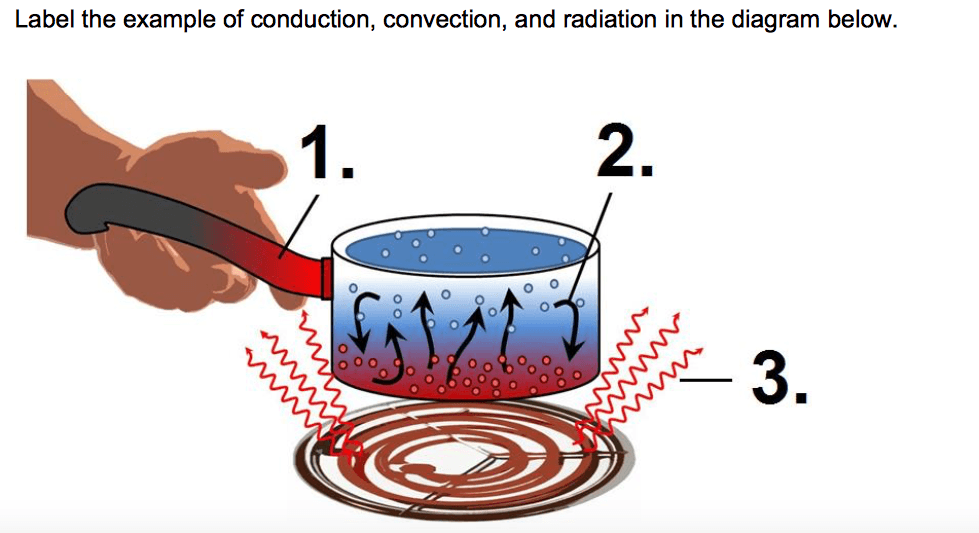
What type of thermal energy transfer is number 1 pointing to?
Convection
Conduction
Radiation
Insulation

What type of thermal energy transfer is number 3 pointing to?
Convection
Conduction
Radiation
Insulation
What is the definition of CONVECTION
When heat transfers through waves.
When heat transfers from objects that are touching.
a hot liquid or air that expands, becomes less dense, and rises or becomes more dense, and sinks.
Heat traveling from the sun
A lava lamp contains colored liquids. These liquids form globs that break off and rise to the top of the liquid. The globs rise due to
Conduction
Convection
Radiation
Insulation
The metal skewer gets so hot you drop your marshmallow into the campfire because of....
Conduction
Convection
Radiation
Insulation
Which type of heat transfer (if any) would be possible in the vacuum of space?
Conduction
Convection
Radiation
No form of heat transfer can happen in space
A boy sits to the side of a campfire. He is 10 feet away but still feels warm. This is an example of ....
Conduction
Convection
Radiation
Insulation
Match these heat transfers

Conduction

Convection

Radiation

What is specific heat capacity?
The measure of a substance's resistance to change in temperature
The amount of energy required to change a substance from solid to liquid state
The ability of a substance to conduct electricity
Amount of heat required to raise the temperature of a 1kg of a substance by one degree Celsius

Why is water often used as a coolant in engines and other machinery?
Water is not flammable and can withstand high temperatures
Water is a good conductor of electricity
Water is readily available and inexpensive
Water has a high specific heat capacity so it can absorb a lot of heat from the machine

Which will heat up faster?
copper
granite
iron
basalt

Which will heat up slower?
water
lead
granite
iron


What is temperature?
Average kinetic energy
Total kinetic energy
Energy transferred between two objects
Heat

What is thermal energy?
Average kinetic energy of object
Total kinetic energy of object
Energy transferred from one object to the other
Heat

Which of these glasses has a greater TEMPERATURE?
Glass A
Glass B
They have the same temperature.
Neither has a temperature.
Which of these glasses has more THERMAL ENERGY?
Glass A
Glass B
They have the same thermal energy.
Neither has thermal energy.
Thermal energy is associated with
kinetic and potential energy of particles
position or shape
chemical reactions
chemical bonds
Heat always moves
in convection currents
by radiation
from hot to cold
from cold to hot
Cold things often have a _________ kinetic energy because_______
lower; particles are moving around less
lower; particles are moving around more
higher; particles are moving around the same
higher; particles do not move

