Worksheets
Biology final mullen
Total questions: 119
Worksheet time: 2hrs 45mins


After meiosis I, which of the following is true about the cells that are produced?
Two cells are produced. They are identical to each other and each contains half the number of chromosomes that the parent cell has.
Two cells are produced. They are unique to each other and each contains half the number of chromosomes that the parent cell has.
Four cells are produced. They are unique to each other and contain the same number of chromosomes that the parent cell has.
Only one cell is produced. It is identical to the parent cell and contains the same number of chromosomes.
The four cells that are produced after Meiosis are _______.
haploid because they contain just half the number of chromosomes as the parent cell.
diploid because they contain as many chromosomes as the parent cell.
diploid because they contain twice as many chromosomes as the parent cell.
What effect does crossing over has in terms of traits of offspring?
Results in identical traits of offsprings.
Causes variation in the traits of offsprings.
It really does nothing to the traits of offspring.
True or False: Crossing-over also happens in Meiosis II.
True
False
After meiosis II, which of the following is true about the cells that are produced?
Four cells are produced. They are identical to each other and each contains half the number of chromosomes that the parent cell has.
Four cells are produced. Each is unique and contains half the number of chromosomes that the parent cell has.
Four cells are produced. Each is unique and contains the same number of chromosomes that the parent cell has.
Two cells are produced. Each is unique and contains the same number of chromosomes that the parent cell has.

Which phase of meiosis is shown in the picture?
prophase I
metaphase I
anaphase I
telophase I

Which phase of meiosis does the picture on the left happen?
prophase I
prophase II
metaphase I
telophase II

Which phase of meiosis is shown in the picture?
Prophase II
Metaphase II
Telophase I
Telophase II

Which phase of meiosis is shown in the picture?
Prophase I
Metaphase I
Anaphase I
Telophase I
In which phase of Meiosis does crossing-over happen?
Prophase I
Metaphase I
Anaphase I
Telophase I

What phase of Meiosis is in this picture?
Prophase I
Metaphase I
Anaphase I
Telophase I
Cell division that results in two identical daughter cells
Mitosis
Meiosis
Mitochondria


In guinea pigs, the allele for rough coat (R) is dominant over the allele for smooth coat (r). A homozygous dominant guinea pig and a homozygous recessive guinea pig are mated.
What would be the phenotype of the offspring?
100% rough coat
100% smooth coat
In a population of bees, long wings (L) are dominant over short wings (l). Bees with long wings are ...
heterozygous only (Ll)
homozygous
dominant only (LL)
heterozygous or
homozygous
dominant (LL or Ll)

This type of inheritance pattern is a MIXTURE of both traits. Example, one flower is red and the other flower is white but they reproduce a pink offspring.

In humans, freckles (F) on the skin are dominant to no freckles (f). If a heterozygous parent and a recessive parent conceive, what is the chances of having a child with NO FRECKLES?
0%
50%
100%

Which of the following is a PHENOTYPE for flower color in pea plants?
Pp
PP
Purple
Which set of alleles are considered heterozygous?
HH
Hh
hh
Genotype: Aa is ....
homozygous dominant
homozygous recessive
heterozygous

Codominance

Cross 2 heterozygous tall pea plants. Tall (T) is dominant to short (t). What fraction of the offspring do you predict will be tall?
1/4
2/4
3/4
4/4
Genotype: TT is ...
homozygous dominant
homozygous recessive
heterozygous

Codominance
The physical expression of a trait is called the ...
genotype
phenotype
Aa, DD, Bb, yy are all examples of _______
genotypes
phenotypes
A __________ is the visible trait or physical appearance.
Genotype
Dominant
Co-dominance
Phenotype
After observing dihybrid crosses, Mendel concluded that the presence of one trait didn't affect the presence of another. This is called
The Law of Inheritance
The Law of Segregation
The Law of Natural Descent
The Law of Independent Assortment
Alleles that are present in a genotype but are not expressed are called
recessive
masked
hidden
dominant
Is the following genotype heterozygous, homozygous recessive, or homozygous dominant?
FF
Heterozygous
Homozygous recessive
Homozygous dominant
Is the following genotype heterozygous, homozygous recessive, or homozygous dominant?
Ee
Heterozygous
Homozygous recessive
Homozygous dominant
Is the following genotype heterozygous, homozygous recessive, or homozygous dominant?
dd
Heterozygous
Homozygous recessive
Homozygous dominant
Is the following genotype heterozygous, homozygous recessive, or homozygous dominant?
BB
Heterozygous
Homozygous recessive
Homozygous dominant
Is the following genotype heterozygous, homozygous recessive, or homozygous dominant?
Aa
Heterozygous
Homozygous recessive
Homozygous dominant
An inheritance pattern in which both alleles for a gene are expressed in the offspring so that both traits show up on its body is known as ---
Codominance
Incomplete dominance

____ is an inheritance pattern that results in offspring that are a MIXTURE of the two traits of its parents, like yellow and blue flowers making green offspring.
incomplete dominance.
codominance
The blending of two traits in which one is not completely dominant over the other is known as ---
incomplete dominance
codominance
The different forms of a gene are called ---
traits
hybrids
alleles


The final stage of the cell cycle is called:
Interphase
mitosis
cytokinesis
daughter cells
The first phase of mitosis is called _______________ .
telophase
metaphase
anaphase
prophase
The phase of mitosis where the nuclear membrane forms
is called ________ .
anaphase
prophase
metaphase
telophase
The phase of mitosis when chromosomes align in the
middle is called ________
anaphase
prophase
telophase
metaphase
The process by which a cell nucleus divides is called:
interphase
mitosis
cytokinesis
cell cycle
The ____________ ensures that our body’s grow and repair
themselves.
The cell growth
The cell repair
The cell recycle
The cell cycle
A pair of similar chromosomes are called:
homocycular
homologous
homocellular
homonucleus
Identical cells formed during cell division are called:
daughter organelles
daughter cycles
daughter nucleus
daughter cells
The three stages of the cell cycle are __________, mitosis, and
cytokinesis.
interphase
anaphase
metaphase
prophase
A version or variation of a gene
trait
gene
allele
DNA
an observable characteristic
trait
gene
allele
DNA
A segment of DNA that codes for a trait
gene
allele
chromosome
chromatid


Alex is hiking a mountain trail. Which description best matches what is shown on the graph?
Alex hiked steadily for the first 50 minutes, and then took a rest.
Alex hiked steadily up the trail for 60 minutes, and then he hiked back.
Alex hiked at one pace for 60 minutes, then he decreased his pace for the remainder.
Alex hike slowly for 60 minutes, then he increased his pace for the remainder.
The cost of a small cup of coffee at a deli is $3.50. You can use the equation t = 3.5n, where t represents the total money made from the sale of small coffees and n is the number of cups of small coffees sold. In this equation, which describes the role of n?
the dependent variable
the independent variable
the dependent quantity
the dependent quantity
Roy is hiking down a mountain at a rate of 3 miles per hour. He started at the top of the mountain on a 12.5-mile trail to his tent camp. Which is the dependent variable in this problem situation?
time
distance
altitude
speed
To convert a distance between miles and feet, you can use the equation f = 5280m, where f represents the number of feet and m represents the number of miles. In this equation, which describes the role of f ?
the dependent variable
the independent variable
the dependent quantity
the independent quantity

Who built models of DNA and said it looked like a twisted ladder (double helix)?
Franklin
Sunny and Cher
Chargaff
Watson and Crick
Who used x ray diffraction to see DNA?
Watson
Chargaff
Franklin
Crick
What does a Double Helix look like?
Twisted ladder
Upside down ladder
Sideways ladder
Double circle
Rosalinda Franklin discovered DNA was ________________.
square
spiral
circular
rectangular


AATCATGGA
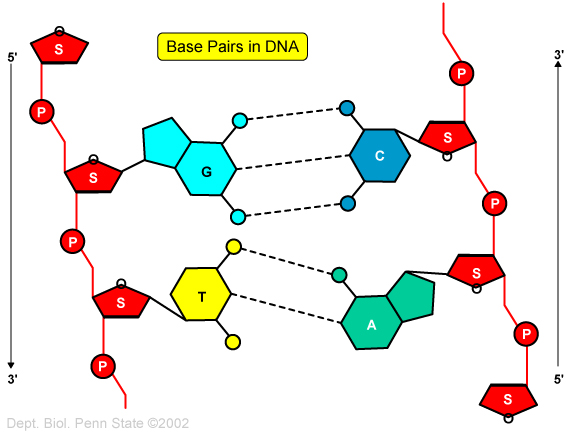

ATG TGA CAG
Where are proteins made?
ER
nucleus
cytoplasm
mitochondria
What is the correct order to make a protein?
Protein, DNA, RNA
RNA, DNA, Protein
DNA, RNA, Protein
Protein, RNA, DNA
Each section of DNA that codes for a protein is called a...
Chromosome
RNA
Gene
Enzyme

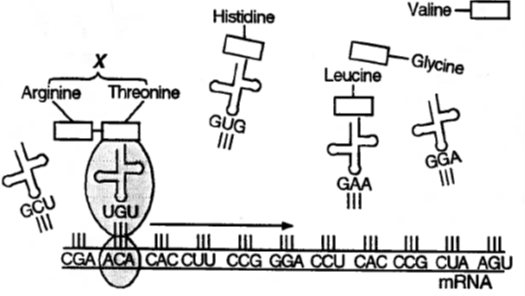
What is this a picture of?
DNA
mRNA
rRNA
tRNA
What is the function of DNA?
Store genetic information
Store energy
Form enzymes
Form the cell membrane
Which statement is true about RNA?
RNA is usually single stranded and contains the base uracil
RNA is usually double stranded and contains the base thymine
RNA is made in the nucleus and stays there to carry out its function
All of the above are true.
Which Nucleic Acids can be found in the nucleus?
DNA only
DNA & RNA
RNA only
enzymes only
The first step of protein synthesis is.....
replication
mitosis
translation
transcription
Through the process of transcription, DNA makes a complimentary strand of
DNA
RNA
CNA
PLB
True or False: RNA uses deoxyribose sugar.
True
False
What is the monomer of RNA?
amino acids
nucleotides
fatty acids
polysaccharides
What are the 4 RNA nitrogen bases?
adenine, thymine, cytoplasm, and guanine
adenine, thymine cytosine, and guanine
adenine, uracil, cytoplasm, and guanine
adenine, uracil, cytosine, and guanine
What does RNA stand for?
Ribonucleic acid
Ricenucleic acid
Ribouncenucleic acid
Rinucleic acid
What is the order for Protein Synthesis?
Transcription -> Translation -> Protein
Translation - > Transcription -> Protein
Protein -> Transcription -> Translation
Translation -> Protein -> Transcription