
 Worksheets
Study Guide SG#7 WW1
Total questions: 10
Worksheet time: 5mins
Name
Class
Date
1.
Cause: Prior to WWI, U.S. foreign policy would be described as...
a)
Imperialist
b)
Isolationist
c)
War-hawking
d)
Internationalist
2.
Cause: Which of the following events did NOT lead to the U.S. entering WWI?
a)
The sinking of the Lusitania and the German policy of unrestricted submarine warfare
b)
The discovery of the Zimmermann Telegram
c)
The attack on Pearl Harbor
d)
Economic ties between the United States and the allied powers
3.
Course: World War I began in (blank) and ended in (blank). However, the U.S. did not join the war until (blank).
a)
1914, 1918, 1917
b)
1861, 1865, 1864
c)
1776, 1783, 1778
d)
1939, 1945, 1941
4.
Course: The U.S. maintained stronger trade relations with ____________ as a result of _____________.
a)
Britain, the British naval blockade surrounding the German Coast
b)
Germany, German unrestricted submarine warfare
c)
France, Polish blockade of the German coastline
5.
Effect: Which of the following was NOT an effect of WWI on the homefront?
a)
As soldiers traveled home, they brought Spanish Flu home with them
b)
Civil liberties, such as the freedom of speech, were restricted by wartime legislation such as the Espionage and Sedition Act
c)
Wartime production led to more women joining the workforce and African Americans migrating from the South to the North
d)
The war led to a construction boom in the United States following the destruction of the war
6.
Effect: Which of the following could be considered a piece of evidence to support the argument that after WWI the U.S. returned to the foreign policy of isolationism?
a)
President Wilson travelled to Versailles to be part of the peace treaty negotiations to end WWI.
b)
The United States maintained strong trade relations with Britain and other European nations after the war
c)
The U.S. congress refused to join the League of Nations following WWI.
d)
Veterans returned home just as the American economy was shrinking.
7.
Effect: As WWI came to an end in 1918, what new challenge did the United States (and the world) face?
a)
The collapse of the United States' economy
b)
The spread of the deadly Spanish Flu
c)
The relocation of American troops from Europe to America
d)
The collapse of the Russian government following WWI
8.
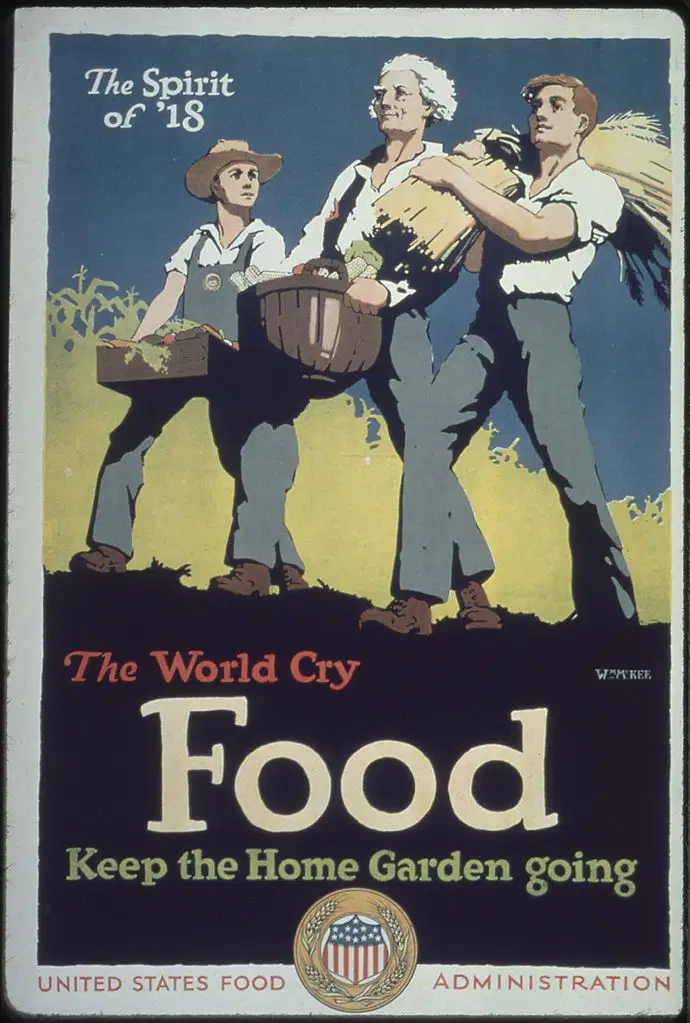
Source Analysis (Purpose/Message): Which of the following best describes the purpose of this propaganda poster?
a)
This poster was created by the War Industries Board to encourage American factories to produce the supplies needed for the war
b)
This poster was created by the Food Administration to encourage Americans to grow food in home gardens
c)
This poster was created by the Navy to encourage enlistment in the U.S. Navy
d)
This poster was created by the Committee of Public Information to encourage women to join the war effort by working in war industries
9.
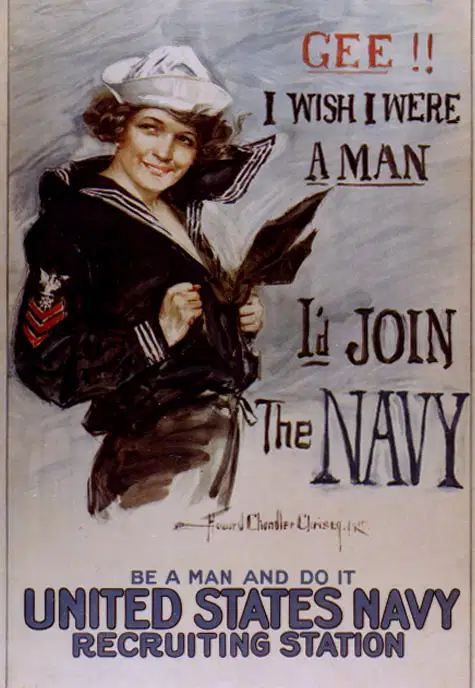
Source Analysis (Purpose/Message): This WWI propaganda poster was meant to encourage Americans....
a)
to conserve their food supplies
b)
to buy liberty bonds to fund the war effort
c)
to enlist in the armed forces
d)
to sign up to work in a war productions plant
10.
Four Worlds: Select the (W) world and (J) justification which best matches the (E) explanation below.
Ordinary Americans helped pay for 2/3rds of the cost of the war through voluntarily purchasing Liberty Loans and Victory Bonds.
a)
W = Politics, J = Taxes
b)
W = Economic, J = Means of Exchange
c)
W = Social, J = Civic Duty, Common Good
d)
W = Culture, J = Identity
100 %

