
 Worksheets
2nd Nine Weeks Assessment ( SPACE)
Total questions: 82
Worksheet time: 59mins
During a fun astronomy class, Henry and Sophia were debating: What is the largest planet in our solar system?
Jupiter
Mars
Earth
Venus
During a fun space trivia game, Anika asked, "Which planet is the closest neighbor to the Sun?"
Mercury
Venus
Earth
Mars
Hey Luna, can you and Ethan guess how many planets are in our solar system?
8
9
7
10
Hey Ethan, Benjamin, and Aiden! Can you guess which planet is the tiniest in our solar system?
Mercury
Mars
Venus
Earth
Hey Isla, can you guess the name of the galaxy that our solar system calls home? It's a bit like a cosmic candy bar!
Milky Way
Andromeda
Triangulum
Whirlpool
Hey Luna, do you know which planet is famously called the Red Planet?
Mars
Venus
Jupiter
Saturn
Hey space explorers! Can you help Noah and Sophia figure out which planet boasts the most magnificent ring system in our solar system?
Saturn
Jupiter
Uranus
Neptune
Hey Priya, Noah, and Abigail! Imagine you're on a cosmic adventure to the Sun. Can you guess what the Sun is mostly made of?
Hydrogen
Oxygen
Carbon
Nitrogen
Hey Isla, Evelyn, and Aria! Can you guess what is Earth's only natural satellite that lights up our night sky?
Moon
Mars
Venus
Jupiter
Imagine you're an astronaut like Aiden, floating in space. What mysterious force keeps planets like Earth dancing around the Sun?
Gravity
Magnetism
Friction
Electricity
Hey Scarlett and Benjamin, can you guess which planet is famous for its gigantic Great Red Spot?
Jupiter
Mars
Venus
Saturn
Hey space explorers! Evelyn and William are on a cosmic quest to find out: What is the name of the closest star to our home planet, Earth?
Sun
Proxima Centauri
Alpha Centauri
Sirius
Hey Luna, can you guess which planet is often called Earth's twin because of its similar size and composition?
Venus
Mars
Jupiter
Mercury
Hey Arjun, Mia, and Isla! Have you ever wondered why each planet has its own unique length of day? Let's find out!
Their rate of rotation
Their distance from the sun
Their size and mass
Their atmospheric composition
Imagine if Earth decided to take a little vacation and moved farther away from the Sun. What do you think would happen?
It would become colder
It would become hotter
The length of the day would decrease
The Earth's gravity would increase
Hey Priya and Emma, have you ever wondered what causes the Moon to change its shape in the sky? Let's find out!
The moon's orbit around Earth
The Earth's rotation on its axis
The Sun's movement across the sky
The changing distance between the Moon and the Sun
Hey Aiden, Zoe, and Kai! Can you guess why Venus is hotter than Mercury, even though Mercury is closer to the Sun? It's a cosmic mystery!
It has a thick atmosphere of carbon dioxide
It is closer to the Sun
It has a larger size
It rotates faster
Imagine you're a space explorer like Aria, James, and Henry! How do scientists decide if a planet is a "dwarf planet"?
It must not clear its orbital path
It must have a ring system
It must be the largest object in its orbit
It must have a moon
Hey Charlotte, Nora, and Daniel! Can you guess what amazing cosmic event happens when the Moon decides to play hide and seek with the Sun?
Moon blocks the sun light from reaching Earth
Earth blocks the sunlight from reaching the Moon
Sun moves behind the Earth
Stars become visible during the day
Hey Anika and Jackson, have you ever wondered why the Moon seems to change its shape in the night sky?
The sun lights different parts of the moon as it orbits Earth
The Moon's surface changes shape due to meteor impacts
The Earth's shadow covers different parts of the Moon
The Moon's distance from Earth changes, altering its appearance
Hey space explorers Grace and Avery! Can you guess why Mercury experiences such wild temperature swings?
It has no atmosphere to retain the heat
It is too far from the Sun
It has a thick atmosphere that traps heat
It rotates very quickly
Imagine Anika, Aria, and Nora are on a cosmic adventure! How do they use their trusty telescopes to explore the wonders of space?
By observing light from distant objects
By sending signals to other planets
By creating artificial stars
By measuring the temperature of the Earth's core
Imagine Aria and Aiden are on a cosmic adventure! What roles do gravity and inertia play in keeping their spaceship orbiting around a star?
Gravity pulls the spaceship towards the star and inertia keeps it moving
Inertia pulls the spaceship towards the star and gravity keeps it moving
Gravity and inertia both push the spaceship away from the star
Inertia stops the spaceship from moving and gravity pulls it away from the star
Hey Ava, Evelyn, and Michael! Do you know what makes the seasons change on Earth? Let's find out!
The tilt of the Earth's axis
The distance of the Earth from the Sun
The rotation of the Earth on its axis
The gravitational pull of the Moon
Hey Mason, Liam, and Priya! Can you guess why black holes are like cosmic ninjas, making them super tricky to spot?
Their gravity traps all the light
They are too far away from Earth
They are too small to be detected
They emit too much radiation
Hey Luna, have you ever wondered how the Sun manages to shine so brightly every day? What's its secret to producing all that energy?
Through nuclear fusion
By burning coal
Through chemical reactions
By gravitational contraction
Hey Aria, Rohan, and Oliver! Have you ever wondered why some planets have a whole bunch of moons while others have just a few? Let's dive into the cosmic mystery!
Larger planets have stronger gravity to capture more moons
Some planets are closer to the Sun and have more moons
Planets with rings tend to have more moons
Planets with atmospheres have more moons
Imagine Kai, Nora, and Aria are the first humans to set foot on Mars! What atmospheric challenges would they face on their exciting adventure?
Lack of oxygen and extreme cold temperatures
Abundant oxygen and mild temperatures
High humidity and frequent rain
Dense atmosphere similar to Earth
Imagine if the Moon suddenly vanished! How might Earth's ecosystems react to this cosmic surprise? Arjun, David, and Ava are curious to know!
Tides would weaken, disrupting marine life.
The Earth's rotation would speed up, causing shorter days.
The Earth's axis would become more stable, reducing seasonal changes.
The Earth's gravity would increase, affecting animal migration patterns.
Imagine you're a space detective like Arjun, Ava, and Liam! How can studying the atmospheres of other planets help us predict Earth's future climate?
By comparing atmospheric changes and greenhouse effect.
By observing the color of the planets.
By measuring the distance of planets from the sun.
By analyzing the number of moons orbiting the planets.
Hey Aiden, Michael, and Zoe! Imagine you're on a cosmic adventure to the Sun. Can you guess what the Sun is mostly made of?
Hydrogen.
Oxygen.
Carbon.
Nitrogen.
Hey Harper, Mia, and Arjun! Can you guess what is Earth's only natural satellite that lights up our night sky?
Moon.
Mars.
Venus.
Sun.
Hey Anika, Ethan, and Mason! Can you guess what magical force keeps our planets dancing around the Sun?
Gravity.
Magnetism.
Electromagnetic force.
Nuclear force.
Hey Maya, do you know which planet in our solar system has the quirky habit of rotating on its side?
Uranus.
Mars.
Jupiter.
Venus.
In a cosmic race around the Sun, which planet would take the longest time to complete its orbit? Join David, Samuel, and Hannah as they explore the solar system!
Mars
Earth
Venus
Neptune
Emma and Olivia are stargazing and wondering why each planet has its own unique length of day. Can you help them figure it out?
Their rate of rotation.
Their distance from the sun.
Their size and mass.
Their atmospheric composition.
Imagine if Earth decided to take a little vacation and drifted farther away from the Sun. What do you think would happen? Let's see if Abigail, Daniel, and Ava can figure it out!
It would become colder.
It would become hotter.
The length of a day would decrease.
The Earth would stop rotating.
Isla, Ava, and Sophia are stargazing and wondering, what magical dance causes the Moon to change its shape in the sky?
The moon's orbit around the Earth.
The Earth's rotation on its axis.
The Sun's position in the sky.
The moon's distance from the Sun.
During a lively debate in science class, Liam asked, "Why is Venus hotter than Mercury, even though Mercury is closer to the Sun?" Can you help him figure it out?
It has a thick atmosphere of carbon dioxide.
It is closer to the Sun than Mercury.
It has active volcanoes that increase its temperature.
It rotates faster than Mercury, generating more heat.
Olivia and Ava are having a friendly debate about physics. Olivia says, "Mass is the measure of the amount of mass on an object," while Ava insists, "Weight is the measure of the gravitational force on an object." Who is correct?
Mass is the measure of the amount of mass on an object.
Weight is the measure of the amount of mass on an object.
Mass is the measure of the gravitational force on an object.
Weight is the measure of the gravitational force on an object.
Hey space explorers! Mia, Nora, and Lily are curious: How does mass change when you hop from one planet to another in our solar system?
Mass stays the same.
Mass increases with distance from the sun.
Mass decreases with distance from the sun.
Mass changes based on the planet's atmosphere.
Hey there, curious minds! Imagine Avery and Henry are on a space adventure. Can you tell them what weight is based on?
The force of gravity on a mass.
The volume of an object.
The color of an object.
The temperature of an object.
Hey Rohan, do you know how long it takes for our planet Earth to do a full spin on its axis? Let's see if you can guess it right!
24 hours
12 hours
48 hours
36 hours
Sophia and Avery are having a fun debate! Sophia says it takes the Earth a whole year to complete one revolution around the sun. Avery thinks it might be just a day. Who's right?
1 year
1 day
1 month
10 years
Hey Nora, have you ever wondered why Earth has seasons? Let's explore this cosmic dance!
Its axis is tilted as it moves around the sun
The distance from the sun changes significantly
The sun's energy output varies throughout the year
Earth's orbit is a perfect circle
Imagine you're stargazing with Noah and Hannah. What determines the phase of the moon you see?
How much of the sunlit side of the moon faces Earth
The distance between the Earth and the moon
The time of year
The weather conditions on Earth
Hey Isla, can you guess where the moon is hiding during a solar eclipse?
Directly between the Earth and sun
Behind the Earth
On the opposite side of the Earth from the sun
Above the Earth and sun
Hey Ethan, Mia, and Olivia! Can you guess what the surface of the moon is covered with?
Craters
Lakes
Forests
Rivers
Hey Rohan, Grace, and Benjamin! Can you guess when an equinox happens?
When neither end of Earth's axis is tilted toward or away from sun
When the Earth is closest to the sun
When the Earth is farthest from the sun
When the moon is directly between the Earth and the sun
Hey Maya and Arjun, have you ever noticed when the moon looks like it's been sliced perfectly in half? Can you guess which lunar phase this happens?
First quarter and third quarter phase
New moon phase
Full moon phase
Waxing crescent phase
What event began the space race?
The Soviet Union launched Sputnik
The United States landed on the Moon
The launch of the Hubble Space Telescope
The first human spaceflight by Yuri Gagarin
Who was the space race between?
The United States and Soviet Union
China and India
France and Germany
Japan and South Korea
What does Earth revolve around?
The sun
The moon
Mars
Jupiter
What do all the inner planets have in common?
Small and have rocky surfaces
Have rings
Are made mostly of gas
Have many moons
Where is the asteroid belt located?
Between Jupiter and Mars
Between Earth and Venus
Between Saturn and Uranus
Between Neptune and Pluto
Which planet was once believed to have water on it?
Mars
Venus
Jupiter
Mercury
What are Saturn's rings made up of?
Chunks of ice and rock
Dust particles
Gaseous clouds
Metallic debris
What unit of measurement is used to measure mass?
Gram & Kilogram
Meter & Centimeter
Liter & Milliliter
Second & Minute
What unit of measurement is used to measure weight?
Ounce, pounds, and Newton
Meters, kilometers, and miles
Liters, milliliters, and gallons
Seconds, minutes, and hours
What instruments are used to measure mass?
Balance
Thermometer
Barometer
Voltmeter
What instrument is used to measure weight?
Scale
Thermometer
Barometer
Anemometer
A Neap tide is a type of tide that occurs when the difference between high and low tide is least. What causes a Neap tide?
The alignment of the Earth, Moon, and Sun in a straight line
The alignment of the Earth, Moon, and Sun at right angles
The Moon being closest to the Earth
The Moon being farthest from the Earth
During which moon phases do Neap tides occur?
first and third quarter moon
new moon
full moon
waxing gibbous
What is a Spring tide?
A tide with the greatest difference between high and low water
A tide with the least difference between high and low water
A tide that occurs during the first and third quarters of the moon
A tide that occurs when the sun and moon are at right angles
During which moon phases do spring tides occur?
new and full moon phases
first and third quarter moon phases
waxing crescent and waning crescent phases
waxing gibbous and waning gibbous phases
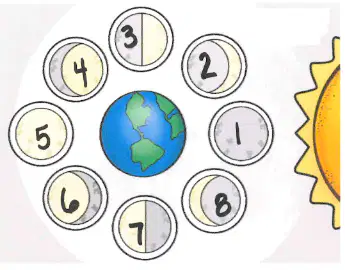
Which of the following options correctly labels the phases of the moon? Think about what phases #1 is all the way to 8.
New Moon, Waxing Crescent, First Quarter, Waxing Gibbous, Full Moon, Waning Gibbous, Last Quarter, Waning Crescent
Full Moon, First Quarter, New Moon, Waxing Crescent, Waxing Gibbous, Waning Crescent, Last Quarter, Waning Gibbous
New Moon, First Quarter, Waxing Crescent, Full Moon, Waxing Gibbous, Waning Crescent, Last Quarter, Waning Gibbous
New Moon, Waxing Crescent, First Quarter, Full Moon, Waxing Gibbous, Waning Gibbous, Last Quarter, Waning Crescent


Earth

Mars

Saturn

Jupiter

Sun
Each object circling the Sun travels along an (a) -shaped path called an orbit. This path is cause by (b) . Gravity is the attractive force, or pull, between objects that have (c) . The (d) an object's mass, the greater its graviational pull. Also, the closer objects are to one another, the (e) gravity's pull is between them.
The Moon travels in an elliptical orbit that is nearly circular around the Earth. This pattern has occurred for millions of years.
Which of the following best explains the cause of the Moon's motion?
The Moon is acted upon by balanced forces, so the orbit maintains the same nearly circular shape.
The gravitational forces that the Sun and the Earth on the Moon are equal, causing the Moon to maintain its orbit.
The Moon is constantly affected by the unbalanced force of the Earth’s gravity which causes it to continue to orbit the Earth.
There was a gravitational force millions of years ago that pulled the Moon in an elliptical direction and the Moon has not since been acted upon by a force.
The closer objects are to one another, the __________ gravity's pull is between them.
weaker
stronger

This is a science lab in space where scientists live and work.
Space Shuttle
International Space Station
Lunar Module
Vostok Space Lab

What are the two types of shadows involved in an eclipse?
Penumbra and Umbra
Umbra and Antumbra
Penumbra and Antumbra
Bioshadow and Lithoshadow
What is located between Mars and Jupiter
the Kuiper belt
the Oort cloud
the asteroid belt
the solar nebula
The currently accepted view of the solar system is called ______
Geocentric

We live in the ______________ galaxy.
Snickers
Baby Ruth
Hershey
Milky Way

Match the following:
A
Mercury
B
Neptune
C
Earth

•The orbital path is is in the shape of a(n) _______.(choose 2)
circle
ellipse
oval
square
The National Aeronautics and Space Administration (NASA) is the agency responsible
for the space program in the United States. What was the goal of NASA’s Apollo
program?
to search for life on planets other than Earth
to land on a planet in another solar system
to determine the composition of the Sun
to send a human to land on the Moon
_________________________ has no true atmosphere with extreme surface temperatures.
Jupiter
Saturn
Mercury

