
 Worksheets
Midterm Review Quiz
Total questions: 25
Worksheet time: 13mins
In a lively art class, Evelyn and Arjun were challenged to uncover the magical seven elements of art. Which of the following options should they pick to ace the challenge?
Emphasis, balance, pattern, movement, proportion, contrast, and unity
Line, color, value, shape, form, texture, and space
Primary, Secondary, Tertiary, Monochromatic, Complementary, Analogous, Split Complementary.
Line, color, value, pattern, form, texture, and unity.
Ava and Priya are on a colorful adventure to paint a giant mural! They need to gather the magical primary colors to bring their masterpiece to life. Can you help them by identifying the primary colors?
Green, orange, and purple
Red-orange, Yellow-green, and blue-purple
Red, blue, and yellow
Pink, gray, and lilac
Scarlett and Oliver are on a colorful adventure, mixing primary colors to create vibrant shades for their art project. Can you help them discover the three magical secondary colors they can produce?
Green, orange, and purple
Red-orange, Yellow-green, and blue-purple
Red, blue, and yellow
Pink, gray, and lilac
In a vibrant art class, Maya and James were challenged to mix colors and create stunning tertiary colors. Which of the following combinations could they achieve?
Green, orange, and purple
Red-orange, Yellow-green, and blue-purple
Red, blue, and yellow
Pink, gray, and lilac
Abigail and Elijah are painting a mural. Abigail wants to create a lighter version of a color. What should she add to achieve this tint?
any hue produced by adding white to a color
any hue produced by adding red to a color
any hue produced by adding black to a color
any hue produced by adding blue to a color
Imagine you're an artist like Grace, and you're mixing colors on your palette. What happens when you add a touch of black to a color?
any hue produced by adding white to a color
any hue produced by adding red to a color
any hue produced by adding black to a color
any hue produced by adding blue to a color
Olivia and Elijah are painting a mural. They want to create a tone of a color. What should they add to their paint to achieve this?
any hue produced by adding white to a color
any hue produced by adding gray (black & white) to a color
any hue produced by adding black to a color
any hue produced by adding blue to a color
Hey artists! Why do you think using color harmonies is like having a secret superpower in your artwork? Just ask Mason and Abigail!
to evoke certain emotions
To make your work more readable and less chaotic
add context to your composition
All of the above
Imagine Liam is painting a magical sunset scene. Which colors should he splash onto his canvas to create a warm and inviting atmosphere that even Benjamin and Arjun would admire?
red, orange, yellow
blue, green, purple
colors with the longest wavelength on the spectrum
colors that you like better than others.
Charlotte is transforming her room into a serene oasis and wants to splash it with cool colors. Which colors should she choose to achieve this calming effect?
red, orange, yellow
blue, green, purple
colors with the shortest wavelength on the spectrum.
colors that are more chill than others.
Hey Luna and Aria, can you guess what a complementary color scheme is?
a color scheme consisting of tints, shades, and tones of one hue
a color scheme consisting hues that are opposite each other on the color wheel.
a color scheme great for creating contrast and emphasis in artworks.
a color scheme with three hues, two are complementary, and one is from a nearby color. Good for contrast with variety
Hey Grace, Liam, and Lily! Can you guess what a monochromatic color scheme is? It's like picking your favorite color and exploring all its shades and tones. Which one do you think it is?
a color scheme consisting of tints, shades, and tones of one hue
a color scheme consisting hues that are opposite each other on the color wheel. Great for contrast.
a color scheme that uses two to four colors that are next to each other on the color wheel. One of the most harmonious color schemes.
a color scheme with three hues, two are complementary, and one is from a nearby color. Good for contrast with variety.
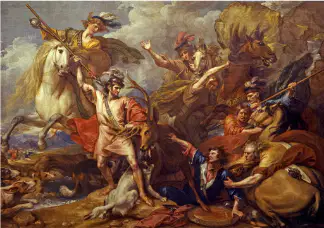
Imagine you're an art detective like Rohan! Which rule of composition is cleverly used in "The Death of the Stag" by Benjamin West?
Golden Ratio
Golden Triangle
Leading Lines
Rule of Thirds

Hey art detectives! Anika and Benjamin are exploring the masterpiece "Paris Streets, Rainy Day" by Gustave Caillebotte. Which rule of composition do you think is guiding their journey through this rainy scene?
Golden Ratio
Golden Triangle
Leading Lines
Rule of Thirds

Imagine you're on a treasure hunt with Priya and Anika, and you stumble upon a painting titled "The Gold Stays Here" by Shuo Shi. Which rule of composition does this artwork best illustrate?
Golden Ratio
Golden Triangle
Leading Lines
Rule of Thirds
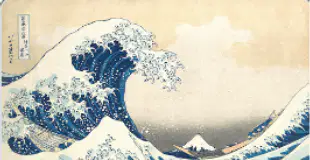
Ava and Arjun are debating art techniques! Which rule of composition is best illustrated by the famous artwork Under the Wave Off Kanagawa, by Katsushika Hokusai?
Golden Ratio
Golden Triangle
Leading Lines
Rule of Thirds
David is on a creative adventure with his painting, aiming to craft a magical illusion of space. Which of the following artistic tricks should he employ to make his masterpiece come alive?
Overlapping
Relative size or scale
One-point perspective
All of the above
Which of the following pictures is the best example of only the concept of overlapping in an artwork?

a

b

c
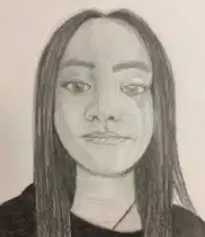
d
Which of the following images is a good example of relative size or scale?



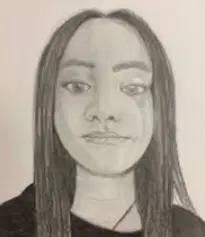
Which of the following is a good example of one-point perspective?
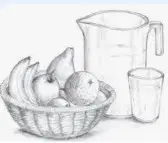


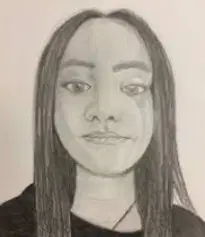
During a lively school art project, Mia and Arjun are on a quest to discover the secrets of a painting. Can you help them find where the magical foreground of the composition is located?
In your face (closest to the viewer)
Out in space (appears farther away from the viewer)
Somewhere in the middle of the composition.
All of the above.
Imagine Jayce is painting a magical landscape for his art class with Daniel and Avery. Where should he place the majestic mountains to make them look like they're part of a dreamy, faraway land?
In your face (closest to the viewer)
Out in space (appears farther away from the viewer)
Appears to be in the middle of the composition.
All of the above.
As Nora paints a beautiful landscape, she's on a quest to find the elusive middle ground of her masterpiece. Where should she focus her artistic gaze?
In your face (closest to the viewer)
Out in space (appears farther away from the viewer)
Somewhere in the middle of the composition.
All of the above.
Mia is creating a masterpiece with her colored pencils and wants her shading to pop with vibrancy. Why should she use complementary colors in her shading technique?
To be different.
To keep her colors from appearing dull and muddy.
To save black for other parts of the composition.
All of the above.
Anika and Grace are on a colorful adventure, creating a masterpiece with their colored pencils. To add a magical touch of depth, Anika wants to use a complementary color for shading. How should she sprinkle this complementary color magic into her artwork?
Apply hard by pressing down with the complementary shade first, then apply lightly with the main shade on top.
Apply lightly with the complementary shade first, then apply the main shade lightly on top.
Apply hard by pressing down with the main shade first, then apply press down for a heavy application of the complementary shade.
Apply light with the complementary shade first, then go harder with the main shade on top.

