
 Worksheets
Fall 2025 Semester Exam Review
Total questions: 108
Worksheet time: 1hrs 7mins
What country financed Columbus’ voyage across the Atlantic in 1492?
(a)
The principle that one of a colony’s most important functions was to provide wealth to the home country was a part of...
(a)
During the Glorious Revolution, whom did Parliament invite to claim the throne of England?
James II
William and Mary
James III
Governor-General Andros
What two European nations were involved in the French and Indian War?
Britain and the colonies
Britain and France
France and Native Americans
France and Spain
What motivated exploration around the world?
Countries wanted to learn from other countries
Kings and Queens wanted more wealth
Explorers from the Enlightenment era wanted fame and fortune
The need for efficient and improved trade routes between countries
What encouraged the founding of the first English colonies in North America?
Religious intolerance
Starvation
Famine
Disagreement with government/royalty
What was the purpose of the American colonies?
To expand England’s empire and culture
To meet with new cultures and see how other people lived
To be a trading partner for the rest of the world
To make England lots of money
How did England plan to pay for the cost of the French and Indian War?
By having France pay for the destruction
It didn’t cost that much money, so the royals covered it
Colonists were now required to pay larger taxes
The citizens of England were now required to pay larger taxes
John Locke wrote about the (a) of all people and the contract theory of government.
According to Locke, when do people have the right to revolt against their government?
When the government becomes a threat to the people’s natural rights
When the government becomes too bureaucratic
When the government is involved in an unjust war
When the people disagree with the government’s policies
The Boston Massacre, which occurred on March 5, 1770, describes:
A protest in which colonists burned Governor Thomas Hutchinson’s house to the ground.
A standoff between colonists and redcoats that resulted in the deaths of five Bostonians.
A mob protest in which two dozen British soldiers were killed.
The dumping of 342 chests of imported tea and other goods into Boston Harbor.
What did President George Washington warn Americans against in his farewell address?
Warned against slavery.
Warned against religious differences.
Amending the US Constitution.
Getting involved in foreign conflicts.
The Battle of Saratoga was a key victory for the Americans because it:
Brought the British to offer recognition of colonial independence.
Brought the American Colonists much-needed support and a formal alliance with France.
Prevented the fighting from spreading into the southern colonies.
Prevented the colonial capital from being captured by the British.
The main purpose for writing the Declaration of Independence was to:
Declare war on Great Britain
To declare independence from France.
Convince Great Britain to abolish slavery
State the colonists' reasons for separating from Great Britain.
The Proclamation of 1763:
Punished the American colonists for their role in the Boston Tea Party.
Permanently removed the Native Americans from the colonial frontier.
Declared war on Chief Pontiac and his fierce warriors.
Banned American colonists from settling west of the Appalachian Mountains
During the Revolutionary War period, Thomas Paine’s Common Sense was important because it:
Described a military plan for the defeat of England
Convinced many Americans who had been undecided to support independence
Warned against independence and argued for staying loyal to Great Britain
Argued for the addition of a bill of rights to the constitution
A series of harsh measures passed by Great Britain in retaliation for the Boston Tea Party, which included the closing of Boston’s harbor, the Quartering Act, and protecting British officials charged with capital offenses to go to England for their trial was known as:
Declaratory Act
Intolerable Acts
Townshend Acts
Stamp Act
The first country to recognize the United States as an independent nation was:
(a)
Common Sense was written by:
Benjamin Franklin
John Locke
Thomas Jefferson
Thomas Paine
The term “Patriot” means:
A person who supports England and continues to pay their taxes to England
A person who supports England’s monarchy but wants independence
A person who is upset about no representation in British Parliament, but does not wish to become independent from England
A person who supports independence from England and fights for the Continental Army
Manifest Destiny was used to justify an American desire to:
Limit the number of immigrants entering the country
Control the area located east of the Appalachian Mountains
Expand the United States to the Pacific Ocean
Warn European countries against colonizing Latin America
How did President Andrew Jackson’s policies affect Native Americans?
Created an independent Cherokee state
Increased civil rights for Native Americans
Increased the available land for Native Americans
Forced most Native Americans out of the Southeast
What event led to mass migration to California in 1849?
The California gold rush
The Mexican-American War
Creation of the Pony Express
Creation of the California trail
During the Texas Revolution, Mexican forces laid siege to what fort in San Antonio, eventually killing nearly all of the 183 fort defenders?
Fort Gonzales
Fort Refugio
The Goliad
The Alamo
The Missouri Compromise resolved a dispute over:
The spread of slavery into new states
European colonization in the Americas
Increasing immigration and urban reform
The border between U.S. and Spanish territory
President Andrew Jackson strongly supported the practice of appointing people to government jobs on the basis of party loyalty and support, a practice known as...
Caucus system
Expansion of suffrage
Spoils system
Nullification crisis
Which of the east-to-west routes carved out by mountain men was most popular with emigrants?
The Oregon Trail
The Mormon Trail
The Sante Fe Trail
The California Trail
What president purchased the Louisiana Purchase?
Thomas Jefferson
John Adams
Andrew Jackson
George Washington
The belief that the interests of the nation as a whole are more important than regional interests is...
Nationalism
Foreign policy
Domestic policy
Sectionalism
The belief that one’s own section, or region, of the country is more important than the whole is...
Nationalism
Foreign policy
Domestic policy
Sectionalism
Which of the following Spanish conquistadors defeated the mighty Aztec Empire?
Francisco Pizarro
Hernan Cortes
Christopher Columbus
Vasco Nunez Balboa
Which of the following is the false concept, which held that the Spanish conquerors merely tortured and butchered the Indians, stole their gold, infected them with smallpox, and left little but misery behind?
Dark Myth
Encomienda System
Spanish Myth
Black Legend
What is the dominant theory about how the first people arrived in what we now call North America?
Native peoples have long existed here.
They traveled in rafts and simple boats.
They walked across the Bering Land Bridge from Eurasia to North America.
They walked as far as they could, then sailed or swam the rest of the way.
The institution of encomienda allowed the…
Native people to enslave members of other tribes.
European governments to grant Native Americans to colonists as slaves if they promised to Christianize them.
Governments of Europe to abolish the practice of Native American slavery.
Europeans to establish an economy based on capitalism.
The king and queen who were financiers and beneficiaries of Columbus’s voyages to the New World…
Elizabeth I/Sir Walter Raleigh
Catherine of Aragon/Henry VIII
Isabella of Castile/Philip II
Isabella of Castile/Ferdinand of Aragon
In the Treaty of Tordesillas, Spain…
Declared all New World territories as its own.
Divided up the so-called New World with Portugal.
Agreed not to enter the Atlantic slave trade.
Granted control of West African silver mines to Portugal.
Pre-Columbian Southwest Native Americans were most noted for which environmental transformation practice?
Draining swamps
Irrigation
Burning grasslands and forest
Nomadic hunting of buffalo
Before 1492, many Native American cultures were strongly influenced by…
The spread of corn cultivation.
Ravages of smallpox epidemics.
Invention of the spoked wheel.
Domestication of horses.
Before Columbus arrived, the only Europeans to have temporarily visited North America were…
Irish
Dutch
Italians
Vikings
What was three-sister farming?
Small women-run farms that were common in some Native American cultures.
An early farming cooperative in which three different tribal groups planted and harvested crops together.
An agricultural method used by Native Americans in which corn, beans, and squash were grown together.
The Iroquois inheritance system, in which property and possessions passed from one generation to the next through the matrilineal (or mother’s) line.
Mississippian settlement where mound builders lived near present-day East St. Louis that was at one time home to as many as 30,000 people.
Chaco Canyon
Moctezuma
Cahokia
Bering Land Bridge
Name a major European disease that devastated Native American populations after 1492.
(a)
Treaty that aimed to divide the Americas between Spain and Portugal.
(a)
The Spanish labor system in which persons were held to unpaid service under the permanent control of their masters for the promise to try to "Christianize" them.
(a)
What are the bookend years of Unit 1?
1492-1607
1491-1607
1491-1610
1400-1607
The first permanent English settlement in the Americas in 1607 was...
Plymouth
Roanoke
Jamestown
St. Augustine
What did Massachusetts governor John Winthrop mean when he said, “We shall be as a city upon a hill”?
He envisioned the Massachusetts Bay Colony as becoming the most economically successful British colony.
He hoped that the Massachusetts Bay Colony would become a holy society that would serve as a model for people everywhere.
He was referring to Jamestown as the city where elite, wealthy, and well-educated people would settle and set an example for other nations.
He was describing Philadelphia as the seat of the English Colonial government.
Native American leader who united several tribes and waged an unsuccessful war against New England’s villages and white colonists…
King Philip
Chief Powhatan
King James I
Squanto
Which of the following terms describes the penniless people obligated to engage in unpaid labor for a fixed number of years, usually in exchange for passage to the New World or other benefits? Their migration addressed the chronic labor shortage in the colonies and facilitated settlement?
Mercantilism
Indentured Servants
Encomienda System
Sharecroppers
Powhatan Indian princess who assisted the settlers of Jamestown, “saved” John Smith’s life, and later married Englishman John Rolfe…
Squanto
Malinche
Pocahontas
Sacagawea
Compared to New England, early English settlement in Virginia and Maryland (the Chesapeake Bay) was characterized by…
Lower life expectancy, an economy based on farming, and a greater gender imbalance.
Lower life expectancy, a greater emphasis placed on education, and a diversified economy.
Higher life expectancy, stable family structures, and an established state church.
Higher life expectancy, religious intolerance, and an emphasis placed on education.
Locke’s writings had the most direct influence on the…
American Revolution
Great Awakening
Mayflower Compact
Zenger Case
Match the following
Focus on establishing settlements for economic gain, such as for trade and to create more markets.
British Colonization
Primarily interested in establishing trading posts for the fur trade.
French Colonization
The first permanent English settlement in North America, known for its strong economic focus.
Jamestown
Established by Pilgrims, it was known for its focus on religious freedom.
Plymouth
Native American resistance toward Colonial American in which Pueblo Indians successfully defeated Spaniard Colonists and regained territory in the New Mexico Area.
Pequot War
Pope's Revolt
King Phillip's War
Stono Rebellion
Considered the first English/Indian War in Colonial America, this skirmish consisted of 3 wars between the Virginia Colony and Algonquian Speaking Indians.
Pequot Wars
Stono Rebellion
Anglo-Powhatan Wars
King Phillips War
All of the following led to the expansion of New World colonies EXCEPT:
God
Glory
Gold
Guarantees

Which European kingdoms explored and settled in parts of North America?
The Spanish
The English
The French
The Dutch
Spanish approach toward Native population
Forcefully convert them to Christianity
French approach toward Native population
Form kinship bonds (understand them and intermarry)
Dutch approach toward Native population
Viewed them strictly as economic partners.
The English approach toward Native population
After a brief window of coexistence they looked to expel them from their lands.
What controversial laws were signed into law during the presidency of John Adams that said “the President could deport or imprison any ‘suspicious’ foreigners and that it was a crime to conduct in any language inciting rebellion against the authority of a state”?
XYZ Affair Acts
Virginia and Kentucky Resolutions
Alien and Sedition Acts
Townshend and Stamp Acts
Which of the following were the first two formal political parties in the United States of America that emerged in the Election of 1796?
Loyalists and Anti-Federalists
Whigs and Tories
Democratic-Republicans and Federalists
Democrats and Whigs
France decided to create a formal alliance with the American Colonies during the Revolutionary War in 1778 following:
The American victory over the British at Saratoga.
American naval victories on the Great Lakes.
The ratification of the United States Constitution.
A personal plea by George Washington at Yorktown.
From the first successful English colony at Jamestown (1607) to the Treaty of Paris ending the French and Indian War (1763), Britain provided its American colonies with (a) , allowing the colonies to act as almost independent states.
self-governance
protection
trade
resources
The Federalist Party, as a formal political party favored all the following EXCEPT:
A strong central federal government.
Closer relations and loyalty to England over France.
An agriculturally based economy.
A national bank.
The Bill of Rights was intended to protect (a) against the potential tyranny of (b) .
The rights of Congress, the President
The army and the navy, the State governments
Civilian authorities, the military
Individual liberties, a strong central federal government

1794 A protest of small farmers in Pennsylvania against new taxes on whiskey
Bank of the United States
French Revolution
Whiskey Rebellion
Political Parties
The (a) was the controversial legislation of President John Adams' administration that restricted citizens from criticizing the government.
What type of people supported the Federalist party?
farmers
women
ranchers
bankers
The Federalist Party tended to be Pro-____________________.
Italian
Chinese
British
French
Pro-French
Democratic-Republican
Federalist
This pamphlet written by Thomas Paine desired to persuade Americans who were undecided about supporting independence from Great Britain
Common Sense
Social Contract Theory
Farmer's Almanac
Uncle Tom's Cabin
The Constitutional Convention addressed the North-South controversy over slavery through the
Great Compromise
3/5 Compromise
Bill of Rights
Northwest Ordinance
Shays' Rebellion
convinced many political leaders of the destructive consequences of a strong central government.
was eventually suppressed when the federal government sent troops to Massachusetts.
convinced some political leaders of the necessity of giving more power to the central government.
came about when American settlers clashed with the British over western land claims.
The majority of German immigrants to the United States in the 1840s and 1850s settled:
Along the Great Lakes region.
On farms in the Midwest.
In crowded cities along the Northeast coast.
On plantations in the South.
The Irish immigrants in early 19th-century America…
Were mostly Roman Catholic.
Tended to settle on western farmlands.
Were warmly welcomed by American workers.
Started the temperance movement.
The overwhelming event for Ireland in the 1840s that led tens of thousands of destitute souls to flee the “land of famine” for the “land of plenty”.
Influx of immigrants from mostly Eastern European countries.
The rebellion against British rule.
The increasing use of English instead of Gaelic.
The potato famine.
The sentiment of fear and opposition to open immigration was called…
The cult of domesticity.
Nativism.
Rugged individualism.
Nullification.
The influential novel Uncle Tom’s Cabin which moved a generation of northerners as well as many Europeans to regard all slave owners as cruel and inhuman was written by…
Elizabeth Cady Stanton.
Harriet Beecher Stowe.
Harriet Tubman.
Margaret Fuller.
Congressman Preston Brooks beat Senator Charles Sumner nearly to death on the Senate floor because…
Sumner had assisted John Brown in the Pottawatomie Massacre in Kansas.
Sumner had used negative language to describe proslavery settlers in Kansas, Southern slave owners, and a South Carolina Senator.
Sumner had personally voted for the admission of Kansas to the Union as a slave state.
Sumner had criticized John Brown in a speech for his attempted raid at Harpers’ Ferry.
The treaty ending the Mexican War that granted vast territories to the United States including California…
Treaty of Guadalupe-Hidalgo
Treaty of Ghent
Gadsden Treaty
Clayton-Bulwer Treaty
U.S. acquisition of land south of the Gila River (Southern tip of Arizona and New Mexico) from Mexico for $10 million; the land was needed for a possible transcontinental railroad line through the southern U.S.
Gadsden Purchase
Louisiana Purchase
Adam-Onis Purchase
Wilmot Proviso
The sentiments like those in the above quote would most likely be found in which of the following publications?
The Liberator
South Carolina Exposition and Protest
Uncle Tom’s Cabin
The Federalist Papers
Which of the following acts of Congress was declared unconstitutional in the Dred Scott decision?
Missouri Compromise of 1820
Compromise of 1850
Kansas-Nebraska Act
Fugitive Slave Law
This group supported anti-immigration and anti-Catholic laws
Deferred Action for Childhood Arrivals
Plyler vs. Doe
Mexican Cession
Know Nothing Party
Match the following
a policy or practice that denies equal rights to certain groups of people
discrimination
the refusal by workers to do their jobs until their demands are met.
strike
a severe food shortage
famine
an American who sought to limit immigration and preserve the country for native-born, white Protestants
nativist
a political party of the 1850's that was anti-Catholic and anti-immigrant
Know-Nothing
Which event is considered a major factor in the Westward Expansion of the United States?
Civil War
Mexican-American War
Louisiana Purchase
American Revolution
Who were some key figures in the Abolition Movement?
Malcolm X, Elizabeth Cady Stanton, Andrew Jackson
Susan B. Anthony, Thomas Jefferson, John F. Kennedy
Martin Luther King Jr., Rosa Parks, Abraham Lincoln
Some key figures in the Abolition Movement were Frederick Douglass, Harriet Tubman, Sojourner Truth, and William Lloyd Garrison.
What were some of the key events leading up to the Civil War?
Boston Tea Party, Battle of Bull Run, Manifest Destiny
Missouri Compromise, Compromise of 1850, Kansas-Nebraska Act, Dred Scott decision, and election of Abraham Lincoln
Declaration of Independence, Battle of Gettysburg, Emancipation Proclamation
Louisiana Purchase, Battle of Antietam, Reconstruction
How did the idea of Manifest Destiny impact Native American tribes?
Native American tribes willingly gave up their ancestral lands due to the idea of Manifest Destiny.
The idea of Manifest Destiny led to the displacement and forced removal of Native American tribes from their ancestral lands.
The idea of Manifest Destiny led to the integration and assimilation of Native American tribes into American society.
The idea of Manifest Destiny had no impact on Native American tribes.
What role did the Underground Railroad play in the Abolition Movement?
The Underground Railroad was a secret society that supported slavery and worked against the Abolition Movement.
The Underground Railroad was a network of underground tunnels used to transport goods and had no connection to the Abolition Movement.
The Underground Railroad was a group of abolitionists who advocated for the legalization of slavery and opposed the Abolition Movement.
The Underground Railroad helped slaves escape to freedom and raised awareness about the horrors of slavery, playing a crucial role in the Abolition Movement.
The belief in (a) meant that it was up to citizens in each state to allow slavery/ban it.
What were effects of the Mexican-American war?
Land resulting from the Treaty of Guadalupe Hidalgo, Mexican Cession + Gadsen Purchase (1/2 of Mexico is seeded to the US)
Training ground for the civil war
Unpassed-Wilmot Proviso-any land gained from Mexico will be ANTI-SLAVERY (Turning point for abolition)
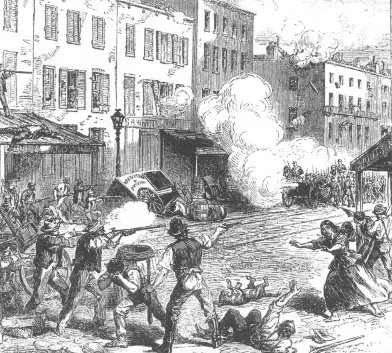
The New York _ _ were fueled by the ability to pay out of war drafts, but only available to the wealthy.
(a)
What were strengths of the South in the civil war?
Strong military leaders (Stonewall Jackson + Robert E Lee)
Fighting a defensive war
Control of the banks + manufacturing
The Civil War broke out at Fort _ when Lincoln tried to send provisions to his captured troops, but the South attacked.
(a)
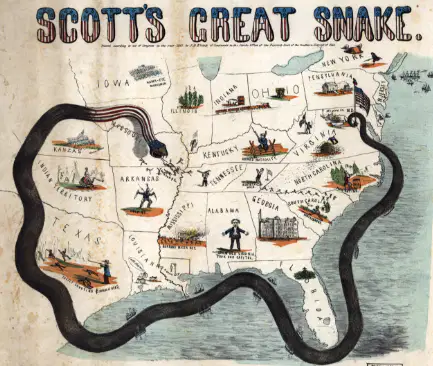
The Unions _ Plan involved using their navy to blockade southern ports to essentially divide the south through the Mississippi River.
(a)
Lincolns _ address, sought to unify the nation, and portray that the struggle of slavery was in direct relation to america's founding democratic principles
(a)
The “Era of Good Feelings” refers to…
The exuberance, unity, and a rise in nationalism Americans felt prior to the War of 1812 during the presidency of James Madison.
The post-War of 1812 presidency of James Monroe was characterized by a rise in nationalism.
The renewed passionate interest in religion during the early 1800s that featured a rise in church attendance, and many new denominations.
The presidency of Andrew Jackson.
As a result of the development of the cotton gin…
The entire textile industry moved to the South.
Slavery was permanently abolished in Europe.
The South diversified its economy.
Slavery revived and expanded.
What is being described by the term the “American System” designed by Henry Clay?
James Monroe’s veto of the charter for the new Bank of the United States.
A statement delivered by President James Monroe that gave a warning to European powers to refrain from seeing any new territories or colonies in the Americas.
A campaign promise to move the Native Americans to the West of the Mississippi River to Indian Territory.
A three-tiered program to promote America’s home markets with a protective tariff, improved transportation, and a National Bank.
Which of the following best describes the transformation in the U.S. characterized by a series of innovations in transportation and communication that dramatically expanded manufacturing and agricultural production? The changes included a movement away from subsistence farming to large-scale cash farming, regional specialization, Western movement, the growth of cities, and an influx in immigration.
“Revolution of 1800”
Market Revolution
Mercantilism
Cult of Domesticity
The primary significance of the Monroe Doctrine (1823) is that…
It outlined non-colonization and nonintervention mandates regarding the Americas to Europe.
It was incorporated into international law.
It led to a treaty and new boundary arrangements with the Russian tsar regarding Alaska.
Its flexibility permitted its reinterpretation by succeeding presidents.
The term that means the sentiment of fear and opposition to open immigration (the Know-Nothing Party was an example of this) was called…
Mercantilism.
Nativism.
Nationalism.
Popular sovereignty.
President Andrew Jackson strongly supported the practice of appointing people to government jobs on the basis of party loyalty and support, a practice known as…
Caucus system
Expansion of suffrage
Spoils system
Nullification crisis


The change depicted on the maps most directly contributed to which of the following?
The Second Great Awakening
The Market Revolution
The issuance of the Monroe Doctrine
The re-emergence of a two-party system

