
 Worksheets
Professional Baking MIDTERM
Total questions: 74
Worksheet time: 42mins
What are pathogens?
Microorganisms that cause illness
Harmful things present in food, making it unsafe to eat
Diseases that spread from one surface or food to another
Chemicals found in air, soil, plants, water, and some food
A foodborne-illness outbreak occurs when ____.
one person gets ill after eating food.
one person gets ill after eating food that was not completely cooked.
two or more people get the same illness after eating different foods.
two or more people get the same illness after eating the same food.
Microorganisms that cause illness are called:
toxins
pathogens
viruses
parasites
Food that is ready to be served and does not need any further preparation or cooking is...
Ready to be served
Ready to eat
Ready to consume
Ready to cook
The temperature range where harmful bacteria multiplies to unsafe levels very quickly is known as the...
Temperature Control for Safety
Temperature Range
Temperature Check List
Temperature Danger Zone
________________ is the process of removing physical debris or dirt.
Cleaning
Sanitizing
______________ REDUCES(kills) the number of pathogens on a surface to a safe level.
Cleaning
Sanitizing
Some foods grow bacteria more easily and quickly than other foods. These foods are known as _______________________ (TCS) foods because they require certain time and temperature controls to prevent unsafe pathogen growth.
Temperature Certain Safety
Time Constant Source
Time Consistant Services
Temperature Control for Safety
Baking soda and baking powder are which type of leavener?
Organic
Physical
Chemical
Biological
The common methods used for mixing quick breads are...
muffin, biscuit, and fast acting
biscuit and creaming
creaming and biscuit
muffin, biscuit, and creaming
In the biscuit method, what piece of equipment can be used to cut in the fat?
pastry blender
food processor
mixer with paddle attachment
all of the above
The type of fat used for the muffin method is...
solid
liquid
softened, room temperature
The type of fat used for the biscuit method is...
solid
liquid
softened, room temperature
The type of fat used for the creaming method is...
solid
liquid
softened, room temperature
Chemical leavening agents release gases through chemical reactions between ________ and ________ contained in the formula.
a) acids, bases
b) vinegar, sour cream
c) lemon juice, baking soda
d) baking powder, baking soda
Baking soda and baking powder are which type of leavener?
organic
physical
chemical
biological
When baking soda is used in a recipe, an acid is required. Which of the following is an example of an acid?
lemon juice
sour cream
buttermilk
all of the above
Examples of chemical leavening agents are...
a) baking soda, baking powder, and yeast
b) yeast, baking ammonia, and acid salts
c) baking soda and baking powder
When quick breads have been overmixed, the final product will be...
a) tough
b) delicate
c) flakey
d) light
If a quick bread has a soapy or bitter flavor or an unusual yellow color, one cause could be that:
too much baking powder was used.
not enough baking soda was used.
too much baking soda was used.
Which of the following is NOT considered a quick bread?
Scone
Soda Bread
Banana Bread
Yeast-raised doughnut
The gas released when chemical leavenings are moistened and heated is called:
alkaline
base
sodium bicarbonate
carbon dioxide
Which of the following chemical leavening agents releases a small amount of gas on contact with moisture, and a second, stronger release of gas when heat is applied?
ammonia carbonate
single-acting baking powder
double-acting baking powder
baking ammonia
Fill in the blank: A quick bread with a soapy or bitter flavor might have had too much _______ used.
baking powder
baking soda
flour
sugar
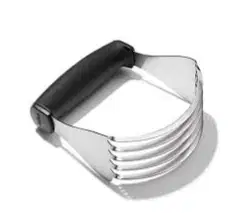
Identify the tool shown in the image.
Grater
Vegetable Peeler
Pastry Blender
Bench Scraper

Fill in the blank: The tool shown in the image is a _______.
Rolling Pin
Tongs
Vegetable Peeler
Meat Tenderizer
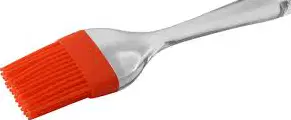
Identify the tool shown in the image:
Paint Brush
Pastry Brush
Pasta Server
Portion Scoop
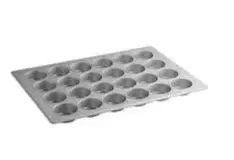
Identify the type of pan shown in the image:
Cake Pan
Pizza Pan
Sauté Pan
Muffin Pan
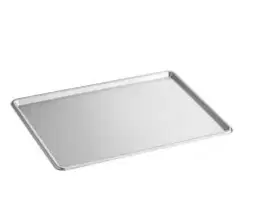
Identify the type of pan shown in the image:
Pizza Pan
Sheet Pan
Muffin Pan
Cake Pan
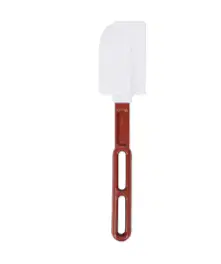
Identify the kitchen tool shown in the image.
turner
spoon
ladel
rubber scraper/spatula
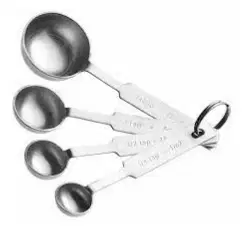
Identify the kitchen tool shown in the image.
peeler
forks
spoons
measuring spoons

Identify the kitchen tool shown in the image.
dry measuring cups
liquid measuring cups
bowls
spoons
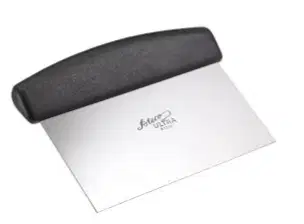
What is the tool shown in the image?
bench scraper
knife
turner
sifter
Fill in the blank: A potential cause of elongated holes in a muffin is ____.
overmixing
too much baking soda/powder
oven temp too high
old batter
What is a potential cause of a flat top with on a small peak in the center of a muffin which means the muffin rose too slow in the oven?
over mixing
oven temp too low
old batter
too much sugar
What is a potential cause of a cracked crust and uneven top of a muffin which means the muffin's crust developed before the batter had time to finish rising?
over mixing
oven temp too high
too much baking soda
old batter
What is a potential cause of tough biscuits?
too much sugar
oven temp too low
over mixing
too much baking soda
When yeast releases _______________ during bread making, the gas becomes trapped in the dough's gluten network.
moisture
heat
oxygen
carbon dioxide
Yeast feeds on carbohydrates present in the starches and sugars in bread dough, converting them to carbon dioxide and ethanol, and alcohol, in an organic process known as _________________.
fermentation
yeast production
growth
proofing
True or False: Yeast breads should be cooled completely before slicing to avoid a soggy internal texture.
True
False
Yeast feeds on carbohydrates present in the starches and sugars in bread dough, converting them to carbon dioxide and ethanol, and alcohol, in an organic process known as
fermentation
yeast production
growth
proofing
True or false: Yeast is a microorganism which is a living thing.
True
False
As with most living things, yeast is very sensitive to ________________ and ________________.
heat and salt
cold and air
salt and moisture
temperature and moisture
Too ____________ salt will cause the bread to taste bland and the bread to rise too rapidly.
little
much
Too ________________ salt will destroy the yeast and prevent the bread from rising properly.
little
much
Which process stretches the outside layer of gluten into a smooth coating, helping to hold in gases and making it easier to shape the dough? (page 178)
bench rest
portioning
retardation
rounding
__________________ relaxes the gluten, making the shaping process easier. (page 178)
rounding
bench rest
portioning
fermenting
What should you look for to determine the doneness of bread?
Internal temperature of 190°F
Uniform, rich, golden brown crust
Hollow sound when bottom of loaf is tapped
All of the above.
A food worker wears nail polish on her fingernails. She is starting her shift and will be preparing sandwiches. What should she do to prevent from contaminating the sandwiches?
A) Wash her hands twice as often
B) Wash her hands and then wear gloves while she prepares the sandwiches
C) Apply hand sanitizer before her shift
D) Ask her manager if she can prepare soup instead.
Fill in the blank: To ensure food safety, chemical containers should be _______.
Clearly labeled
Stored in an unmarked container
Used where they will be stored
Stored in the original container.
Which symptom must you report to your manager?
Hives
Vomiting
Coughing
Joint pain
When must the sanitizing step occur when cleaning and sanitizing in a three-compartment sink?
After washing and rinsing
After air-drying
Before washing
Before removing food
A food worker has been slicing melons for 4 hours. Her single-use gloves are intact. Should this food worker change her gloves?
No, because her gloves are not torn
No, because she may wear the gloves for up to six hours at a time.
Yes, because should use cloth gloves instead
Yes, because pathogens on the gloves may have multiplied to dangerous levels after 4 hours.
A food worker has finished organizing the fridge and returns to the kitchen. What must he do before slicing bread?
Sharpen his knife
Wash his hands and put on new gloves
Remove his gloves, wash his hands and work with bare hands.
No answer text provided.
A food worker washes his hands and puts on new gloves before taking fresh tomatoes from a box and slicing them for burgers WITHOUT washing them. What food hazard should the worker have accounted for?
Pathogens on his hands and gloves
Gluten in the burger buns
Pesticides and soil on the tomatoes.
No answer text provided.
Where are you allowed to wash your hands in the kitchen?
A handwashing sink
A food preparation sink
A bathroom sink
A three-compartment sink
What is a foodborne-illness outbreak?
When 2 or more people report the same illness from eating the same food
When 4 or more people report the same illness from eating the same food
When 6 or more people report the same illness from eating the same food
No answer text provided.
What is TCS food?
Food requiring Thermometer Checks for Security
Food requiring Training Commitments for Standards
Food requiring Trustworthy Conditions for Service
Food requiring Temperature Control for Safety
What is the MOST important way to prevent a foodborne illness from BACTERIA?
Control time and temperature
Practice good personal hygiene
Prevent cross-contamination
Practice good cleaning and sanitizing
What is the most important way to prevent a foodborne illness from VIRUSES?
Control time and temperature
Practice good personal hygiene
Prevent cross-contamination
No answer text provided.
What should food handlers do to prevent food ALLERGENS from being transferred to food?
Control time and temperature
Practice good personal hygiene
Prevent cross-contact
Practice good cleaning and sanitizing
How long can food stay in the temperature danger zone before it must be THROWN OUT?
1 hour
2 hours
3 hours
4 hours
How many days can most leftovers be safely stored in the refrigerator?
2 days
3 days
6 days
7 days
What is the problem with storing raw chicken above cheesecake?
Cross-contamination
Time-temperature abuse
Poor personal hygiene
Cross-contact with allergens
A cook preps a beef tenderloin on a cutting board and then immediately cuts pies for dessert on the same cutting board without washing it. This is an example of which risk factor?
Purchasing food from unsafe sources
Using contaminated equipment
Holding food at incorrect temperatures
Practicing poor personal hygiene
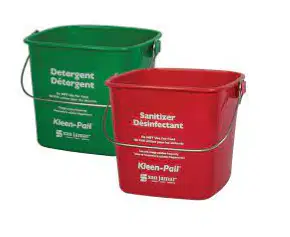
What color pail is the cleaning solution in?
green
red
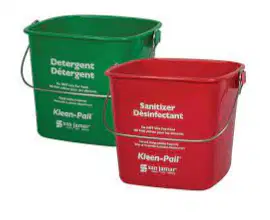
What color pail is the sanitizing solution in?
green
red

How do you measure brown sugar
Scoop into dry measuring cup and pack down
Lightly scoop into measuring cup and level with a flat edge
Scoop into liquid measuring cup and pat down
You don't need to measure it just estimate
When looking at a recipe, the capital T stands for
teaspoon
1/4 teaspoon
1/2 teaspoon
Tablespoon
What would you use to measure 1 cup of oil?
Dry measuring cup
A ladle
Liquid measuring cup
Measuring spoons
What is the process used to measure flour?
Scoop into a dry measuring cup and then spoon ingredients into the mixing bowl
Spoon into the correct dry measuring cup, pack, then level it off with a straight edge. Use rubber scraper to scoop out ingredients
Pour into a liquid measuring cup and then read it at eye level
Lightly spoon into dry measuring cup and level off with straight edge of knife. Do not move or shake cup.
Which of the following is a sign that muffins have been overmixed?
Moist crumb
Evenly rounded tops
Light and fluffy texture
Tough texture and peaked tops
Which ingredient acts as a leavener in quick breads?
Butter
Salt
Milk
Baking powder