
 Worksheets
Fall Semester ~ Science Test ~ 2024
Total questions: 125
Worksheet time: 1hrs 3mins
Name
Class
Date
1.
What is a wave?
a)
a movement of matter
b)
a disturbance that carries energy
c)
the process of electrons being transferred
d)
large fluctuations in force
2.
Type of wave that requires a medium to travel through?
a)
Electromagnetic
b)
Mechanical
3.
Why do waves move fastest through solid mediums?
a)
because the particles are moving faster
b)
because the particles are moving slower
c)
because the particles are closer together
d)
because the particles are farther apart
4.

What property of a wave is represented by letter A?
a)
Wavelength
b)
Amplitude
c)
Speed
d)
Frequency
5.

What property of a wave is represented by letter B?
a)
Wavelength
b)
Amplitude
c)
Trough
d)
Frequency
6.

What property of a wave is represented by letter C and is measured per second?
a)
Amplitude
b)
Speed
c)
Frequency
d)
crest
7.

What part of a wave is represented by letter D?
a)
Crest
b)
Compression
c)
Rarefaction
d)
Trough
8.

What part of a wave is represented by letter E?
a)
Crest
b)
Compression
c)
Rarefaction
d)
Trough
9.
Which of the following can act as a medium for a wave?
a)
Sound and Light
b)
Water
c)
Air
d)
Solids, liquids, and gases
10.
When the frequency of a wave decreases .
a)
the wavelength increases.
b)
the wavelength decreases.
c)
the wavelength increases and then decreases.
d)
the wavelength remains the same.
11.
Mechanical waves can travel through empty space and do not require a medium through which to travel.
a)
True
b)
False
12.
A transverse wave moves the medium perpendicular (right angle) to the direction in which the wave travels.
a)
True
b)
False
13.
As amplitude increases, energy increases.
a)
True
b)
False
14.
In transverse waves, what is the distance between 2 consecutive crests or 2 troughs?
a)
amplitude
b)
wavelength
c)
crest
d)
trough
15.
What is the unit of measurement for wavelength?
a)
Decibels
b)
Meters
c)
Hertz
d)
Meters/Seconds
16.
The number of complete wavelengths that pass a point in a given time (1 second) is called?
a)
amplitude
b)
frequency
c)
decibels
d)
energy
17.
What is the unit of measurement for frequency?
a)
Decibels
b)
Meters
c)
Hertz
d)
Meters/Seconds
18.
What is the unit of measurement for speed/velocity?
a)
Decibels
b)
Meters
c)
Hertz
d)
Meters/Seconds
19.
A wave in which the vibration of the medium is parallel to the direction the wave travels is called?
a)
surface wave
b)
transverse wave
c)
wavelength
d)
longitudinal wave
20.
The area in a longitudinal wave in which the particles are closest together is called?
a)
crest
b)
trough
c)
rarefaction
d)
compression
21.
The area in a longitudinal wave in which the particles are farthest apart is called?
a)
crest
b)
trough
c)
rarefaction
d)
compression
22.
The highest point of a transverse wave is called?
a)
crest
b)
trough
c)
rarefaction
d)
compression
23.
The lowest point of a transverse wave is called?
a)
crest
b)
trough
c)
rarefaction
d)
compression
24.
All sound waves are what kind of waves?
a)
transverse
b)
longitudinal
c)
surface
d)
gnarly
25.
The higher the frequency, the the pitch of the sound we hear.
a)
lower
b)
higher
26.
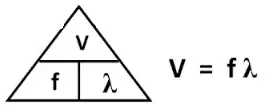
If a wave is traveling at 30 m/s and has a wavelength of 60 meters, what is its frequency?
a)
5 Hz
b)
2 Hz
c)
0.5 Hz
d)
1800 Hz
27.
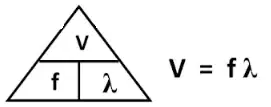
If a wave has a frequency of 0.5 Hz and a wavelength of 100 m, what is its velocity?
a)
.005 m/s
b)
200 m/s
c)
50 m/s
d)
5 m/s
28.
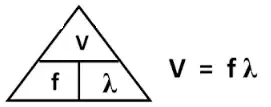
If the frequency of a wave is 110 Hz and it has a wavelength of 3 m, what is its velocity?
a)
330 m/s
b)
75 m/s
c)
330 Hz
d)
75 m
29.
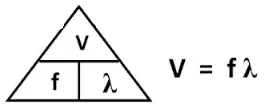
The velocity of a wave with a frequency of 20Hz and a wavelength of 10m is
a)
2 m/s
b)
200 m/s
c)
2 m
d)
200 m
30.
Waves that are continuous and transmit signals that get weaker over long distances are
a)
digital
b)
analog
31.
Waves that encode information into a series of 1's and 0's ((binary) are
a)
digital
b)
analog
32.
Which signal type is more reliable?
a)
digital
b)
analog
33.
Which signal type is more susceptible to interference?
a)
digital
b)
analog
34.
Radio waves are an example of which kind of wave?
a)
Electromagnetic
b)
Longitudinal
c)
Mechanical
d)
Transverse
35.
Sound waves can be heard in space.
a)
True
b)
False
36.
All electromagnetic waves have the same .
a)
frequency & wavelength
b)
speed and amplitude
c)
pitch and sound
d)
energy
37.
Which color of visible light has the longest wavelength?
a)
Orange
b)
Violet
c)
Red
d)
Green
38.
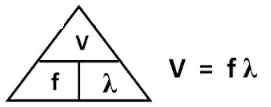
If a wave's speed is 60 m/s and it has a wavelength of 15 m, what is its frequency?
a)
900 Hz
b)
900 m
c)
4 Hz
d)
4 m/s
39.
All of the following are examples of analog signals EXCEPT?
a)
human voice speaking
b)
music from speakers
c)
fiber optics
d)
music from a guitar
40.
All of the following are examples of digital signals EXCEPT?
a)
computers
b)
CDs
c)
DVDs
d)
a dog barking
41.
The amount of inertia an object has depends on its _____.
a)
force
b)
mass
c)
friction
d)
age
42.
Which of these is measured in newtons (N)?
a)
acceleration
b)
mass
c)
momentum
d)
net force
43.
A group of students are playing tug-of-war. The students on both sides pull with EQUAL force. This is an example of:
a)
unbalanced forces
b)
balanced forces
c)
acceleration
d)
air resistance
44.
The sum of all the forces acting on an object is called the _____ force.
a)
net
b)
gravitational
c)
final
d)
inertial
45.

If the same force is applied to each of these balls, which one will have the SMALLEST acceleration?
a)
a
b)
b
c)
c
d)
d
46.
Which of the following is NOT an example of unbalanced forces acting on an object?
a)
An acorn falling from a tree, accelerating
b)
A car moving straight at 80 km/h
c)
A car changing speed from 50 km/h to 80 km/h
d)
A truck slowing down as it approaches a stop sign
47.
A person in a head-on car collision, who is not wearing a seatbelt, continues to move forward at the original speed of the car because of ____________.
a)
friction
b)
inertia
c)
gravity
d)
weight
48.
A feather will fall through the air more slowly than a brick because of _____ acting on it.
a)
gravity
b)
air resistance
c)
terminal velocity
d)
momentum
49.
The force that pulls all objects towards the Earth is called?
a)
friction
b)
gravity
c)
magnetic
d)
electrical
50.
A force that is transferred from a person or object to another object is called?
a)
applied
b)
spring
c)
friction
d)
gravity
51.
The force exerted by a compressed or stretched spring on any object that is attached to it is called?
a)
normal
b)
applied
c)
spring
d)
tension
52.
The force that pushes objects up due to the fluid pressure of a liquid is called?
a)
air resistance
b)
normal
c)
buoyancy
d)
spring
53.
The force that is transmitted through a string, rope, cable or wire when it is pulled tight is called?
a)
applied
b)
normal
c)
gravity
d)
tension
54.
The force that is created when two surfaces rub against one another is called?
a)
normal
b)
tension
c)
friction
d)
applied
55.
The force that pushes objects up when they are on a solid surface is called?
a)
normal
b)
tension
c)
friction
d)
applied
56.
A rocket's action is to push down on the ground with the force of its powerful engines. The reaction is that the ground pushes the rocket upwards with an equal force but opposite in direction. Which law best explains this event?
a)
The Universal Law of Gravity
b)
Newton's 1st Law of Motion
c)
Newton's 2nd Law of Motion
d)
Newton's 3rd Law of Motion
57.

While driving down the road a firefly hits the windshield of a bus. This makes a big mess on the glass. This is certainly an example of Newton's Third Law of Motion, but which object has the greater force when the firefly hit? The firefly hit the bus and the bus hit the firefly back. Which of the two forces is greater: the force on the firefly or the force on the bus?
a)
The force is equal for the firefly and the bus because of Newton's Third Law of Motion
b)
The force of the firefly is greater because it was moving faster than the bus
c)
The firefly has so little mass, it has no force
d)
The force of the bus is greater because it has more mass
58.
What is Newton's Third Law of Motion?
a)
Force = mass x acceleration
b)
Same as the law of inertia
c)
For every action, there is an equal and opposite reaction
d)
An object at rest stays at rest unless acted on by an unbalanced force
59.
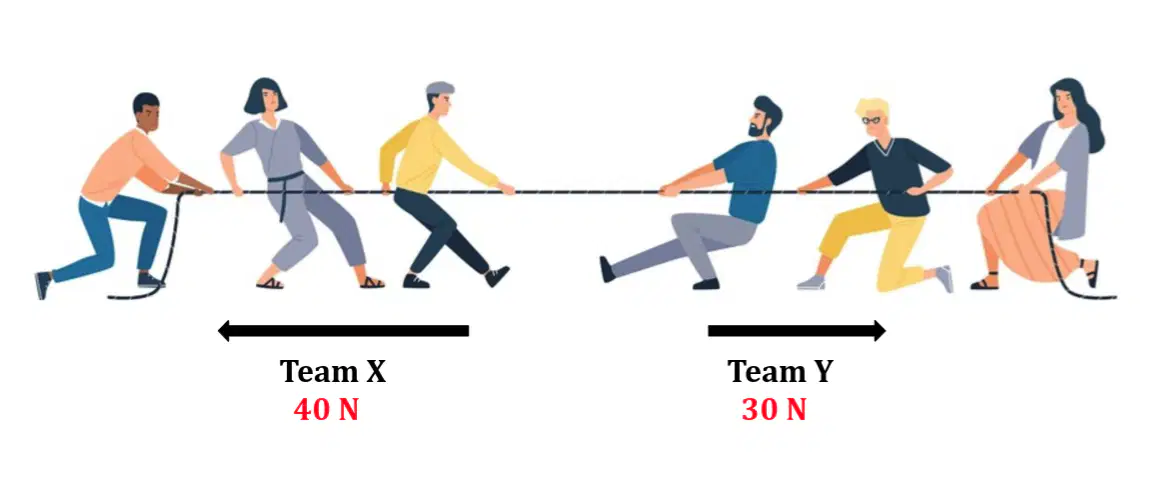
In the image below, two teams are playing tug of war. The arrows and their labels demonstrate the strength and direction of each team's pull force. What can be concluded based on the diagram?
a)
The rope will not move
b)
The rope will not be acted on by friction
c)
The rope will move toward team X
d)
The rope will move toward team Y
60.
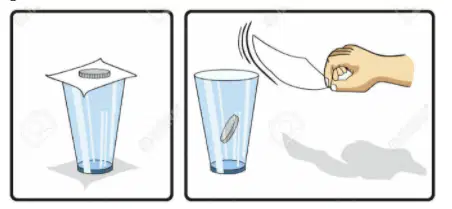
5. Which of the following options BEST applies Newton’s First Law of Motion the image below?
a)
The coin started off in motion until an unbalanced force force caused it to stop
b)
The coin started off in motion until a balanced force caused it to stop
c)
The coin started off at rest until an unbalanced force caused it to move
d)
The coin started off at rest until a balanced force caused it to move
61.
An object's speed or direction will not change unless it is acted on by a(n)?
a)
Strong force
b)
Unbalanced force
c)
Balanced force
d)
Pull force
62.
The tendency of an object at rest to stay at rest (or an object in motion to stay in motion) is known as?
a)
velocity
b)
gravity
c)
acceleration
d)
inertia
63.
A force is described as a .
a)
back and a forth
b)
pull only
c)
push or pull
d)
push only
64.
A notebook is placed on a table. Two students both reach for and pull the notebook. Student A pulls to the left with 70 N. Student B pulls to the right with 50 N. What is the net force on the notebook?
a)
20 N to the left
b)
20 N to the right
c)
220 N total
d)
60 N to the left
65.
This force of attraction exists between objects in the universe. We are pulled downward to Earth. This force is known as?
a)
electromagnetism
b)
friction
c)
strong
d)
gravity
66.
A baseball is thrown into the air. As it falls to the ground, what forces are acting on the ball?
a)
air resistance and gravity
b)
gravity only
c)
air resistance only
d)
air resistance and normal
67.
Objects at rest tend to stay at rest. This is described by?
a)
Newton's First Law of Motion
b)
Newton's Second Law of Motion
c)
Newton's Third Law of Motion
d)
Newton's Laws of Acceleration
68.
Force equals mass multiplied by _________________. This equation describes Newton's ____________ Law of Motion.
a)
speed; second
b)
velocity; third
c)
acceleration; second
d)
acceleration; third
69.
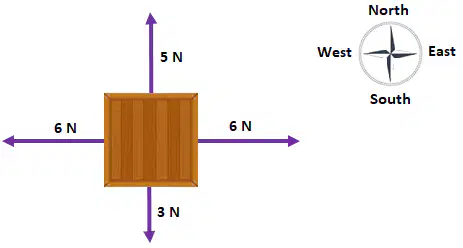
The arrows in this diagram represent the sizes of forces acting on a stationary box. What will happen to the box?
a)
move north
b)
move south
c)
will not move
d)
move west
70.
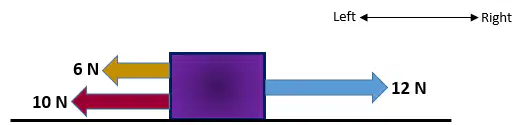
The diagram shows forces acting on a box. Which of the following statements is NOT CORRECT about the diagram.
a)
The magnitude of the net force is 4 N.
b)
The directions of the net force is to the left.
c)
The forces on the box are balanced.
d)
The forces on the box are unbalanced.
71.
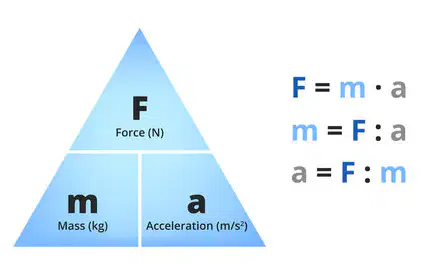
If the mass of an object is 300 kg and the applied force is 3,600 N, what is the acceleration?
a)
1,080,000 m/s/s
b)
12 m/s/s
c)
0.083 m/s/s
d)
3,600 m/s/s
72.
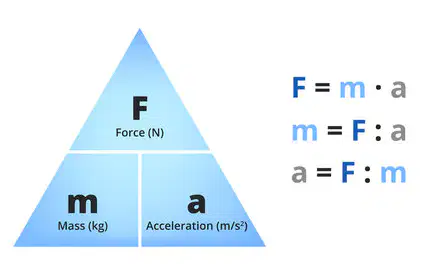
If the acceleration is 500 m/s/s and the mass is 200 kg, what is the force?
a)
2.5 N
b)
3 N
c)
200 N
d)
100,000 N
73.
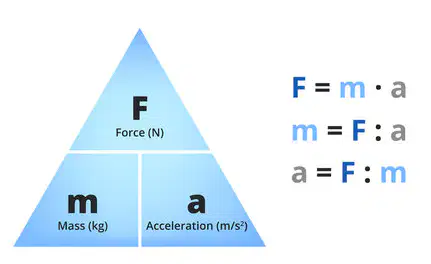
If the force is 1,500 N and the acceleration is 500 m/s/s, what is the mass?
a)
750,000 kg
b)
1.5 kg
c)
3 kg
d)
5,000 kg
74.
An object can still be in motion if the net force acting on it is zero.
a)
True
b)
False
75.
Which of the following is true about mass and weight?
a)
Mass and weight are the same thing
b)
Mass changes when gravity changes but weight stays the same
c)
Weight changes when gravity changes, but mass stays the same
d)
Both mass and weight change when gravity changes
76.
You would weigh less on Uranus than you do on Earth. Uranus has more mass than the Earth, so why is the force of gravity lower?
a)
Uranus has a much smaller radius so you are closer to the center of mass
b)
Uranus has a much larger radius so you are much farther to the center of mass
c)
Uranus has the same radius as Earth
77.
Which scientist wrote the laws of gravity in the 1600s?
a)
Darwin
b)
Newton
c)
Nye
d)
Pasteur
78.
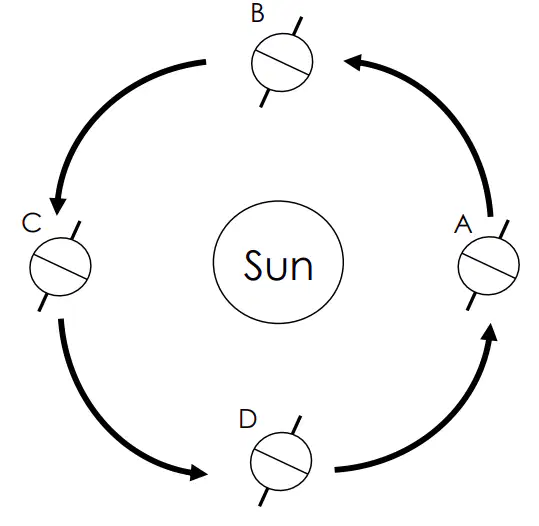
Which label corresponds with winter in the Northern Hemisphere?
a)
A
b)
B
c)
C
d)
D
79.
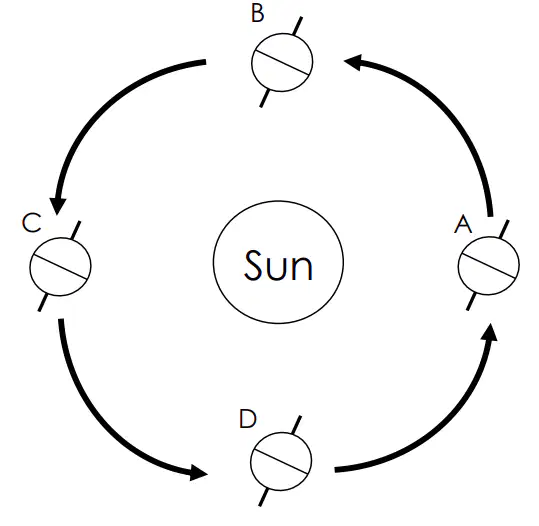
Which label corresponds with fall in the Northern Hemisphere?
a)
A
b)
B
c)
C
d)
D
80.
Which best describes spring in the Northern Hemisphere?
a)
Northern Hemisphere is tilted away from the Sun.
b)
Northern Hemisphere receives the most direct sunlight.
c)
South Pole receives constant sunlight.
d)
Equal length of day and night.
81.
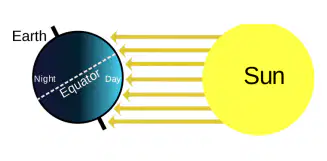
Two students are trying to understand this diagram. Here is what they think:
Jose: It is winter in the Southern Hemisphere because the equator points away from the Sun.
Darlene: It is summer in the Southern Hemisphere because it receives more direct sunlight.
a)
Jose
b)
Darlene
c)
both students
d)
neither student
82.
The time it takes a planet to go around the sun is its
a)
Orbital radius
b)
Orbital period
c)
day
d)
orbital velocity
83.
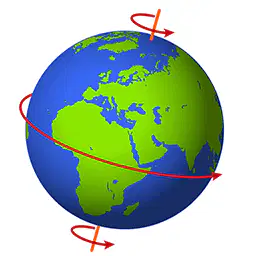
The spinning motion of a planet on its axis is called?
a)
Rotation
b)
Revolution
c)
orbital period
d)
orbital radius
84.
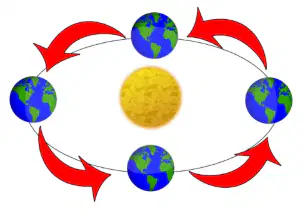
The orbital motion of an object around another object is called?
a)
Rotation
b)
Revolution
c)
orbital period
d)
orbital radius
85.

Which planet has the shortest orbital period?
a)
Mercury
b)
Earth
c)
Mars
d)
Neptune
86.

Which planet has the longest orbital radius?
a)
Mercury
b)
Earth
c)
Mars
d)
Neptune
87.
As you move farther away from the sun, how does the orbital period change?
a)
It doesn't change
b)
it gets longer
c)
it gets shorter
88.
As you move farther away from the sun, how does the orbital speed change?
a)
The orbital speed stays the same
b)
The orbital speed gets faster
c)
The orbital speed gets slower
89.
The sun's gravity keeps the planets in orbit. How does the force of the sun's gravitation pull change as you move away from the sun?
a)
It gets stronger
b)
it gets weaker
c)
It doesn't change
90.
True or False - The moon makes its own light.
a)
True
b)
False
91.
What term is used to describe the phases of the moon that appear to be getting bigger?
a)
Waxing
b)
Waning
92.
You are standing outside looking up at the sky. You remember just a few nights ago there was a New Moon, and you couldn't see anything. What kind of moon do you think you are looking at now?
a)
Waxing Gibbous
b)
Waxing Crescent
c)
Full Moon
d)
Waning Gibbous
93.
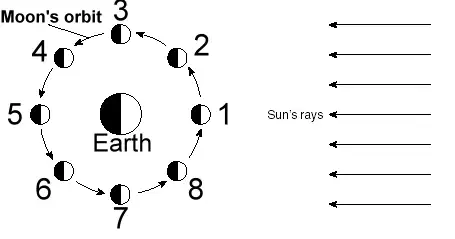
Which moon phase do we see at position 5?
a)
New moon
b)
1st quarter
c)
Full Moon
d)
3rd quarter
94.
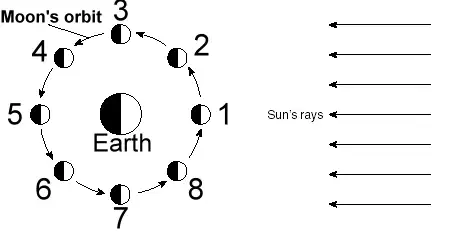
What moon phase do we see at position 8?
a)
New Moon
b)
Waxing Crescent
c)
Waning Gibbous
d)
Waning Crescent
95.
What does the moon orbit around?
a)
The sun
b)
nothing
c)
its moon
d)
Earth
96.
How long does a lunar cycle take?
a)
1 day
b)
28 days
c)
365 days
d)
28 months
97.
What is the only phase of the moon that will cause a solar eclipse?
a)
Full
b)
New
c)
1st quarter
d)
3rd quarter
98.
When a solar eclipse occurs, which of the following is true?
a)
The sun moves between the moon and the earth.
b)
The earth moves between the moon and the sun.
c)
The moon moves between the sun and the earth.
99.
Which phase of the moon can experience a lunar eclipse?
a)
Full moon
b)
New moon
c)
1st quarter
d)
3rd quarter
100.
The force of gravity on an object is the object's
a)
Force
b)
Gravity
c)
Weight
d)
Intertia
101.
The attractive force between all objects in the universe
a)
Force
b)
Gravity
c)
Weight
d)
Inertia
102.
The path a planet follows as it moves around the sun
a)
Orbit
b)
Rotation
c)
Axis
d)
Revolution
103.
Two factors that affect the force of gravity between two objects are
a)
weight and mass
b)
mass and speed
c)
mass and distance
d)
weight and speed
104.
The force of gravity would _______ if the sun got bigger
a)
Incresase
b)
Decrease
c)
Stay the same
105.
If you went to Jupiter, your mass would
a)
Increase
b)
decrease
c)
stay the same
106.
If you went to the moon, your weight would
a)
Increase
b)
Decrease
c)
Stay the same
107.
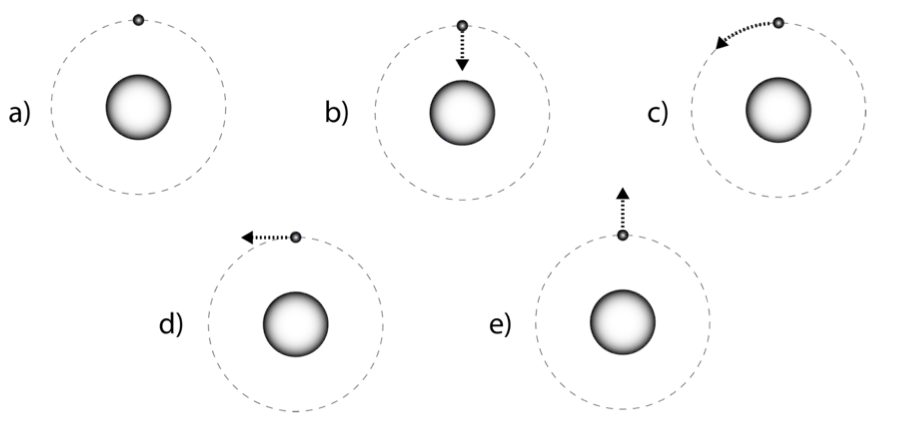
Which picture shows what would happen if the force of gravity between the sun and earth were turned off?
a)
a
b)
b
c)
c
d)
d
108.
Gravity pulls everything toward
a)
The ground
b)
the moon
c)
The center of a mass
d)
the sun
109.
Any object with mass has gravity.
a)
True
b)
False
c)
It depends
110.
The gravity of the is the biggest factor in determining the ocean tides.
a)
the Sun
b)
the Moon
c)
Earth
d)
the planets
111.
When the Sun, Earth, and the Moon are aligned in a straight line, Earth's oceans will experience which tide?
a)
neap
b)
fall
c)
spring
d)
solar
112.
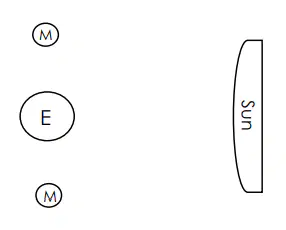
Which of the following represents a phase the Moon is in when at these positions?
a)
new moon
b)
first quarter
c)
waning gibbous
d)
full moon
113.
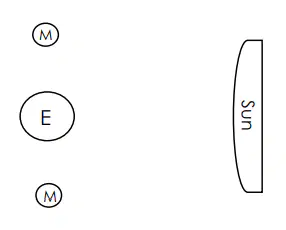
What type of tides would Earth experience during these moon phases?
a)
neap
b)
fall
c)
spring
d)
solar
114.
Since the Earth rotates, all areas near an ocean will experience two high tides and two low tides approximately once every ____ hours.
a)
6
b)
8
c)
12
d)
24
115.
Which statement does NOT true about the inner planets?
a)
They are made mostly of rock.
b)
They are the smallest four planets.
c)
They have a longer revolution.
d)
They are more dense than the other planets.
116.
Which statement does NOT true about the outer planets?
a)
They are made mostly of gas.
b)
They are the largest four planets.
c)
They are farther apart than the other planets.
d)
More is known about them than the other planets.
117.
An icy body that orbits the sun:_________
a)
asteroid
b)
moon
c)
meteor
d)
comet
118.
Which of the following is NOT a characteristic of comets?
a)
has a nucleus, coma, and a tail
b)
orbits around the Sun
c)
tail points toward the Sun
d)
sometimes called a "dirty snowball"
119.
What is the solar wind?
a)
The solar wind a material that sprays off the tail of a comet.
b)
The solar wind is a breeze from the sun.
c)
The solar wind is the hot wind we feel in the summer.
d)
The solar wind is the charged particles ejected from the sun.
120.
How does solar wind impact comets?
a)
Solar wind is frozen ice that crashes into comets knocking them off course.
b)
Solar wind pushes the particles coming off the comet away from the sun.
c)
The solar wind cools comets down so they don't explode.
d)
Solar wind is a myth. It has no impact on comets.
121.
What is a small-bodied object in the solar system that is an irregularly-shaped rock mainly found between Mars and Jupiter?
a)
comet
b)
asteroid
c)
meteor
d)
moon
122.
Why do meteors burn up in the atmosphere? ___________
a)
Meteors crash into each other breaking them into tiny pieces that burn up easily.
b)
Meteors shower down causing the atmosphere to heat up and set them ablaze in the sky. .
c)
Meteors burn up from friction as they speed through Earth's atmosphere.
d)
Meteors don't burn up in the atmosphere, they melt because they are made of ice.
123.
When a meteor hits the surface of a planet and is no longer moving it is called?
a)
comet
b)
asteroid
c)
meteorite
d)
meteoroid
124.
When a meteor hits the surface of a planet and is no longer moving it is called?
a)
comet
b)
asteroid
c)
meteorite
d)
meteoroid
125.
Comets, asteroids, meteors, and meteorites all orbit the Sun.
a)
True
b)
False
100 %