
 Worksheets
Fuel and Polymer
Total questions: 20
Worksheet time: 15mins
Which two elements do all organic compounds contain?
Carbon and hydrogen
Carbon and oxygen
Oxygen and hydrogen
Carbon and nitrogen
Which one of the following characteristics is not correct for all of the members of the same homologous series?
Same general formula
Similar chemical properties, i.e. undergo the same reactions
Varying physical properties, i.e. change in a predictable way
Different functional group

How does the temperature change from top to bottom in the fractional distillation column?
What process is used to separate crude oil in hydrocarbons with different chain lengths?
distillation
fractional distillation
cracking
polymerisation
Used in gas cooker
kerosene
fuel oil
bitumen
refinery gas
For surfacing roads
bitumen
refinery gas
petroleum
diesel
Homologous series ?
Heptane
Metylhexena
Butane
Propene
Polymers are made of
Acids
Hydrogen
Carbons
Monomers
Most of the polymers around us are made up of a __________
Hydrocarbons
Hydrocarbon backbone
Carbon
Hydrogen
What is the classification of polymer based on Polymerisation
Linear,branched, crosslinked
Addition, condensation
Natural, synthetic
Homomer, co-polymer
Which repeat unit would be formed by the polymerisation of propene?


What monomer forms this polymer chain?


A fraction of crude oil is made up of:
Hydrocarbons of similar chain lengths
Numbers
Large hydrocarbons
Alkenes only
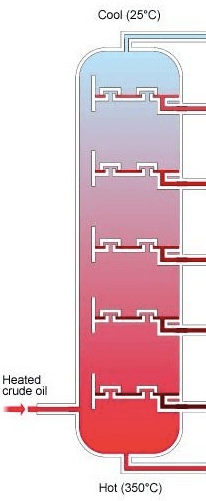
What process happens at each level in the fractionating column?
Evaporation
Condensation
Combustion

Where do long chain hydrocarbons collect?
At the top
In the middle
At the bottom

Where do short chain hydrocarbons collect?
At the top
In the middle
At the bottom

