
Font size
 Worksheets
CRID 34-2/Mandell 274: Malaria+Protozoa
Total questions: 28
Worksheet time: 22mins
Which mosquito carries malaria?
Aedes
Culex
Anopheles
all of them
These Plasmodium species have dormant hypnozoite phase
P. falciparum
P. ovale
P. vivax
P. malariae
The infective form of malaria is the
Gametocyte
Sporozoite
Schizont
Trophozoite
Match the fever patterns
falciparum
"Q48"
vivax/ovale
Q48
malariae
Q72
knowlesi
Q24
Morphology buzzwords to know
Banana shaped gametocyte
P. falciparum
Banded or basket trophozoite, "rosette"
P. malariae
Double chromatin dot ring form
P. knowelsi
"spikey" RBC's
P. ovale
Enlarged/old RBC, amoeboid trophozoite
P. vivax
28-year-old pregnant patient comes to you to discuss malaria prophylaxis. She wants to go home to Nicaragua for 10 days to visit family. Last time she went, she had to take prophylaxis for 4 weeks after she got back. She wants to know if there is a different medication she can take for a shorter duration of time when she gets back?
Mefloquine
Chloroquine
Atovaquone-proguanil
No options :(
32 year old female from Liberia presents to the ED with a fever and headache. She arrived to the US from Africa about 1 week ago. She is febrile to 101F with HR 110 but otherwise stable, on room air. She is alert & oriented x3, neuro exam normal, BMP normal, CBC with Hgb 9, normal bilirubin.
She is diaphoretic but non-toxic appearing, tachycardic, but lungs CTA bilaterally, no evidence of bleeding. The ED screened her for malaria, the rapid test came back positive for P. falciparum. Parasitemia is 7%. What treatment do you recommend in addition to supportive care? Patient is tolerating PO and you are at a magic hospital with a pharmacy that has everything you could ever want.
Hydroxychloroquine
Doxycycline
PO Artemether + lumefantrine is given twice a day for 3 days
IV Artemether + lumefantrine is given twice a day for 3 days
A 57-year-old man was admitted with new onset confusion and a 2-day history of fevers. The fevers began during his return home from a month-long safari in South Africa. He was found to have severe P. falciparum malaria and treated with IV artesunate with significant improvement. Ten days later, he developed a sudden drop in hemoglobin and rise in bilirubin.
Delayed postartesunate hemolysis
Persistent/relapsed malaria
GIB
Medication toxicity
25-year-old male from Benin presents for malaria evaluation. He is found to have P vivax with parasitemia of 2%. His G6PD testing shows deficiency. What do you do for treatment?
Chloroquine x3 days + primaquine x14 days
Chloroquine x3 days then weekly for 1 year
Chloroquine x3 days
Artemether-lumefantrine x3 days
32-year-old male from Myanmar comes to the ED for headache and AMS. He is febrile to 102F, tachycardic to 115, BP 97/78 and hypoxic requiring 3LNC. He is disoriented on exam and has a seizure in the ED. Hgb 6.5, Cr 2.3 and urine appears reddish brown, TBili 2.1, glucose is 98. his initial malaria test is positive for P. falciparum with a parasitemia of 8%. What do you recommend starting?Again, you have access to anything and everything you need pharm-wise
IV artesunate
IV artesunate + IV quinine + primiquine x1
Artemether-lumefantrine
Atovaquone-proguanil
If a patient has a history of epilepsy, which malaria prophylaxis should NOT be used?
Atovaquone-proguanil
Mefloquine
Doxycycline
Chloroquine
A pregnant patient is diagnosed with uncomplicated malaria P. falciparum. She is from an area with chloroquine resistance and is in her first trimester of pregnancy. Can you use artemether-lumefantrine?
Yes!
No!
Is exchange transfusion recommended for malaria?
Only in severe cases
No
Don’t know
Match the following free living ameobas to their buzzwords
Acanthamoeba
Necrotic skin lesions, keratitis
Balamuthia
Facial skin lesions, brain abscess
Naegleria
Warm water, more rapid progression
Acanthamoeba and Naegleria
Leaves clear tracks on GI bacterial lawn
Match the following vectors to diseases
Tsetse/glossina fly
African trypanosoma
Triatomine insects
Chagas
Sand fly
Leishmania
Black/simulium fly
Onchocerciasis
Deer/chrysops fly
Loaloa
This African trypanosomiasis is characterized by fever, headache, lymphadenopathy, hepatosplenomegaly, and endocrine disorders over a longer time course (can be over the course of months to years)/
Trypanosoma brucei gambiense
Trypanosoma brucei rhodesiense

A 30-year-old man presents with 3 days of watery diarrhea, abdominal cramps, and nausea after returning from a backpacking trip in Mexico 2 weeks ago. Stool O&P reveals the following (see image). What is the most likely cause of this patient's symptoms?
Entamoeba histolytica
Giardia duodenalis
Cryptosporidium parvum
Cyclospora cayetanensis
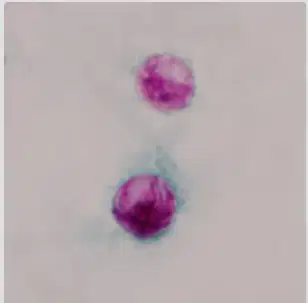
A 25-year-old female presents with explosive, watery diarrhea, abdominal bloating, and nausea. A week ago she ate raspberries out of season. Stool microscopy with a modified acid-fast stain reveals spherical oocysts (7.5-10 micrometer diameter). What is the most likely cause of her infection?
Cryptosporidium parvum
Cystoisospora belli
Cyclospora cayetanensis
Entamoeba histolytica

A 60-year-old male with HIV (CD4 count 100) presents with chronic, watery diarrhea for the past 3 weeks. His stool sample shows oocysts on modified acid stain (4.2-5.4 micrometers). What is the most likely diagnosis?
Giardia duodenalis
Cryptosporidium parvum
Cyclospora cayetanensis
Cystoisospora belli
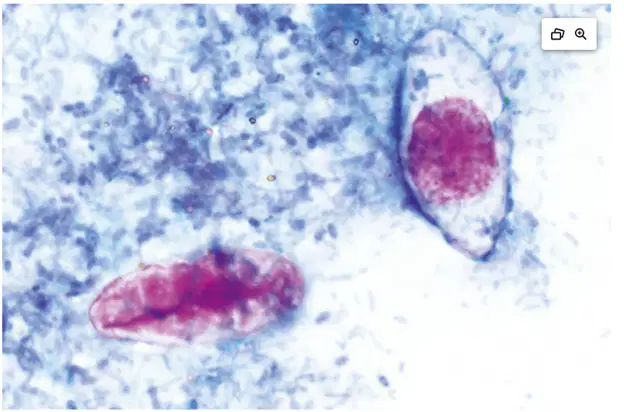
A 40-year-old man presents with watery diarrhea, weight loss, and malaise following a trip to Southeast Asia. Stool microscopy shows large oocysts with a modified acid-fast stain (25-30 micrometers in diameter). Choose treatment options for his infection below (multiple correct answers).
Supportive care
TMP-SMX
Metronidazole
Ciprofloxacin
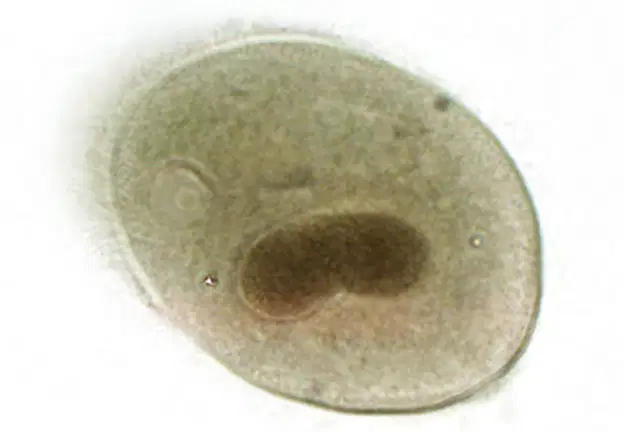
A 45-year-old man from a rural area in the tropics presents with watery diarrhea, abdominal cramping, and occasional blood in the stool. He reports a history of working with pigs. Stool examination reveals large ciliated protozoa with a kidney-shaped macronucleus. Which of the following is the most likely causative organism?
Entamoeba histolytica
Giardia lamblia
Neobalantidium coli
Cyclospora cayetanensis
Which of the following is the most likely outcome of an untreated Neobalantidium coli infection in a small subset of patients?
Colonic perforation
Extra-intestinal spread to the liver
Severe malabsorption
Meningitis
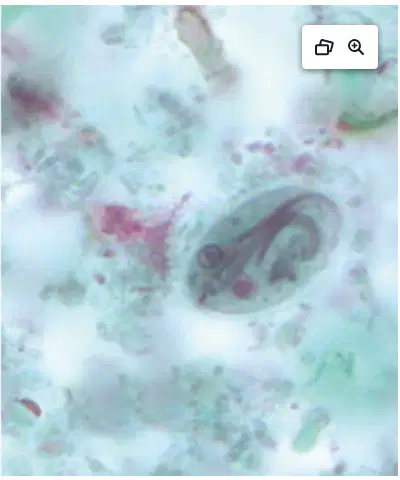
A 25-year-old man presents with a 4-week history of intermittent diarrhea, abdominal bloating, and weight loss. He also reports frequent flatulence and malaise. His history reveals that he had a camping trip in a remote area, where he drank water from a lake. Stool examination is as pictured. What is the most appropriate treatment?
Supportive care
Azithromycin
TMP-SMX
Metronidazole
Match the following
Blastocystis
Rarely pathogenic, look for other causes
Dientamoeba fragilis
Possibly transmitted via helminth eggs
Microsporidia
Can disseminate in immunocompromised
Match the following
Giardia
Untreated fresh water
Cyclospora
Foodborne outbreak
Neobalantidium
Exposure to pig feces
Entamoeba histolytica
Dysentery
Order from most to least common cause of diarrhea in returning traveler.
Giardiasis
Amebiasis
Campylobacter
Shigella
Salmonella
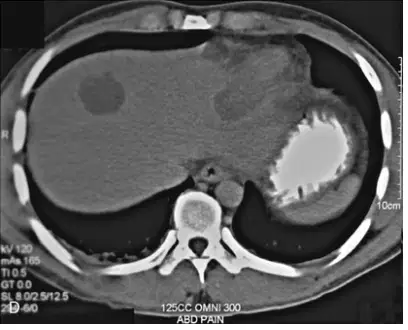
A 35 yo M from Mexico presents with fever, leukocytosis and RUQ abdominal pain. Imaging findings as shown. What is the best next step in management?
Stool O&P
Stool antigen testing
Serum antigen testing
Empiric paromomycin
A 55 yo F has incidental finding of E. histolytica on colon biopsy from screening colonoscopy. She is asymptomatic. What is the next best step in management?
No treatment
Paromomycin
Metronidazole
Tinidazole

