
 Worksheets
Realism
Total questions: 12
Worksheet time: 9mins
The Barbizon School is known for being one of the exponents of Realism. Even thought they were inspired by Romanticism's search for solace in nature, the Barbizons distanced themselves from this movement's ideals. Regarding this fact, which of the following statements are TRUE about the Barbizon School?
Turned away from the melodramatic picturesqueness of established Romantic landscape painters
Used landscapes merely as a backdrop for allegory and historical narrative
Emphasized permanent features, painting solid, detailed forms in a limited range of colours
They were also concerned with mood, altering physical appearances to express what they saw as the objective “character” of the landscape
What are some characteristics of artists that belonged to the Barbizon School?
Applying wet paint onto wet paint
Completing a canvas in a single sitting
Concentrating on the effects of light on the landscape
Looser brushstrokes and a freer style than what was traditional in Academic painting
About some of the Barbizon School's artists, which statements are correct?
Rousseau’s vision was melancholy, concentrating on vast sweeps of landscape and looming trees
Dupré’s close-range, detailed scenes are suffused with foreboding
Daubigny didn't favour scenes of lush and verdant fields
Diaz painted sun-dappled forest interiors
Troyon and Jacque refused to paint placid scenes that featured livestock
Select artworks done by artists that belonged to the Barbizon School.

The Forest in Winter at Sunset, Théodore Rousseau

The Windmill, Jules Dupré

Riverbank with Fowl, Charles-François Daubigny

A Vista through Trees: Fontainebleau, Narcisse-Virgile Diaz de la Peña

Dedham Vale, John Constable
Jean-François Millet
's principal concern were peasant subjects
Periodically faced the charge of being a socialist
Fundamentally approached his subjects in a more classical sense, not as form of protest
Was influenced by both Neoclassicism and Naturalism
Camille Corot
Had peasants as his main subjects
Favoured a naturalistic treatment of the landscape, depicting its details precisely, rather than the idealising treatment of nature favoured by Neoclassicism
Had his own multifaceted approach, resulting in simple landscapes, but also figurative painting, and genre work
Was influenced by both Neoclassicism and Naturalism
Which statements are TRUE about Gustave Courbet?
Did not glorify his peasants but presented them boldly and starkly, which created a violent reaction in the art world
Was strongly opposed to idealisation in his art, and he urged other artists to instead make the commonplace and contemporary the focus of their art
Rebelled against the Romantic painting of his day, turning to everyday events for his subject matter
Was influenced by both Neoclassicism and Naturalism
Drew sharp criticism to the establishment
Which statements are TRUE about Honoré Daumier?
Did not glorify his peasants but presented them boldly and starkly, which created a violent reaction in the art world
Found his working-class heroes and heroines and his villainous lawyers and politicians in the slums and streets of Paris
Used energetic linear style, boldly accentuated realistic detail, and an almost sculptural treatment of form
Publishing caricatures critical of the monarchy
Drew satirical caricatures of French society and politics
Select examples of Jean-François Millet's artworks.

The Gleaners

The Angelus

Harvesters Resting (Ruth and Boaz)

Hagar in the Desert
Select examples of Camille Corot's artworks.
The Gleaners

Forest of Fontainebleau

The Bridge at Narni
Hagar in the Desert
Select examples of Gustave Courbet's artworks.

Burial at Ornans

The Third-Class Carriage

Young Ladies on the Banks of the Seine (Summer)
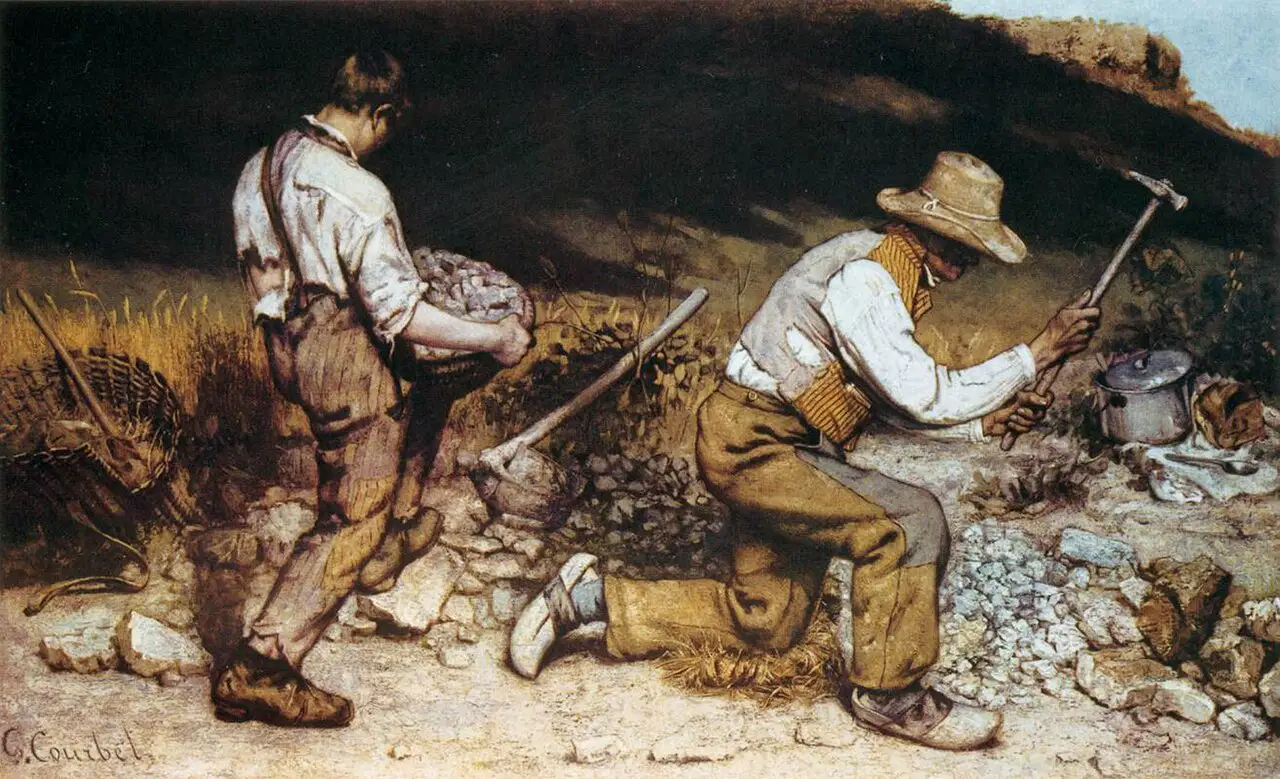
The Stone Breakers
Select examples of Honoré Daumier's artworks.
Burial at Ornans
The Third-Class Carriage

Gargantua

Rue Transnonain, le 15 Avril 1834

