
 Worksheets
First Semester Advanced Social Studies Final
Total questions: 55
Worksheet time: 28mins
Name
Class
Date
1.

Which city is located at 33 N, 112 W
a)
Phoenix
b)
Fargo
c)
Raleigh
d)
Denver
2.

What is city is located at 35 N, 78 W
a)
Boston
b)
Niagara Falls
c)
Raleigh
d)
Lincoln
3.

What city is located at 46 N, 96 W
a)
Denver
b)
Fargo
c)
Lincoln
d)
Houston
4.

What city is located at 45 N, 122 W
a)
Portland
b)
Phoenix
c)
Miami
d)
Denver
5.
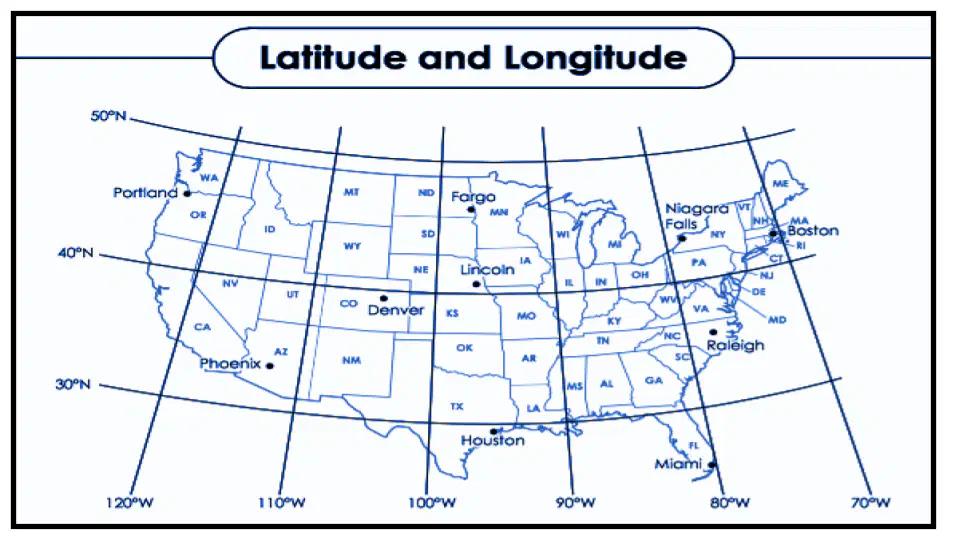
What city is located at 29 N, 95 W
a)
Phoenix
b)
Denver
c)
Miami
d)
Houston
6.
A community relies on a nearby river for drinking water, transportation, and irrigation. This is an example of humans:
a)
Movement
b)
Human Interaction
c)
Location
d)
Place
7.
A town is located at 45°N latitude and 93°W longitude. What type of location does this describe?
a)
Relative Location
b)
Absolute Location
c)
Regional Location
d)
Human-Environment Interaction
8.
A new shopping mall is built five miles west of a major highway. This is an example of:
a)
Absolute Location
b)
Relative Location
c)
Human - Environment Intervention
d)
Region
9.
Farmers in a mountainous region build terraces on the hillsides to grow crops. This is an example of humans:
a)
Movement
b)
Place
c)
Location
d)
Human - Environment Interaction
10.
The Great Plains of the United States are known for their flat terrain and agricultural production. This is an example of which theme?
a)
Human - Environment Interaction
b)
Place
c)
Location
d)
Region
11.
A city builds levees to prevent flooding during heavy rains. This is an example of:
a)
Human - Environment Interaction
b)
Region
c)
Place
d)
Movement
12.
A city is known for its tall skyscrapers, busy streets, and iconic yellow taxis. This is an example of__________
a)
Location
b)
Place
c)
Region
d)
Movement
13.
A tropical island has white sandy beaches, coral reefs, and palm trees. This is an example of:
a)
Location
b)
Region
c)
Place
d)
Human - Environment Interaction
14.
A tourist asks for directions to a museum, and you reply, "It's two blocks north of the park." What type of location are you describing?
a)
Absolute
b)
Physical
c)
Relative
d)
Regional
15.
A group of countries in the Middle East share a similar desert climate and predominantly speak Arabic. This is an example of a:
a)
Region
b)
Human - Environment Interaction
c)
Movement
d)
Absolute Location
16.
A large urban area includes the city center and its surrounding suburbs that rely on it for jobs and services. This is an example of a:
a)
Location
b)
Region
c)
Culture
d)
Place
17.
A country imports bananas from tropical regions and exports technology to other countries. This is an example of:
a)
Relative Location
b)
Movement
c)
Human-Environment Interaction
d)
Place
18.
An outbreak of a new disease spreads rapidly through international travel. This is an example of:
a)
Place
b)
Movement
c)
Region
d)
Location
19.
A small village is famous for its unique traditional dance and local cuisine. This is an example of?
a)
Place
b)
Region
c)
Movement
d)
Human - Environment Interaction
20.
New ideas about green energy spread globally through online articles and videos. This is an example of?
a)
Region
b)
Place
c)
Movement
d)
Location
21.
Why do scientists believe that early humans crossed from Asia to North America?
a)
Following herds of animals
b)
Looking for new farm land
c)
Escaping natural disasters
d)
Looking for other civilizations
22.
What was the Bering Land Bridge?
a)
A river that connected two continents.
b)
A land bridge that connected Asia and North America.
c)
A mountain range separating two continents.
d)
An ocean route used by early humans.
23.
What role did the Ice Age play in the migration of early humans?
a)
It lowered sea levels, making the land bridge accessible.
b)
It created a barrier between the continents.
c)
It allowed humans to travel by boat.
d)
It caused the extinction of many animals.
24.
How long ago do scientists believe early humans crossed the Bering Land Bridge?
a)
5,000 years ago
b)
12,000 years ago
c)
100,000 years ago
d)
50,000 years ago
25.
What is one reason why early humans might have crossed the land bridge?
a)
To escape severe weather conditions
b)
To trade with other groups
c)
To follow animals for hunting and food
d)
To build new civilizations
26.
Where was the Aztec capital city, Tenochtitlán, located?
a)
In the Andes Mountains
b)
On an island in Lake Texcoco
c)
On the coast of the Pacific Ocean
d)
In the Valley of the Nile
27.
What was one of the key farming techniques used by the Aztecs?
a)
Crop rotation
b)
Terrace farming
c)
Chinampas (floating gardens)
d)
Slash-and-burn agriculture
28.
What was the social structure of the Aztec civilization?
a)
Emperors at the bottom, commoners at the top
b)
Priests, warriors, and nobles were at the bottom
c)
Emperors at the top, followed by nobles, priests, warriors, and commoners
d)
There were no social divisions in Aztec society
29.
Why did the Aztecs practice human sacrifice?
a)
To honor their emperor
b)
To make their warriors stronger
c)
To appease their gods
d)
To celebrate harvest festivals
30.
Which of the following best describes Tenochtitlán?
a)
A small village
b)
A large, impressive city with temples and canals
c)
A military fort
d)
A center for trade with Europe
31.
Where was the Inca Empire located?
a)
In Central America
b)
In the Andes Mountains of South America
c)
In the Valley of Mexico
d)
Along the Mississippi River
32.
What was the role of the Sapa Inca?
a)
A military leader
b)
The emperor, considered a living god
c)
A priest who performed religious ceremonies
d)
A trader who handled goods in the markets
33.
What farming technique did the Incas use in the mountains?
a)
rrigation from rivers
b)
Terrace farming
c)
Crop rotation
d)
Chinampas
34.
How did the Inca keep records?
a)
By writing on paper
b)
Using quipus (knotted strings)
c)
Carving symbols on stone tablets
d)
Keeping oral histories
35.
Which of the following best describes the Inca Empire’s road system?
a)
A series of trade routes connecting neighboring towns
b)
A massive network of roads connecting the empire
c)
A series of roads primarily for military use
d)
A small network for religious pilgrims only
36.
How did the Iroquois adapt to their environment?
a)
They built longhouses and farmed corn, beans, and squash.
b)
They built tipis and followed the buffalo herds.
c)
They developed irrigation systems for farming in the desert.
d)
They built igloos and hunted sea animals.
37.
What was a key feature of the Sioux and Cheyenne's way of life?
a)
They lived in large cities.
b)
They were primarily farmers.
c)
They followed buffalo herds and lived in tipis.
d)
They built adobe homes in desert areas.
38.
Why did the Hopi and Zuni build adobe homes?
a)
To stay warm in cold climates
b)
To stay cool in hot, desert climates
c)
To use the natural resources available to them in the forest
d)
To follow buffalo herds
39.
What farming techniques did the Southwest tribes, like the Hopi and Zuni, use to adapt to their environment?
a)
Slash-and-burn farming
b)
Terrace farming
c)
Irrigation to water crops
d)
Crop rotation in small gardens
40.
What is the benefit of the "Three Sisters" farming technique?
a)
It helps plants grow independently of each other.
b)
Corn provides shade for beans and squash.
c)
Corn supports beans, beans enrich the soil, and squash helps prevent weeds.
d)
It increases the amount of space available for farming.
41.
Trade Routes that connected the Middle East, Northern Africa, and Europe to India and China
a)
The Renaissance
b)
The Protestant Reformation
c)
The Bubonic Plague
d)
Silk Road
e)
Conquistador
42.
This time period in Europe translates to "Rebirth" in French.
a)
The Renaissance
b)
The Protestant Reformation
c)
The Bubonic Plague
d)
Silk Road
e)
Conquistador
43.
Spanish explorers who were sent to Conquer the new land claims in North & South America.
a)
The Renaissance
b)
The Protestant Reformation
c)
The Bubonic Plague
d)
Silk Road
e)
Conquistador
44.
Led by Martin Luther, this religious movement weakened the power of the Pope and the Catholic Church in Europe.
a)
The Renaissance
b)
The Protestant Reformation
c)
The Bubonic Plague
d)
Silk Road
e)
Conquistador
45.
This disease, caused by a virus, decimated the populations of Asia and Europe.
a)
The Renaissance
b)
The Protestant Reformation
c)
The Bubonic Plague
d)
Silk Road
e)
Conquistador
46.
This Portuguese noble is sometimes referred to as "The Navigator," even though he didn't do any actual exploring.
a)
Prince Henry
b)
King Henry
c)
Marco Polo
d)
Christopher Columbus
e)
Hernan Cortez
47.
This Italian born explorer was inspired by Marco Polo's story to seek a new trade route to India when he discovered North & South America.
a)
Prince Henry
b)
King Henry
c)
Marco Polo
d)
Christopher Columbus
e)
Hernan Cortez
48.
This English noble was known for marital troubles which led to his creation of the Church of England.
a)
Prince Henry
b)
King Henry
c)
Marco Polo
d)
Christopher Columbus
e)
Hernan Cortez
49.
This explorer traveled the Silk Road to China and then wrote famous stories about it.
a)
Prince Henry
b)
King Henry
c)
Marco Polo
d)
Christopher Columbus
e)
Hernan Cortez
50.
This Spanish explorer famously conquered the Aztec civilization.
a)
Prince Henry
b)
King Henry
c)
Marco Polo
d)
Christopher Columbus
e)
Hernan Cortez
51.
Farming system implemented by the Spanish in North & South America that focuses on cash crops grown using slave labor.
a)
Missions
b)
Plantations
c)
Slave Trade
d)
Conquest
52.
Small Spanish towns build throughout North America to build relationships with Native Americans and teach them about Christianity.
a)
Presidios
b)
Plantations
c)
Missions
d)
Forts
53.
Canadian city built by the French after the Age of Exploration on the St. Lawrence River that translates to the Royal Mountain.
a)
Ontario
b)
New York
c)
Montreal
d)
St. Augustine
54.
The crew of this explorer became the first people to Circumnavigate the earth after exploring the Pacific Ocean for Spain.
a)
Ferdinand Magellan
b)
Christopher Columbus
c)
Amerigo Vespucci
d)
Henry Hudson
55.
This Spanish explorer searched Florida for the Fountain of Youth and built St. Augustine.
a)
Hernan Cortes
b)
Ponce de Leon
c)
Hernando de Soto
d)
Juan de Onate
100 %

