
Font size
 Worksheets
Semester1 Biology Final Exam Quarter 1 Part 1 topics
Total questions: 20
Worksheet time: 18mins
Organize the Biomolecule Functions and examples into the right categories
Provide energy, quick form
Cell wall, cell membrane
Long term energy storage
Structural, transport molecules, enzymes, hormones, antibodies
Contains/store genetic info. for cell processes; instructions to make proteins
Cell Membrane only
Cell membrane, all throughout cell(ribosomes/cytoplasm
Nucleus(DNA) and RNA(ribosomes)
What is the relationship between proteins and nucleic acids?
Both have Carbon,Hydrogen,Oxygen, Nitrogen
Nucleic Acids(DNA/RNA) used to make proteins
Both have Carbon, Hydrogen, Oxygen, Nitrogen, and Phosphate
Both used to make a cell wall
This image is showing Photosynthesis and Cellular Respiration. Label reactants and products of the processes shown.
Water & Carbon Dioxide
Chloroplast
Oxygen & Glucose
Mitochondria
ATP
Sun
Drag the term: What is the energy transfer that happens during photosynthesis and Cellular Respiration?
Where do the carbon(C) and hydrogen(H) atoms come from that is used in photosynthesis to make glucose?
Use photosynthesis formula below for reference: 6CO2 + 6H2O + Sun → C6H12O6 + 6O2
Carbon Dioxide(CO2) & Water(H2O)
Sunlight and H2O
Glucose (C6H12O6 and Oxygen(O2)

Autotrophs(plants, some bacteria, algae) contain BOTH a mitochondria & chloroplast. What processes can Autotrophs perform?
Only Cellular Respiration
Only Photosynthesis
Both Cellular Respiration & Photosynthesis

What type of organisms perform cellular respiration? Hint: Both Heterotrophs and Autotrophs
Only animals and plants
ALL living things
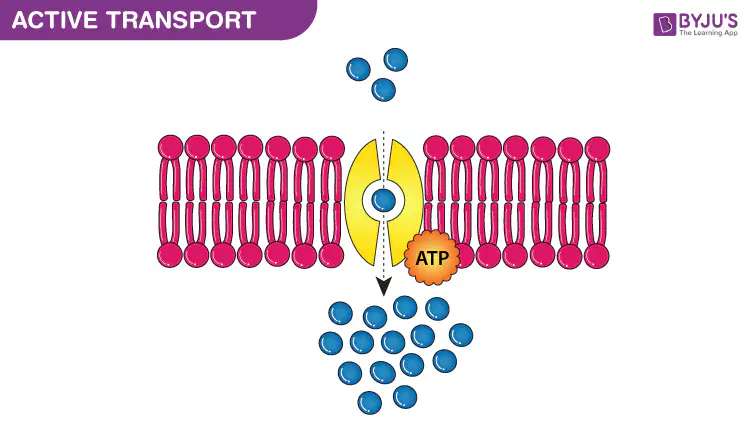
Active transport requires (a) , moves materials from (b) , and goes (c) the concentration gradient.

Osmosis(passive transport) is the movement of
salt
sugar
carbohydrates
water

Both diffusion and facilitated diffusion are a type of passive transport since both don't require energy(ATP). What difference do they both have?
Diffusion is passive and facilitated diffusion is active transport
Diffusion does not require help from a protein while facilitated diffusion does
Diffusion carries molecules through the semipermeable membrane from high to low concentrations, and facilitated is the opposite.
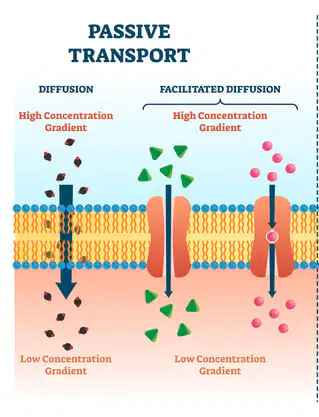
The process of molecules moving from a high to low concentration across the cell membrane without using energy(ATP) known as
passive transport
osmosis
active transport
phagocytosis
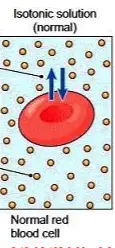
What is homeostasis?(use picture for reference)
Balance, or maintaining relatively stable conditions. Both sides equal
The cell component that controls what can enter and exit the cell.
The idea that phospholipids and proteins slide past one another in the membrane.
The transport of molecules
What is the complementary strand for
GGC TAA CCG?
(HINT: A pairs with T and G pairs with C)
CCG ATT GGC
GGC TAA CCG
CCG UAA GGC
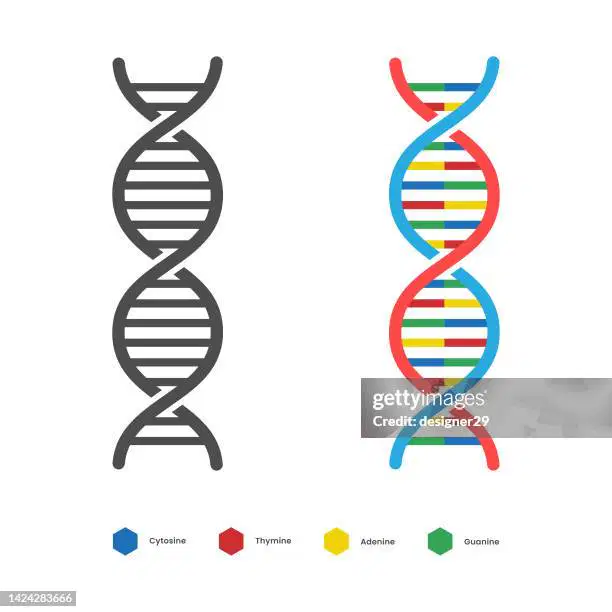
STORES genetic information for producing proteins


Which letter represents a nucleotide?
A
B
C
D

How is information for a specific trait (ex. hair color) carried on DNA?
In the sequence of nucleotides/bases
in the double helix structure
in the phosphates and sugars
in adenine and thymine

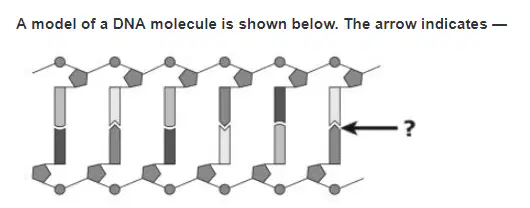
What is the bond that will hold the nitrogen bases together?
hydrogen bond
nitrogen bond
covalent bond
oxygen bond
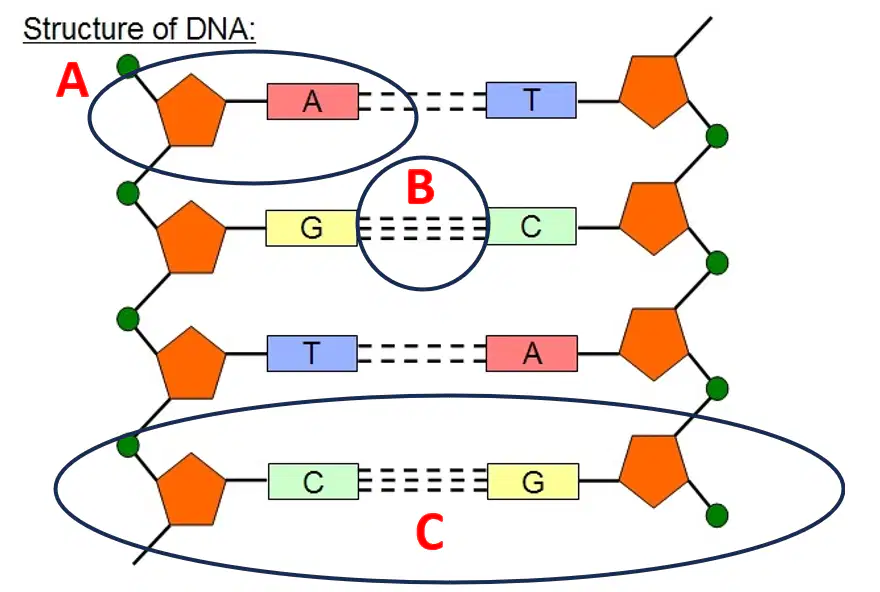
Look at the picture. Which letter shows a DNA base pairing?
A
B
C

