wayground logo

Free Printable Worksheets

Font size

S
M
L
XL
Worksheets

Second Benchmark

Total questions: 20

Worksheet time: 25mins

Name
Class
Date
1.

The science of describing, classifying, and naming organisms is:

a)

taxonomy

b)

classification

c)

life science

d)

organization

2.

Felis domesticus is the scientific name for a house cat. Which part of the name is the genus name?

a)

domesticus

b)

felis

c)

dom

d)

cus

3.

Which of the following is the correct order for least related to most related?

a)

Domain

Kingdom

Phylum

Class

Order

Family

Genus

Species

b)

Species

Kingdom

Phylum

Class

Order

Family

Genus

Domain

c)

Species

Genus

Family

Order

Class

Phylum

Kingdom

Domain

d)

Domain

Kingdom

Class

Phylum

Order

Genus

Family

Species

4.

Who created the most commonly used system of taxonomy?

a)

Niels Bohr

b)

Watson and Crick

c)

Charles Darwin

d)

Carl Linnaeus

5.

The eight levels of classification in order from general to specific are: domain, kingdom, phylum, class, order, family, genus, and species.

a)

True

b)

False

6.

The change in the characteristics of a species over several generations and due to the process of natural selection is called ______.

a)

variation

b)

adaptation

c)

evolution

d)

camoflauge

7.
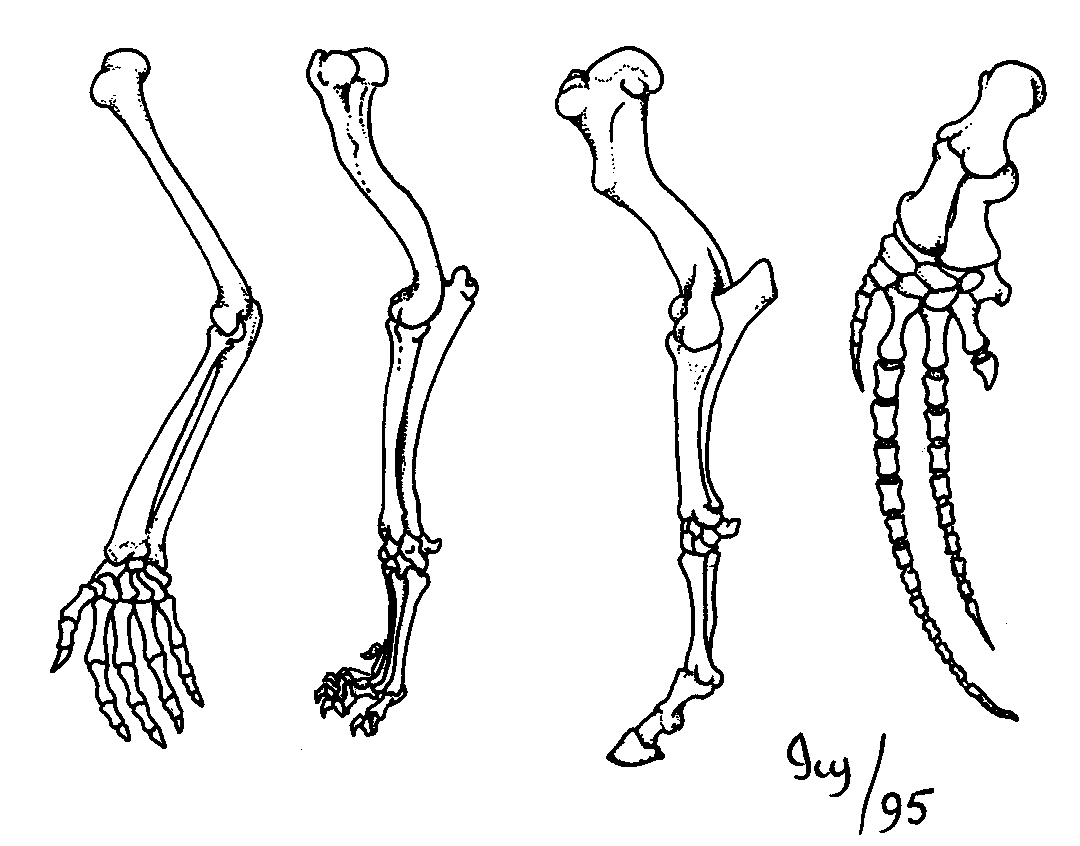
Structures with the same parts have different functions; suggests that organisms share a common ancestry
a)
vestigial structures
b)
homologous structures
c)
adaptive radiation
d)
fossil
8.
When all of the organisms of a species have died it is called
a)
evolution
b)
extinction
c)
adaptation
d)
natural selection
9.
Behavioral changes of individuals of a species that allow for better survival. (Acquired traits)
a)
Variation
b)
Adaptation
c)
Behavior
d)
Environment
10.
Bird wings and butterfly wings are an example of
a)
Homologous structure
b)
Analogous structure
c)
Mimicry
d)
Camoflague
11.
The word Tropism mean_________
a)
growth in response to stimuli
b)
to create something new
c)
Chemical energy
d)
Taproot system
12.
What does it mean if a plant has a POSITIVE phototropism?
a)
That the plant grows toward light.
b)
That the plant grows away from light.
c)
That the plant grows toward gravity.
d)
That the plant grows away from gravity. 
13.
What does it mean if a plant has a NEGATIVE gravitropism?
a)
That the plant grows toward light.
b)
That the plant grows away from light.
c)
That the plant grows toward gravity.
d)
That the plant grows away from gravity. 
14.

Plants curling around a pole or mailbox is an example of:

a)

Phototropism

b)

Germination

c)

Turgor pressure

d)

Thigmotropism

15.

When plants grow in towards the light, this is called:

a)

Phototropism

b)

Geotropism

c)

Germination

d)

Thigmotropism

16.
If a plant experiences a gravitropism, then it will do what?
a)
Grow toward or away from light. 
b)
Grow away from light. 
c)
Grow toward light.
d)
Grow in response to gravity. 
17.
What type of tropism response to water? 
a)
Hydrotropism
b)
Gravitropism
c)
Thigmotropism
d)
Phototropism
18.

Eutrophication is caused by

a)

excess nutrients building up in the water.

b)

industrial point-source pollution.

c)

unlined landfills and septic tanks.

d)

wastewater from homes mixing with drinking water.

19.

Are decomposers biotic or abiotic factors?

a)

biotic

b)

abiotic

20.

An ecosystem is made up of __________.

a)

living things only

b)

non-living things only

c)

both living and non-living things