
 Worksheets
Digital Art Semester 1 Final Review
Total questions: 25
Worksheet time: 14mins
It can convey information with a variety of styles as well as add to the overall feeling of a design. Color, style, placement, and hierarchy can be used to help enhance this elements in a design.
Typography
White Space
Hierarchy
Lines
Specific style of characters within a typeface or typography are called
fonts
serifs
baselines
decorations
Which of the following is a sans-serif font?


Which of the following is a serif font?

Which of the following is a script or cursive font?
Which of the following is a decorative font?
An element that is derived from reflected light; It can be used for the focal point, subject, background, or to fill other elements.
Typography
Shapes/Forms
Color/Hue
Hierarchy
Which of the following is an analogous color scheme?


Which of the following is an complementary color scheme?
Which of the following is an monochromatic color scheme?
The ____ area color model is used for print materials, such as business cards, posters, and brochures
RGB
CMYK
The ____ color model is used for digital media, such as computer screens, websites, and TVs
RGB
CMYK
Which colors make up "RGB" colors? (Chose all that apply)
Red
Green
Yellow
Blue
Black
Which colors make up "CMYK" colors? (Chose all that apply)
Red
Cyan
Yellow
Black
Magenta
Drawing emphasis to a specific area of your composition is called the
focal point
typography
balance
hamrony
The area of your design with no elements is called the
white space
focal point
hierarchy
typography
When you _______ an image, you are changing the image size and quality
crop
resize
reflect
align
When you _______ an image you are cutting away part of the image without changing the quality or size of the remaining parts.
crop
resize
reflect
align
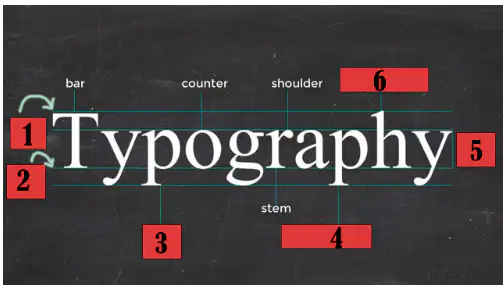
#1 is called the
Cap Height (height of the capital letters)
Baseline (the line in which all the letters sit on)
The Serif (the extra piece on the end of each letter)
The Stem (the part of a letter that goes below the baseline)
#2 is called the
Cap Height (height of the capital letters)
Baseline (the line in which all the letters sit on)
The Serif (the extra piece on the end of each letter)
The Stem (the part of a letter that goes below the baseline)
#3 is called the
Cap Height (height of the capital letters)
Baseline (the line in which all the letters sit on)
The Serif (the extra piece on the end of each letter)
The Stem (the part of a letter that goes below the baseline)
#4 is called the
Cap Height (height of the capital letters)
Baseline (the line in which all the letters sit on)
The Ascender (the part of the letter that extends above the x height)
The Descender (the part of the letter that extends below the baseline)
#6 is called the
X height (the height of the lowercase letters)
Baseline (the line in which all the letters sit on)
The Ascender (the part of the letter that extends beyond the X height)
The Descender (the part of the letter that extends below the baseline)
#5 is called the
X height (the height of the lowercase letters)
The Cap Height (the height of the capital letters)
The Ascender (the part of the letter that extends beyond the X height)
The Descender (the part of the letter that extends below the baseline)
The (a) of design are the building blocks such as line, color, shape, form, value, and texture. The (b) of design are the way we use the elements to create an overall composition such as harmony, typography, white space, emphasis, and balance.

