
 Worksheets
2024 1st Semester Review
Total questions: 160
Worksheet time: 2hrs 38mins
A ________________ feedback loop makes a system more stable.
Positive
Neutral
Negative
Circular
A _________________ feedback loop moves a system to an extreme.
Positive
Neutral
Circular
Negative

A wolf population is introduced into an ecosystem, causing the deer population to decrease. The wolf population decreases as the deer population decreases, allowing the deer to begin to increase again. This is an example of what type of feedback?
Neutral
Ecosystem
Positive
Negative
Polar Ice Caps are melting due to an increase in Earth's temperature. This lowers the albedo (ability to reflect sunlight) of Earth, which in turn increases Earth's temperature. This is an example of what type of feedback?
Negative
Neutral
Positive
Ecosystem
If I have a data table that has one column for years and one column for temperature, what would I put on the x-axis of a graph?
Temperature
Carbon Dioxide levels
Population
Years
An increase in Carbon Dioxide levels in the atmosphere could lead to which of the following?
Increase in temperature on Earth
Decrease in Albedo (reflection of the sun's rays back to space) on Earth
Change in overall climate on Earth
All of the above

What is the relationship between the red and the blue systems in the graph?
An increase in CO2 concentrations has no effect on temperatures.
An increase in CO2 concentrations is leading to an increase in temperatures.
An increase in CO2 concentrations is leading to a decrease in temperatures.
I don't know
What is the relationship between the red and the blue systems and the black line in the graph?
An increase in CO2 concentrations is leading to an increase in temperatures which is leading to an increase in the size of glaciers.
An increase in CO2 concentrations is leading to an increase in temperatures which is leading to a decrease in the size of glaciers.
An increase in CO2 concentrations is leading to an increase in temperatures which has no effect on the size of glaciers.
I don't know
Is the relationship between the red and blue lines showing a positive or negative feedback loop?
Negative
Positive
There is no feedback loop evidence
I don't know
Is the relationship between the red and blue system and the black line showing a positive or negative feedback loop?
Negative
Positive
There is no feedback loop evidence
I don't know

What is happening to wildfires in the U.S. overtime?
Wildfires are burning less and less area.
Wildfires are doing less damage overtime.
Wildfires are not changing in frequency.
Wildfires are burning more and more area.

What is one thing that could be causing this increase in acres burned by wildfires?
An increase in precipitation
A decrease in Carbon Dioxide in the atmosphere
A decrease in Earth's temperature
A decrease in precipitation overtime
A thermostat in a central heating system can determine the temperature of your living room. It switches the air conditioner on when the temperature increases to a predetermined level and shuts it off when it cools to another level. The room temperature remains within a comfortable level regardless of the temperature outside.
Positive Feedback Loop
Negative Feedback Loop
A group of parts that work together to do a job, perform a function, or produce a result is called a
function
system
feedback
I need to check Monday's notes
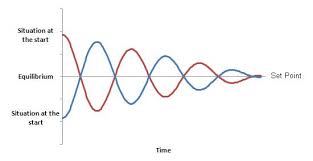
Does the graph show positive or negative feedback?
Positive, because when the red line shifts, the blue one does also
Negative, because the blue line starts below equilibrium
Negative, because the two actions are keeping each other near equilibrium
Both positive and negative because the graph moves up and down

Based on the graph, which country releases the most greenhouse gases?
Russia
Brazil
China
U.S.

The gases that make up Earth’s atmosphere are commonly referred to as air. What are the two most abundant gases in the atmosphere?
nitrogen and carbon dioxide
nitrogen and oxygen
water vapor and argon
oxygen and carbon dioxide
As the ocean heats up, what happens to the amount of dissolved CO2?
It increases
It decreases
It doesn't change
I need to check Monday's Notes
Which of the following items produced in the ocean can promote cloud formation?
Sea Salt
Sand
Algae
Silver nitrate
What does the term 'climate' mean?
Day-to-day weather conditions
Average temperature, precipitation and wind speed of a country
Average weather across a large area of the earth's surface
Average annual weather conditions of a particular area
For an area's climate to be determined, certain weather conditions are measured over how many years?
1 week
1 year
1 Month
More than 10 years

What are the three categories of global climates?
Tropical, Polar, and Temperate
hot, medium, and cold
Wet, Dry, equal amounts
sunny, cloudy, and partly cloudy
Which of the following help distinguish between the three different global climates?
Line of Latitude
Levels of precipitation
Size of the country/continent
Line of Longitude

Which of the following climates are found either on or 30 degrees north or south of the equator?
Tropical
Temperate
Polar
I don't know

Which global climate is found between 30-60 degrees north and south of the equator?
Tropical
Temperate
Polar
I don't know

Which climate type is found in the far north of the northern hemisphere, between 50-66 degrees north of the equator?
Tropical
Temperate
Polar
I don't know
Marine West Coast and Mediterranean climates are found between the 23 degrees and 66 degrees. They are examples of local climates from which category?
Tropical
Temperate
Polar
I don't know

Biosphere
all the water on Earth
regions that contain all the living things on Earth
the envelope of gases that surrounds Earth
Ground, soil, and everything below it

When is energy absorbed during the water cycle?
during evaporation
during transpiration
during condensation
during precipitation

What happens when water vapor loses thermal energy?
it expands into millions of droplets that form clouds
it condenses into millions of droplets that form clouds
it condenses into millions of droplets that form lakes and rivers
it expands on the surface of plants and goes into the air

Evaporation adds water to the
biosphere
atmosphere
lithosphere
geosphere

As you go to the top of a mountain, what happens to the air temperature?
nothing
it decreases
it increases
it fluctuates between warm and cold
Warm air can carry more water vapor (moister) than cool air.
true
false

As warm air rises it ______.
warms and condenses
cools and condenses
warms and expands
cools and expands

Why is the north pole the coldest?
Because it receives the indirect sunlight
What is the positive feedback loop that impacts the climate systems?
The water cycle
GHG system
Plate Tectonics System
Carbon Cycle

If a city has a high elevation like Fairbanks, Reno, or Montpelier, what would you expect their temperatures to be?
Hotter
Colder
Elevation doesn't affect the temperature
I don't know
If a city has a low elevation like San Diego and Vancouver, what would you expect their temperatures to be?
Hotter
Colder
Elevation doesn't affect the temperature
I don't know

Fairbanks, Alaska has a lower elevation than Montpelier, Vermont. However, Fairbanks is COLDER than Montpelier. What could be the explanation?
Fairbanks has a greater latitude than Montpelier.
Fairbanks has a lesser latitude than Montpelier.
The Atlantic Ocean is colder than the Pacific Ocean
I don't know
A ________________ feedback loop makes a system more stable.
Positive
Neutral
Negative
Circular
A _________________ feedback loop moves a system to an extreme.
Positive
Neutral
Circular
Negative
Label the earth
Polar
Temperate
Tropical
evaporation
liquid water to water vapor
condensation
water vapor back to liquid
precipitation
water droplets stick together and fall from clouds
Why is the Earth's core so hot?
the Earth uses nuclear fusion (like the Sun) to release energy and produce bigger elements
the Earth uses leftover heat from its original formation to stay warm
the Earth uses radioactive decay to release energy and produce smaller elements
the Earth absorbs energy from the Sun in the core

What is the correct order of Earth's Layers starting from the outer layer to the center?
Crust - Outer core - Inner Core - Mantle
Mantle - Outer core - Inner core - Crust
Inner Core-Mantle-Outer Core-Crust
Crust - Mantle - Outer Core-Inner Core

Earth's Inner core is made up of
A layer of rock that forms Earth's outer surface
A layer of molten (liquid) iron and nickle
A sphere of solid iron and nickel
A solid/plastic layer of Peridotite that flows over time?

The Earth's Mantle is made up of?
A solid layer of Iron and Nickel
A molten (liquid) layer of of Iron and Nickel
A solid layer of Granite and Basalt
A semi-solid layer of that moves over time through the process of convection

The outer layer of the Earth is called the
Crust
Mantle
Inner core
Asthenosphere
In which layer of the Earth would you expect to find the hottest temperature?
Crust
Mantle
Inner Core
Lithosphere

During the candle lab, you watched the energy from the candle heat the metal. The hot metal then dropped the thumb tack in a predictable order. This energy transfer is called?
Convection
Radiation
Conduction
Subduction
Push Play: During the Lava Lamp Lab, we learned that heat transfer within a fluid takes place by
Convection
Conduction
Radiation
Sublimation
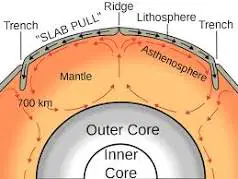
What do the circular arrows in the asthenosphere represent?
pathways
convection currents
lava
convergent

What is radioactivity in the mantle responsible for?
convection currents and plate tectonics
Photosynethsis
Magnetic Storms
Skin Cancer

What is the theory of plate tectonics?
The theory that describes how Earth's outer layers is broken up into moving tectonic plates
Tectonic plates stay in one place
All of the continents were once apart of a Super Continent called Panthalassa
All of the plates were once a solid plate until they broke up and moved to their current position


When oceanic plates move away from each other and new crust is made, what type of landform will be created?
islands
mid ocean ridges
ocean trenches
all of the above

When oceanic plate and continental plate collide, what type of land form will be created?
mid ocean ridges
volcanoes
islands
earthquakes

Letter B on the diagram below represents which of the following:
The oldest lithosphere/crust
The youngest lithosphere/crust
hot spot
island chain

Letter B in the diagram shows a subduction zone. Why is the oceanic crust subducted?
it is less dense
it is more dense
it is heavier because the ocean is pushing it down
none of the above

What are the two types of earthquake seismic waves?
P and S waves
Surface and Underground waves
Fast and Slow waves
Up and Down Waves
What type of seismic wave travels the fastest?
Love
Reyleigh
P
S
What type of seismic wave travels in and up and down motion perpendicular to the direction of wave travel and can only move through solid material?
S
P
Love
Reyleigh

Base your answer on the diagram of a graph of P waves and S waves. We can conclude that
P-waves travel faster than S-waves
P-waves travel slower than S-waves
P-waves travel the same as S-waves
I don't know
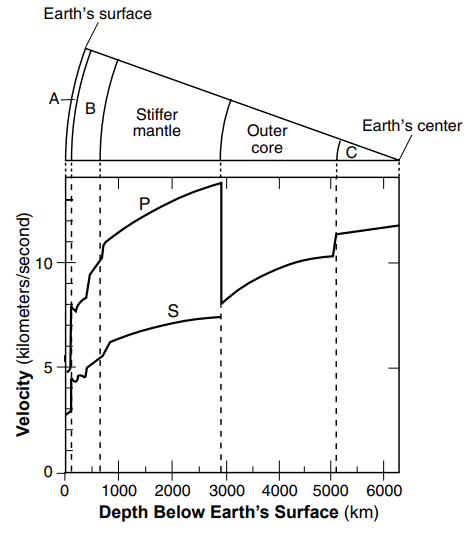
Primary (P) Waves can pass through...
solids only
liquids only
gases only
solids, liquids, and gases
(S) Waves can pass through...
solids only
liquids only
gases only
solids, liquids, and gases
_______ is when two small nuclei collide and join together to form a larger nucleus releasing large amounts of energy.
fission
beta decay
alpha decay
fusion
Absorb energy
Maintain energy
Release energy
I don't know
The process of fusion happens in a star's
Corona
Convection Zone
Radiative Zone
Core
When hydrogen is "fused" together on the Sun, what new element is created?
Helium
Carbon Dioxide
Oxygen
Light
Which term means the transfer of energy by electromagnetic waves, such as light and microwaves?
Conduction
Radiation
Convection
heat
During the Marshmallow Lab, you were instructed to make a helium nucleus and "fuse" it to other marshmallows to make other nuclei. As you added the marshmallows, what happened to the mass?
The mass increased
The mass decreased
The mass stayed the same
I don't know
According to the "Star in the Box" lab and the "Marshmallow" lab, what happens when a star runs out of Hydrogen nuclei to fuse?
Running out of Hydrogen has no effect on a star.
As a star runs out of Hydrogen to fuse, the star's mass decreases.
As a star funs out of Hydrogen to fuse, it stars to fuse other nuclei to form new elements and the mass increases.
I don't know
How do elements like gold, copper, and lead end up on earth?
they flow through sunshine to the earth
as the earth gets close to a red giant, its gravity pulls these elements to the ground
a supernova sends these elements into the space matter and they end up on earth from space
these elements are made on earth by volcanic action

According to this map, where can you infer that mountains are being formed?
between the Scotia Plate and the Pacific Plate
between the Cocos Plate and the Caribbean Plate
between the South American Plate and the African Plate
between the North America Plate and the Antarctic Plate
What happens at a divergent tectonic plate boundary?
2 tectonic plates move horizontally past one another.
2 plates pull away from one another forming a mid-ocean ridge.
2 tectonic plates come together to form one plate.
2 tectonic plates collide and causing subduction.
Plate (a) ultimately recycles the crust. At (b) boundaries, new crust erupts at the mid-ocean ridge. Old (c) gets pushed toward a convergent boundary. If the old crust is denser, it will (d) back into the heat of the earth. The old crust begins to melt and become magma. The magma will rise and become lava in a (e) adding new crust on land.
What is climate?
average weather in a region over a long period of time
average weather in a region over a short period of time
average precipitation
average solar radiation
What is one way to describe climate change?
changes in the average global and regional weather patterns
change in seasonal patterns of a climate zone
changes in the average weather pattern of a city
What is an example of a cause of climate change caused by human activities?
Combustion of Fossil Fuels
Volcanic Eruptions
Ocean Circulation
Plate Tectonics
What is an impact of global warming?
Ice Caps Freezing
Rising sea levels and saltwater intrusion
Increase of biodiversity
Cancer
Volcanic activity is a natural source of Greenhouse Gases. (a)
Which of the following is a greenhouse gas?
Nitrogen Gas
Oxygen
Water Vapor
Helium Gas
What does melting sea ice cause?
Deforestation
Coastal flooding and erosion
Cancer
I don't know
What would the Earth be like if there were no greenhouse gases in the atmosphere?
Too hot
Too cold
No atmosphere
Just right
Which greenhouse gas is excessively released by the combustion of fossil fuels?
Methane
Carbon Dioxide
Water Vapor
Hydrogen Monoxide
Carbon Sinks were studied in 1st quarter. It is a natural way for "mother nature" to remove and store carbon. What is the world's largest carbon sink?
Mountains
Tectonic Plates
Volcanoes
Oceans
How do greenhouse gases (GHG) affect our atmosphere?
GHG reflect solar radiation
GHG absorb solar radiation
GHG block solar radiation
GHG radiate solar radiation
What greenhouse gas does cattle, landfills, and mining produce?
Carbon Dioxide
Methane
Water Vapor
I don't know
The less ice on the planet, the (a) likely global warming will occur.
Why is polar sea ice important and how does it prevent further global warming?
It absorbs solar radiation
It reflects solar radiation
It is not affected by solar radiation
It is difficult to melt
What can we do to prevent Global Warming?
Develop more land for agriculture
Educate the public
Use more renewable resources for energy
Use transportation often
How can climate change effect biodiversity?
Range Expansion will lead to more competition.
Sea Levels will take human homes and establishments
Mosquitos may spread diseases to humans.
I don't know
One concern about global warming is range expansion. If the planet warms areas that are usually too cold for mosquitos and mosquitos expand their range to these new areas, what is the worry?
The cost of bug repellant will go up.
Mosquito-born diseases like malaria will spread.
More people will become allergic.
The biodiversity will improve.

Tree rings are used to reconstruct past climates. How does this work?
A thicker ring indicates more growth and therefore warmer temperatures.
A thicker ring indicates more growth and therefore colder temperatures.
A thinner ring shows that the temperatures must have been a lot warmer that year.
It is impossible to tell the temperature of the year by looking at the rings.
Particles that are located in the nucleus of an atom and no charge ____________
proton
neutron
electron
dust
Small, negatively charged subatomic particles that are located around the nucleus are called __________
protons
neutrons
electrons
dust
A dense positively charged sub atomic particle is called a _________
proton
neutron
electron
plasma
_______ is when two small nuclei collide and join together to form a larger nucleus releasing large amounts of energy.
fission
beta decay
alpha decay
fusion
Absorb energy
Maintain energy
Release energy
I don't know
The process of fusion happens in a star's
Corona
Convection Zone
Radiative Zone
Core
When hydrogen is "fused" together on the Sun, what new element is created?
Helium
Carbon Dioxide
Oxygen
Light
The process of fusion requires
High heat and high pressure
Cool temperatures and no gravity
A snack
High heat and low pressure


What element is it?
Hydrogen
Helium
Iron
I don't know

What element is it?
Hydrogen
Helium
Iron
I don't know
Which term means the transfer of energy by electromagnetic waves, such as light and microwaves?
Conduction
Radiation
Convection
heat
The sun provides energy to which process on Earth that was so important to the beginnings of life?
Plate Tectonics
Photosynthesis
Water Cycle
I don't know
During the fusion lab (bottle cap lab), it was determined that the faster the bag was shaken, the more pairs of "helium" were generated. This evidence explains fusion how?
High temperatures are needed for fusion to happen.
Low temperatures are needed for fusion to happen.
Temperature is required for fusion to happen.
I don't know

Every element emits a particular spectra fingerprint. When examining stars in our universe, we see that they also emit these fingerprints. Scientists use spectra from stars to determine...
the temperature of a star.
what the star is made of and its age
the star's distance from Earth.
the star's movement.
According to our "plant in a bag" lab, the seed was provided with only water and air. What allowed the plant to sprout and turn green?
Nutrients
Heat and Light from the Sun
Oxygen
I don't know
What is nuclear fusion?
The process of fusing two Hydrogen Nucli together to form Helium
The process of splitting two Hydrogen nucli together to form Helium
The process of bonding two electrons together
I don't know
What is a large celestial body that is composed of gas and emits energy in the form of light and heat?
Nebula
Star
Galaxy
Planet
What is an exploding, high mass star called?
black hole
Milky Way
supernova
solar system
What determines HOW a star dies?
Temperature
Brightness
Mass
I don't know
A white dwarf is the final stage for _________ mass stars like our Sun.
low
high
red giants
I don't know
Where does a star begin its life?
A high mass star explodes in a Supernova. This star is not heavy enough to collapse on itself and turn into a black hole. What does it turn into>
White Dwarf
Neutron Star
Black Dwarf
Black Hole
Why do stars die?
Fission stops in the core of the star
Fusion stops in the core of the star
The chemical reaction stops in the core of the star
I don't know
According to the "Star in a Box" lab, where do the greatest mass stars lie on the main sequence?
Top of the Main Sequence
Middle of the Main Sequence
Bottom of the Main Sequence
I don't know
According to the "Star in the Box" lab, at what stage of life is the star at its most massive?
Birth
During its time on the Main Sequence
As a red or super red giant (end of its life)
I don't know
During the Marshmallow Lab, you were instructed to make a helium nucleus and "fuse" it to other marshmallows to make other nuclei. As you added the marshmallows, what happened to the mass?
The mass increased
The mass decreased
The mass stayed the same
I don't know
According to the "Star in the Box" lab and the "Marshmallow" lab, what happens when a star runs out of Hydrogen nuclei to fuse?
Running out of Hydrogen has no effect on a star.
As a star runs out of Hydrogen to fuse, the star's mass decreases.
As a star funs out of Hydrogen to fuse, it stars to fuse other nuclei to form new elements and the mass increases.
I don't know

The analysis of the way matter emits and absorbs radiation is called ___.
astronomy
chemistry
spectroscopy
atomic theory

Line spectra are specific to the element or elements that make up a star. Because of that, line spectra can be described as a _____
classification as a solid, liquid or gas.
location on the table.
ability to react to form compounds.
unique spectral "fingerprint."


A sample of gas is analyzed, producing the spectrograph in the image. The sample has 2 purple lines, a blue line, a teal line, a green line, an yellow line and 2 red lines. Identify which element the sample is mostly made-up of?
Hydrogen
Helium
Neon
Mercury

Which elements are in the mixture?
A only
D only
Z only
A and D
D and Z
If you find a star that shows more Helium than Hydrogen, you could interpret that star to be what age?
Younger
Older
Middle Aged
I don't know
During nuclear fusion, lighter elements combine to create ____________ elements.
lighter
heavier
smaller
I don't know
When stars supernova they make room for new stars
It has no real importance, its just part of the system
I don't know
How do elements like gold, copper, and lead end up on earth?
they flow through sunshine to the earth
as the earth gets close to a red giant, its gravity pulls these elements to the ground
a supernova sends these elements into the space matter and they end up on earth from space
these elements are made on earth by volcanic action

Use the periodic table. Carbon has a mass of 6. What combination of elements in a star can make carbon?
H + H
He + He + He
O + He
H + He + N

