
 Worksheets
Semester 1 Exam Practice
Total questions: 248
Worksheet time: 5hrs 25mins
Subscripts tell us the number of _________ of an element and coefficients tell us the number of __________ of a substance.
molecules ; atoms
reactants ; products
atoms ; molecules
products ; reactants
This subatomic particle determines an element's identity.
Both a proton and a neutron have this much mass.
1 AMU
2 grams
13 AMU
10 cm
What do valence electrons determine about an element?
How much mass it has
How reactive it is
What the charge of the nucleus is
How many neutrons the element has in its nucleus
An atom has 10 protons, 15 neutrons and 10 electrons what is its mass number.
20
10
5
25


What do we call columns on the Periodic Table?
What do we call rows on the periodic table?

What do elements in the same period have in common?
the number of energy levels
the number of valence electrons
the number of protons
the number of neutrons
What do elements in the same group have in common?
the number of energy levels
the number of valence electrons
the number of protons
the number of neutrons
Which Group contains nonreactive gases?
Group 1
Group 7
Group 2
Group 8
Which group of metals is the most reactive?
Group 1
Group 4
Group 8
Group 2
Which group of nonmetals is the most reactive?
Group 2
Group 7
Group 8
Group 2
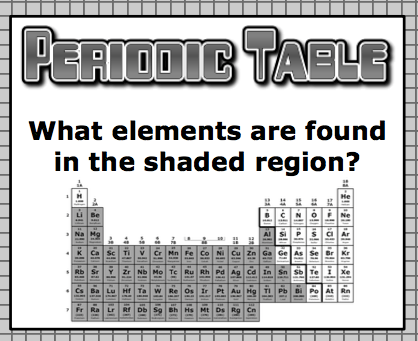
What elements are found in the shaded region?
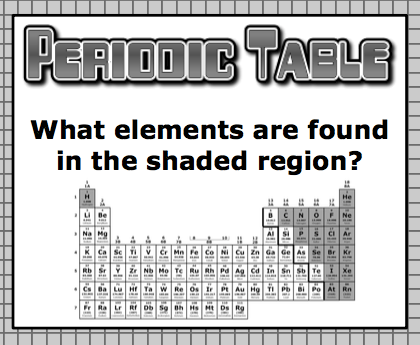
What elements are found in the shaded region?
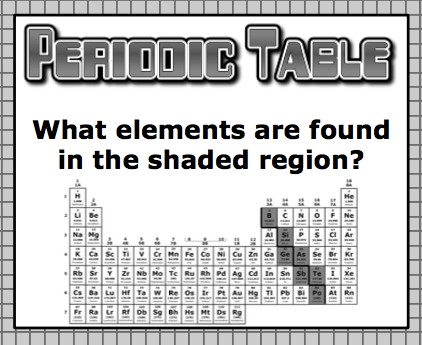
What elements are found in the shaded region?

Which elements are shiny (lustrous) and malleable?
Which elements are dull and brittle?
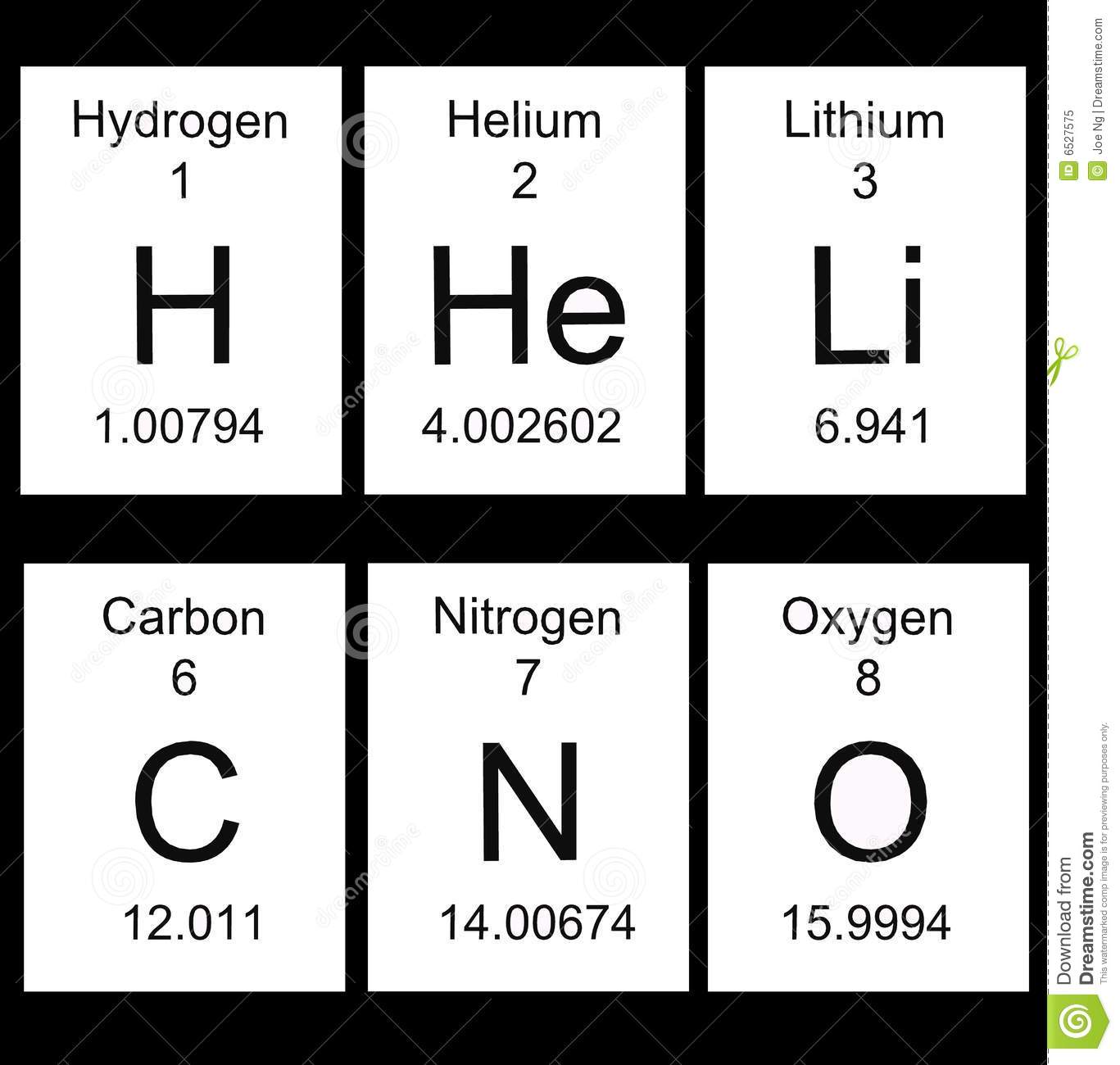
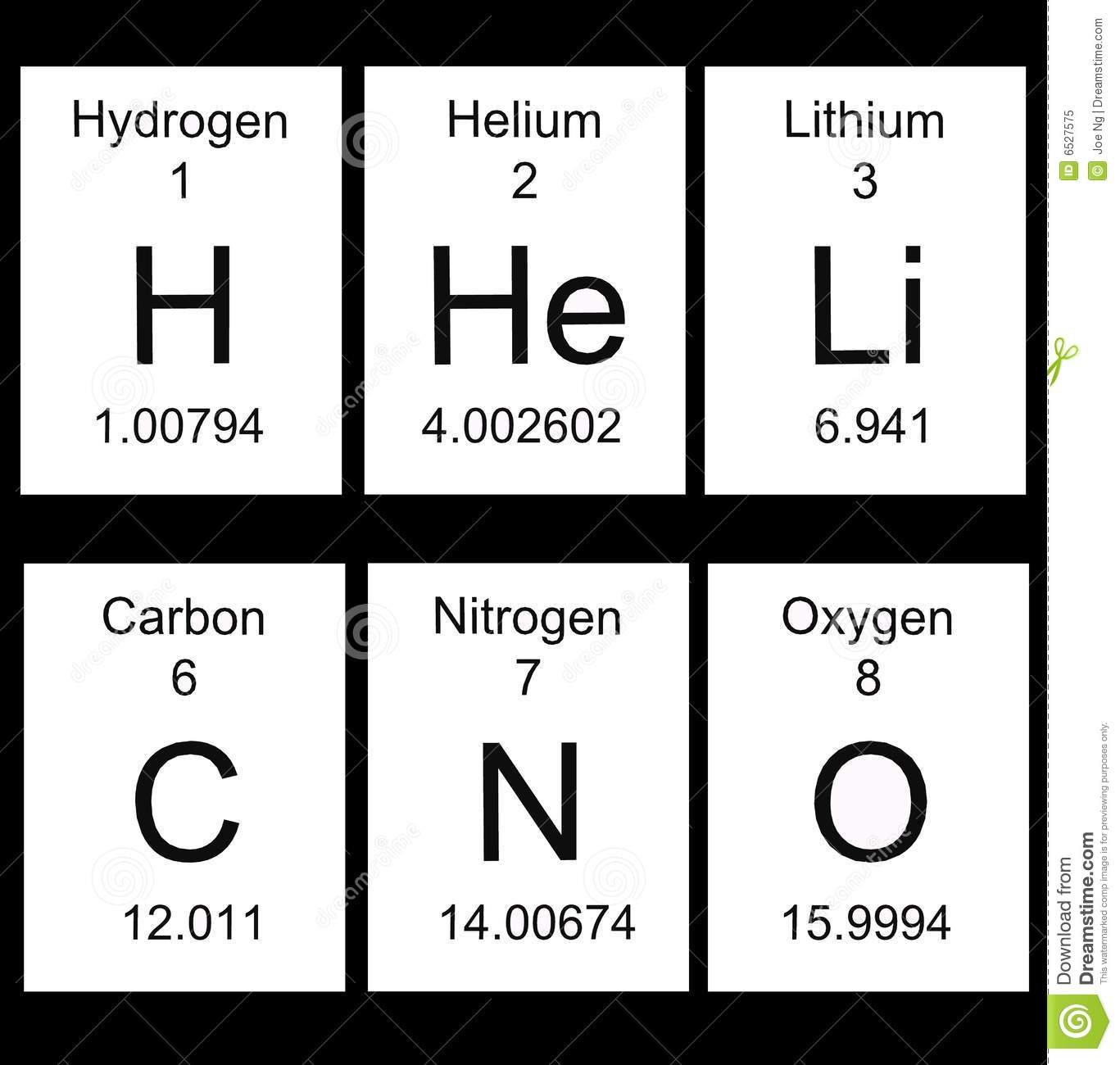

How many valence electrons?

How many valence electrons?

How many valence electrons?

The Law of Conservation of Mass states that -
the number and type of atoms on both sides of a chemical reaction are equal
there are more atoms on the reactant side than the product side
there are more atoms on the product side than the reactant side
the mass of the product will not equal the reactants
You know you a chemical reaction has occurred if:
there is a precipitate.
there is a permanent color change.
there is a temperature change.
All of these answers are evidence.
In the equation,
2Mg + O2 ---> 2MgO, which are the reactants?
2Mg + O2
2MgO
2Mg and MgO
O2 and MgO
H2 + O → H2O

The coin was at rest until the card was removed, so it tended to remain in the same location. Once the card was gone, the unbalanced force of gravity caused the coin to fall.
Moving the card applied an action force on the coin. Since the card was gone, gravity applied a reaction force on the coin.
The card had less mass than the coin, so a smaller force of gravity acted on the card. The larger force of gravity on the coin made it fall.
The acceleration of the coin falling into the cup was equal and opposite to the acceleration of the card.
If a flower and a marble are dropped from the same height, what force will cause the flower to fall more slowly?
inertia
friction
motion
newton


The mass of a car is 1000 kg. How much force would be required to accelerate the car at a rate of 3 m/s2? The answer to this question is most likely (HINT: Look at the units!!!) -
3000 N
3000 m/s2
3000 kg
How do you calculate average speed?
distance divided by time
time divided by speed
speed divided by time
total distance divided by total time
A car travels 120 miles in 12 hours. What is the car's speed?
10 mph
10 m/s
240 mph
240 m/s
A train travels 225 kilometers in 2.5 hours. Calculate the train's speed.
95 mph
90 km/h
90 h/km
90 m/s
Speed in a given direction
acceleration
speed
velocity
average speed
An average of all the speeds over a given time
average speed
total speed
net force
speed units
A golf ball is hit a distance of 300 yards in 10 sec. What is the speed of the golf ball?
3000 yards per second
30 yards per second
30 meters per second
3000 meters per second
Mr. Smith is traveling from Houston, TX to Dallas, TX. It takes 4 hours to make the 224
mile trip. What is his velocity?
56.5 miles per hour
56 miles per hour
55.65 yards per second
56 yards per second
Speed divided by time is the formula for
velocity
acceleration
speed
average speed
Dave runs 2000 m in 25 minutes. What is the speed?
90 mph
80 m/m
50 m/s
90 m/s
If you were to drive 60 miles in 1 and a half hours, what would be your average speed in mph
40 mph
40 m/s
90 mph
90 m/s


#1 Show all your work on your answer document. speed = distance/time
2 m/s
0.5 m/s
2 mi/hr
500 m/s

#2 Show all your work on your answer document.
400 m/min
0.0025 m/min
3600 mi/hr
40 m/s

#3 Show all your work on your answer document.
55 mi/hr
0.018 mi/hr
0.018 hr/mi
220 mi/hr

#4 Show all your work on your answer document.
4.5 m/s
0.22 m/s
175 m/s
11250 m/s

#5 Show all your work on your answer document.
4.25 ft/min
0.24 ft/min
68 ft/min
21 ft/min

#6 Show all your work on your answer document. (Average speed = total distance / total time)
1000 mi/yr
100,000 mi/yr
100 mi/yr
.001 mi/yr

#7 Show all your work on your answer document. (Average speed = total distance / total time)
5 km/min
5 m/s
0.2 km/min
0.2 m/s

#8 Show all your work on your answer document. (Average speed = total distance / total time)
2 km/min
20 m/s
0.5 km/min
200 m/s

#9 Show all your work on your answer document. (Average speed = total distance / total time)
1.6 km/min
1.6 m/s
0.625 km/min
0.625 m/s

#10 Show all your work on your answer document. (Average speed = total distance / total time)
6.25 km/min
21 m/s
0.16 km/min
100 m/s
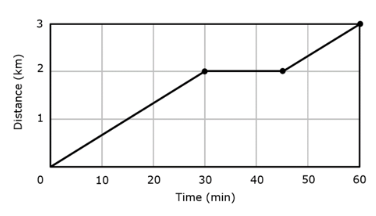
A student walks 2.0 km in a time of 30 minutes. The student then stop for 15 minutes to eat a snack then travels 1.0 km in 15 minutes.
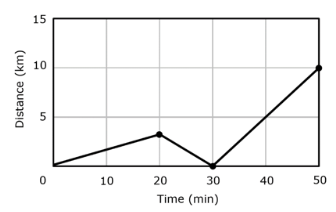
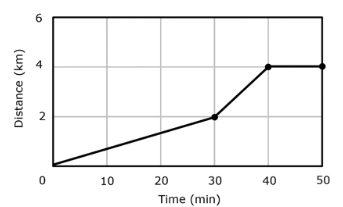
A student travels 2 km in 30 minutes. The student then travels another 2 km in only 10 minutes. After that, the student rests.
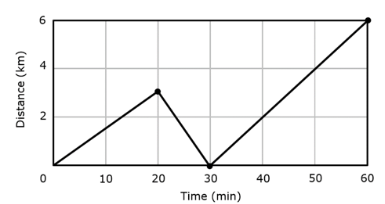
A girl rides her bike 3 km in 20 minutes. She then returns home in only 10 minutes to get her lunch. She then travels 10 km in only 20 minutes.
A boy rides his bike 3 km in 20 minutes. The boy then returns home in only 10 minutes to get his homework. He then travels 6 km in only 30 minutes.
A student walked 2 km to his friend's house in 20 minutes. Then the two friends walk 1 km together in 40 minutes.


A boy walks 1.0 kilometers in 30 minutes. He then walks at a faster rate for another 30 minutes and travels 2.0 kilometers in that time.
A student travels 6 km in 20 minutes to a friend's house. The two students then travel 4 km together over the next 30 minutes.
A student rides her bike a distance of 5 km in a time of 25 minutes. She then rides at a faster rate traveling another 10 km in 25 minutes.
A girl walks a distance of 1.5 km in 20 minutes. She rests for 10 minutes, then she walks another 1.5 km in 30 minutes.


A student rides his bike 4 km in a time of 25 minutes. He then stops to talk to his friend for 15 minutes. After that, he travels 2 km in 10 minutes.
A student rides her bike 3 km in 15 minutes. The student's bike chain breaks, and it takes 10 minutes to fix. The student then rides 12 km in 25 minutes.
A student jogs 4 km in 30 minutes. The student then rests for 15 minutes before jogging 2 km more in a time of 15 minutes.

Find the average speed from 30 to 60 minutes on this graph. (Hint: distance traveled during time range /divided by time)
0.03 km/min
0.05 km/min
0.67 km/min
0.07 km/min

Find the average speed represented on this graph. (Hint: total distance divided by total time)
6 km/min
0.12 km/min
10 km/h
0.1 km/min

Find the average speed represented on this graph. (Hint: total distance/total time)
0.3 km/min
3.33 km/min
0.3 km/hr
3.33 km/hr


What star phase happens when an average star expands its outer layers to increase in size and luminosity (brightness)?
Neutron star
White Dwarf star
Red Giant star
Black Hole
Massive stars life cycles come to a close with an explosive Supernova phase which leads to which two outcomes?
A black hole and a neutron star
A black hole and a Red Supergiant
A pulsar and a main sequence star
A planetary nebula and a new planet

Which category of stars are very hot, but not very bright?
Blue Giants
Red Giants
White Dwarfs
Red Supergiants

What type of star is the Sun classified as?
A red giant star
A red supergiant star
A neutron star
A main sequence star
Most stars of lower mass are more stable, and more common in our universe. These average stars are known as...
Main Sequence stars
White Dwarfs
Red Giants
Pulsars

A collection of gas and dust where new stars are born is known as a...
Planetary Nebula
Black Hole
Supernova
Stellar Nebula
The remnants of a Red Giant star after shedding its outer layers are the _______________ and ________________.
Planetary Nebula and a White Dwarf
Neutron Star and a Pulsar
Neutron Star and a Black Hole
Stellar Nebula and a Main sequence star
A black hole is an area where even light cannot escape, what is the cause of this phenomenon?
The size of a black hole
The luminosity of a black hole
The gravity of a black hole
The depth of a black hole

Which star would be very hot and very bright?
Rigel
Sirius
Alpha Centauri B
Betelgeuse

Which phase of a star results in an explosion sending dust, gas, and radiation into space?
Red Giant
Supernova
Black Hole
White Dwarf
The edge of a black hole where light and matter cannot escape from is called the...
Gravity Well
Outer rim
Edge of Darkness
Event Horizon

Which of the following pieces of information are given by an H-R diagram? Check all that apply.
Temperature of the star
Color of the star
Planets around the star
Location of the star

Which group of stars is not very hot, but is extremely bright?
White Dwarfs
Blue Giants
Red Supergiants
Main Sequence

Which category of star is the Sun found in on an H-R Diagram?
Red Giants
Main Sequence
Blue Giants
White Dwarfs
What determines the life cycle path that a star will take?
Mass of the star
Temperature of the star
Location of the star
Speed of a star's rotation


What type of galaxy is this?
Irregular Galaxy
Spiral Galaxy
Elliptical Galaxy

What type of galaxy is pictured here?
Elliptical
Irregular
Spiral
Rounded or oval shape galaxy.
Elliptical
Irregular
Spiral
Galaxy has no definite shape. Looks like a splatter of stars.
Elliptical
Irregular
Spiral
Galaxy with thick center and has "arms".
Elliptical
Irregular
Spiral
Choose the image that represents the spiral galaxy


A wave is a disturbance that transfers ________ from one place to another.
Matter
Mass
Energy
The highest point on a transverse wave is the
compression
crest
rest position
trough
If the wavelength of a wave increased, what would happen to the frequency?
decrease
increase
stay the same
Mechanical waves usually travel fastest through:
solids
liquids
gases
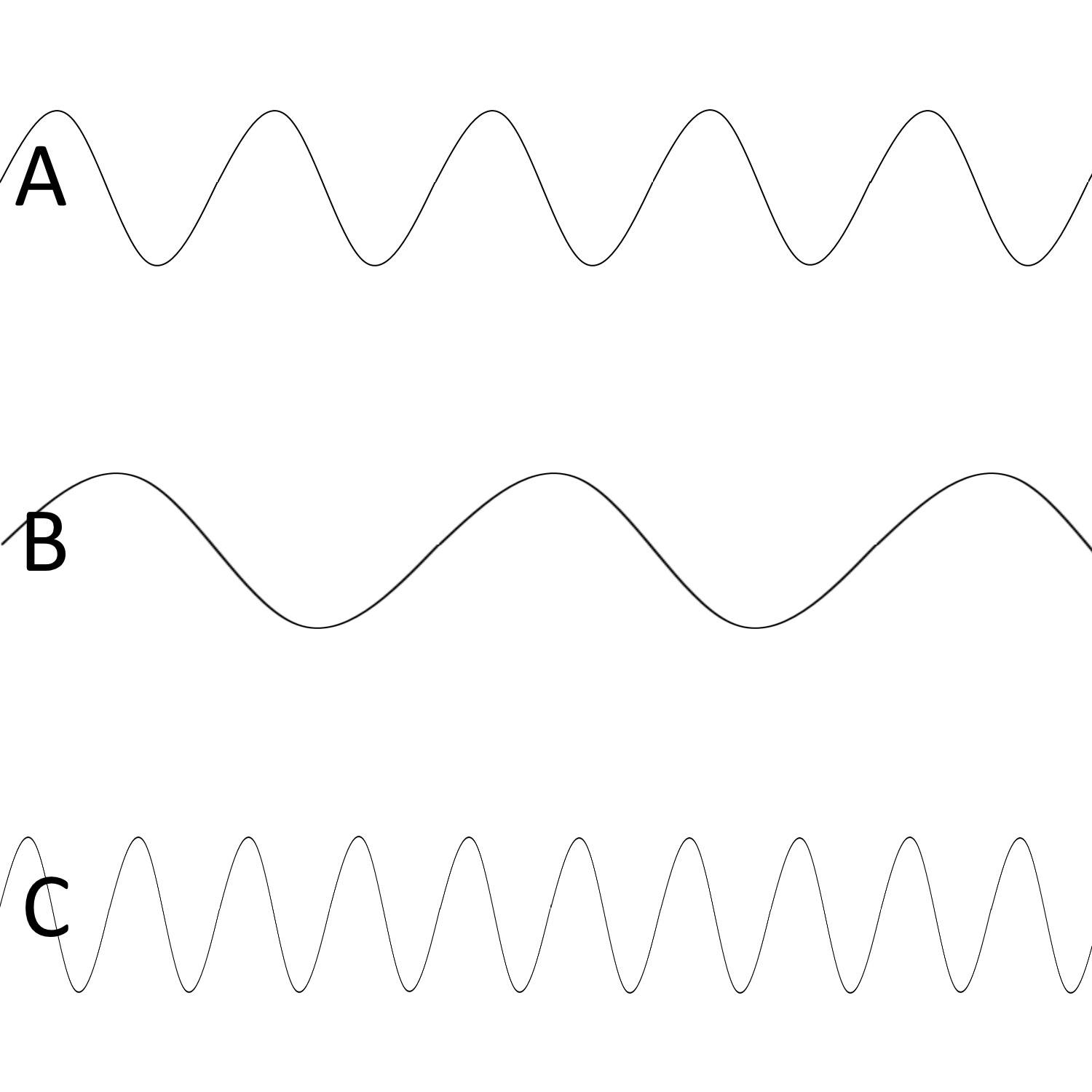
Waves that require a material to travel though are called
electromagnetic waves
mechanical waves
ocean waves
transverse waves
I do not know and do not wish to answer.
The lowest point on a transverse wave is the
compression
crest
rest position
trough
The number of waves that pass somewhere in a second is:
amplitude
frequency
wavelength

#4 refers to the
wavelength
amplitude
crest
trough
#3 refers to the
wavelength
amplitude
crest
trough
Longitudinal waves have:
crests and troughs
crests and compressions
compressions and rarefactions
troughs and rarefactions
Transverse waves have:
crests and troughs
troughs and rarefactions
compressions and contractions
rarefactions and crests
Transverse waves move mediums
at a right angle
in a circle
and matter too
at an acute angle
Longitudinal waves move:
at a right angle compared to the direction the wave is traveling
in a circle compared to the direction the wave is traveling
matter
in the same direction as the wave is traveling

What is the relation between the frequency of electromagnetic waves and their wavelength?
Higher frequency= Higher wavelength
Higher frequency= Lower wavelength
Lower frequency = Lower wavelength

Which wave has more energy? Why?
Top wave because the amplitude is smaller
Bottom wave because the amplitude is larger
They are the same because the wavelengths are equal
The measurement for Frequency is...
Cycle
Meters
Hertz
Seconds
The number of cycles or oscillation made in one second is defined as
time taken
period
frequency
amplitude

The number to the correct term

Amplitude

Wavelength

Crest

Trough
(a) best reflects the amount of (b) in a wave.

crest
A
amplitude
C
wavelength
B
Trough
D
wavelength
E
Match the following
Cell phones, Wi-Fi, Radar
Radio Waves
Warming up food, thermal imaging
Microwaves
Sterilizing equipment, create fluorescent effects
Ultraviolet Rays
Diagnostic imaging that can pass through most objects, including the body.
X-Rays
Cancer treatment, PET scans, Nuclear deterrence
Gamma Rays

What does the picture below illustrate?
Visible Light Spectrum
Electromagnetic Spectrum
Frequency Indicator
Color Line
What is the saying that can help you remember the order of the visible spectrum?
ROYGBIV
RYOBIVG
ROYBVIG
RIBYOVG
Reorder the following according to the spectrum
red
orange
yellow
green
blue
Reorder the following from shortest wavelength to the longest wavelength.
gamma waves
x-rays
ultraviolet waves
visible light
infrared rays

A wave with a large wavelength will have...
Low Frequency & Low Energy
High Frequency & High Energy
High Frequency & Low Energy
Low Frequency & High Energy

Which term means the distance from the crest of one wave to the next crest?
Amplitude
Frequency
Wavelength
How long is a rotation of Earth?
365 days (1 year)
48 hours
1 minute
24 hours (1 day)
The force that attracts all objects toward each other is called
motion
inertia
gravity
magnetism
Which of these objects has more MASS
Earth
Moon
Jupiter
Sun
How long does it take the Earth to make one full REVOLUTION around the Sun?
24 hours
365 days (1 year)
30 days
7 days
The movement of the Earth, Rotation and Revolution around the Sun, gives us
Day and Night
4 Seasons
Our 365 Calendar Year
All of the these things
The force of gravity would (a) if the distance between the moon and earth decreased.
(a) will cause the ball to hit the ground.

True or False: Earth's gravity pulls the moon inward.
True
False
A force that attracts all objects toward each other
Force
Inertia
Mass
Gravity
The Sun is the center of our....
universe
Solar System
school
planet
Earth orbits the Sun in a...
circular orbit
square orbit
The Earth and other planets are held in place by the Gravity of the....
Sun
Moon
The Sun is a....
planet
moon
satellite
star
The Sun appears brighter than all other stars because it is.....
further away from Earth than other stars
closer than other stars
the brightest star in the universe
How long does it take the moon to orbit the Earth?
about one month
about one year
about 10 years
about one day
From New Moon back to New Moon take about....
one year
one month
one day
Rotation of Earth on its axis takes about....
72 hours
365 days
24 hours
Why do the Sun, Moon and stars appear to move across the sky?
They are all rotating and revolving
Earth is rotating and revolving
Everything is moving
A year is the time it takes Earth to make one ____________
around the sun.
revolution
rotation
Like Earth, the moon rotates on an _________.
phase
axis
The axis of Earth has a slant, or _______.
revolution
tilt
The spinning of Earth on its axis is a __________.
phase
rotation
Which of these causes the day/night cycle on Earth?
Earth’s rotation
Earth’s polar tilt
Earth’s revolution
Earth’s circle of illumination
both the moon and Earth have
gravity
liquid water
day and night cycles
weather
True or False: The moon creates its own light.
True
False
The diagram models four lunar phases.
During which lunar phase is the tide highest?
Different relative positions of the sun, the moon, and Earth have different effects on Earth's oceans. Which model shows the positions of the sun, the moon, and Earth that have the greatest effect on ocean tides?


During the moon phase shown in the image Earth will experience a -
Spring Tide
Neap Tide

What type of tide would this arrangement of earth-moon-sun create?

During the moon phase shown in the image Earth will experience a -
Spring Tide
Neap Tide


The diagram provided depicts tidal height related to four moon phases. Which points in the diagram could represent the height of tides during the full Moon and the new Moon?
W and X
W and Y
X and Z
X and Y
What are the two main factors that create the tides on Earth?
Gravitational forces and rotation of Earth on its axis.
Phases of the Moon and distance from the Moon.
Distance from the Sun and distance from the Moon.
Gravitational forces and rotations of Moon on its axis.
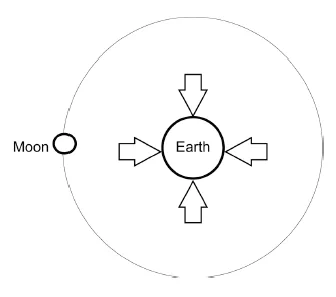
Look at the diagram provided. How many points on Earth, as indicated by the arrows, will be experiencing high tides?
1
2
3
4
High tides are created on Earth when nearby celestial bodies create what change in the oceans?
Electromagnetic waves reverse the direction of ocean currents.
Water is warmed by the Sun and then rises to higher levels.
Radiation striking the water increases salt content.
Gravity pulls on the water creating bulges on two sides of Earth.
A tide that occurs in an area where the Moon is in a direct line with the location
Spring Tide
Neap Tide
A tide that occurs when the Sun, Earth, and Moon aligned in a straight line
Spring Tide
Neap Tide
A tide that occurs when the Sun, Earth, and Moon are positioned to form a right triangle
Spring Tide
Neap Tide
A tide that occurs in an area located at 90 degrees (right angle) from the direct line of the Moon.
High Tide
Low Tide
Spring Tide
Neap Tide
The gravitational pull
of the (a) and the Sun affect the ocean tides.
Ocean (a) are the cyclical rise and fall of the waters on Earth.
The ocean tides are the effect of the relative positions of the Sun, Earth, and Moon, and therefore can be linked to the (a) cycle

What are large ocean waves caused by the gravitational pull of the Moon?
Tides
Tsunamis
EM Spectrum
How many high tides per day at a given location? (answer is a NUMBER)
(a)
How many low tides per day at a given location? (answer is a NUMBER)
(a)

What causes tides on Earth?
The gravitational pull of the Moon
The gravitational pull of Mars
The gravitational pull of Earth's core

What has a bigger effect on tides on Earth?
The Moon
The Sun

What do we call the strongest tides?
Spring Tides
Neap Tides

What do we call the weakest tides?
Spring Tides
Neap Tides
Where would the Moon be located to cause spring tides on Earth?
Select TWO.
Where would the Moon be located to cause neap tides on Earth?
Select TWO.
Which moon phases are associated with a spring tide? Select TWO.
New Moon
Full Moon
First Quarter Moon
Last (Third) Quarter Moon
Which moon phases are associated with a neap tide? Select TWO.
New Moon
Full Moon
First Quarter Moon
Last (Third) Quarter Moon

