
 Worksheets
4 U3C3 Ancient Greece
Total questions: 25
Worksheet time: 13mins
How did physical geography help the Greeks in warfare?
Greece's territory was very mountainous, its cities hard to attack.
Greece had many rivers for easy travel.
Greece was mostly flat, making it easy to build roads.
Greece had large forests for hiding.
How did physical geography lead the Greeks to become seafarers?
Greece had many deserts, so Greeks needed to find water.
Mountainous Greece had little land for farming, so Greeks looked to the sea for resources.
Greece had large forests, so Greeks built ships for trade.
Greece was mostly flat, making it easy to travel by land.
How did the sea affect the development of ancient Greek civilization?
The sea made it difficult for Greeks to travel.
Greeks relied on the sea, becoming skilled seafarers and navigators.
The sea provided no resources for the Greeks.
Greeks avoided the sea due to dangerous creatures.
Where and when did the Minoans live?
The Minoans lived on the island of Crete from about 2700 to 1500 BCE.
The Minoans lived in Athens from 500 to 300 BCE.
The Minoans lived in Sparta from 1000 to 500 BCE.
The Minoans lived in Rome from 2000 to 1000 BCE.
Why do historians think Mycenaean culture influenced Greek culture?
Mycenaeans wrote many books about Greece.
Mycenaeans built large cities in Greece.
Artifacts have been found that link Mycenaean and Greek cultures.
Mycenaeans spoke the same language as the Greeks.
What was a polis?
A large building in ancient Greece.
A type of Greek ship.
A city-state of ancient Greece.
A Greek festival.
How did the idea of citizenship shape Greek city-states?
It made everyone equal in wealth.
It created the need for public spaces like agoras.
It stopped wars between city-states.
It allowed only kings to rule.
What is aristocratic government in ancient Greece?
Rule by a single king.
Rule by the people.
Rule by an upper class.
Rule by soldiers.
What is the difference between a king and a tyrant?
Kings are elected by the people. Tyrants are born into their role.
Kings take power by force. Tyrants are given power by family members.
Kings are given power by a family member. Tyrants take power.
Kings are chosen by the gods. Tyrants are chosen by citizens.
What was the assembly in ancient Athens?
A group of merchants
The governing body of Athens
A religious festival
A school for girls
What were women in ancient Athens expected to do?
Participate in debates
Own property
Raise their own children and support the home
Go to school
How did metics contribute to the Athenian economy?
By farming
By being soldiers
By making and selling goods
By teaching
What types of work did enslaved people do in ancient Athens?
Teaching in schools
Governing the city and making laws
Cleaning, washing clothing, and carrying water
Writing books
What was the goal of Athenian education for boys?
To produce loyal citizens who were cultured and well-rounded
To produce strong and mighty warriors
To focus only on sports
To learn farming skills
What was the center of Spartan life and culture?
The military
Art and music
Trade and commerce
Farming
What type of government did ancient Sparta have?
Democracy
Monarchy
Oligarchy
Republic
Who were the Persians?
People from Europe
People from Southwest Asia
People from Africa
People from North America
Why did the Greeks and the Persians fight the Persian Wars?
The Greeks wanted to conquer Persia
The Persians wanted to remain independent
The Persian Empire tried to conquer the Greeks
The Greeks wanted to join the Persian Empire
How did Athens's physical geography help its troops during the Persian Wars?
Athens was far from the coast
Athens had many mountains
Athens was close to the coast
Athens had large forests
Which of the following was a cause of the Peloponnesian War?
Sparta wanted to spread democracy
Athens was becoming too powerful
Sparta wanted to join Athens
Athens wanted to become a monarchy
How did Sparta defeat Athens in the Peloponnesian War?
By forming an alliance with Athens
By cutting off Athens from its grain supplies
By building a stronger wall around Sparta
By making peace with Athens
How did the Peloponnesian War affect Athens?
It led to the Golden Age of Athens
It strengthened Athens's navy
It ended the Golden Age of Athens
It made Athens more democratic
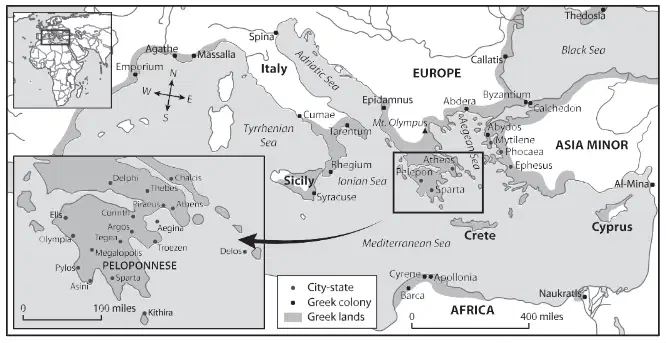
Where were most of ancient Greece's territory located?
along coastlines
on islands
south of Crete
in the Black Sea
How did education in Athens differ from education in Sparta?
Athens focused on physical education; Sparta focused on arts and sciences.
Sparta focused on citizenship; Athens focused on managing the household.
Sparta focused on military training; Athens focused on producing well-rounded citizens.
Athens focused on reading, writing, and the arts; Sparta focused on logic, math, and science.
Which type of government is being described? All male citizens hold power.
tyranny
oligarchy
democracy

