
NEW
Font size
 Worksheets
Plate Tectonics Quiz
Total questions: 17
Worksheet time: 10mins
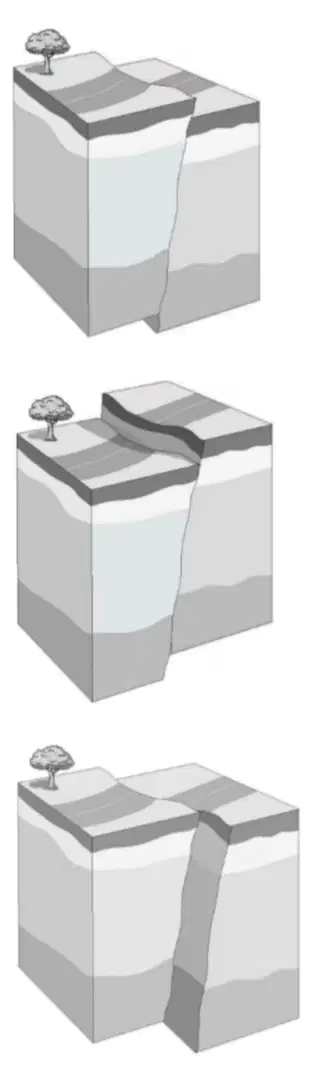
What type of movement and plate boundary do the illustrations show?
Colliding and Convergent
Separating and Divergent
Sliding and Transform
None of the above
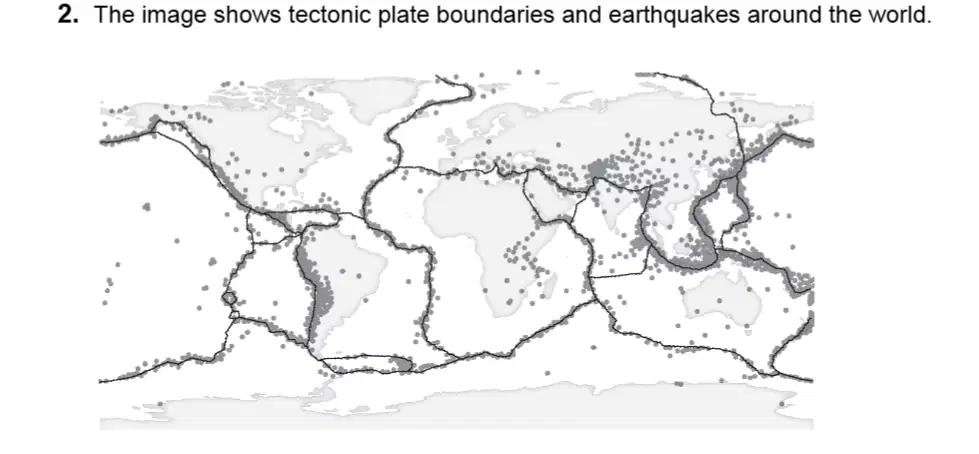
The image shows tectonic plate boundaries and earthquakes around the world. Choose the correct way to end this sentence. Earthquakes can occur at _________
Convergent and divergent boundaries.
Divergent and transform boundaries.
Convergent and transform boundaries.
Transform plate boundaries.
Which of the following is a correct statement about how tectonic plates cause earthquakes?
The movement of tectonic plates releases seismic waves that come from the focus/center of an earthquake.
The movement of tectonic plates creates tsunamis, which can cause earthquakes.
Seismic waves constantly flow through tectonic plates. When the waves reach a plate boundary, they cause an earthquake.
Earthquakes are not caused by tectonic plates.
Convergent boundaries, ____________ and depending on the type of crust it can form a ______________________ , island, mountain or trench .
collide; rift
separate; ridge
collide; volcano
subduct; earthquake
slide; fault
Compare an earthquake that registers 3.1 on the Richter scale with an earthquake that registers 5.6. How are the tectonic plate movements that cause each similar and how are they different?
Both earthquakes are caused by the same type of plate movement, but the 5.6 earthquake involves more energy release.
The 3.1 earthquake is caused by volcanic activity, while the 5.6 is caused by tectonic plate movement.
The 5.6 earthquake is caused by human activity, while the 3.1 is natural.
Both earthquakes are caused by different types of plate movements.
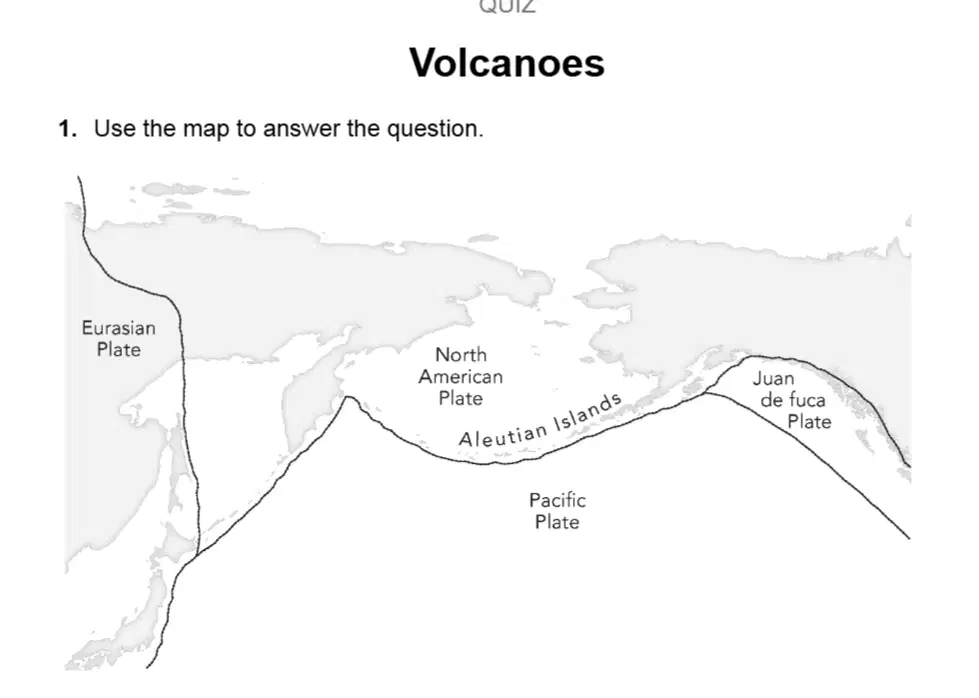
Use the map to answer the question. The Aleutian Islands are a volcanic island arc. Which statement explains how they were formed?
Earthquakes at the boundary of the Pacific and North American Plates formed the Aleutian Islands.
Subduction of the Pacific Plate beneath the North American Plate formed the Aleutian Islands.
Divergence of the Pacific and North American Plates formed the Aleutian Islands.
Horizontal movement of the Pacific and North American Plates in opposite directions formed the Aleutian Islands.
Very large volcanoes that form due to increased pressure and magma build up over time and that have had an eruption with a VEI (Volcanic Explosivity Index) of 8 are classified as:
Hot spots
Normal volcanoes
Supervolcanoes
All types of volcanoes

Based on the information in the table, which of the following volcanoes is most likely classified as a supervolcano?
Mount Etna
Yellowstone
Kilauea
Mount Fuji
The Hawaiian Islands formed over a ________, which is a relatively fixed location in the mantle where the magma is much _____ than the surrounding magma. Which terms best complete the sentences?
hot spot; hotter
convergent boundary; colder
divergent boundary; hotter
reverse fault; colder
subduction zone; cooler

Describe two differences between a volcano that forms above a hot spot and a volcano that forms at a subduction boundary.
Hot spot volcanoes are found at tectonic plate boundaries, while subduction boundary volcanoes are not.
Hot spot volcanoes are usually more explosive than subduction boundary volcanoes.
Subduction boundary volcanoes are typically found in the middle of tectonic plates, while hot spot volcanoes are not.
Hot spot volcanoes can form island chains, while subduction boundary volcanoes are often part of mountain ranges.
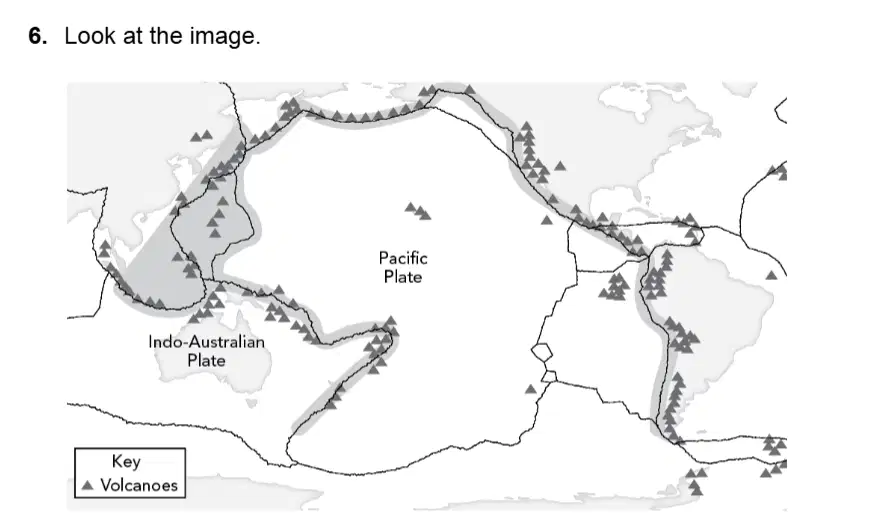
What does the "Ring of Fire" describe?
A series of earthquakes around the Atlantic Ocean
A group of volcanoes around the Pacific Ocean Plate
A chain of mountains in Europe
A desert region in Africa
How does plate tectonics cause ocean basin formation?
New crust forms due to seafloor spreading at convergent boundaries.
New crust forms due to seafloor spreading at divergent boundaries.
Oceanic trenches form at transform boundaries.
Oceanic trenches form at divergent boundaries.
At which boundary type are mountains usually formed?
Convergent
Divergent
Transform
Convection
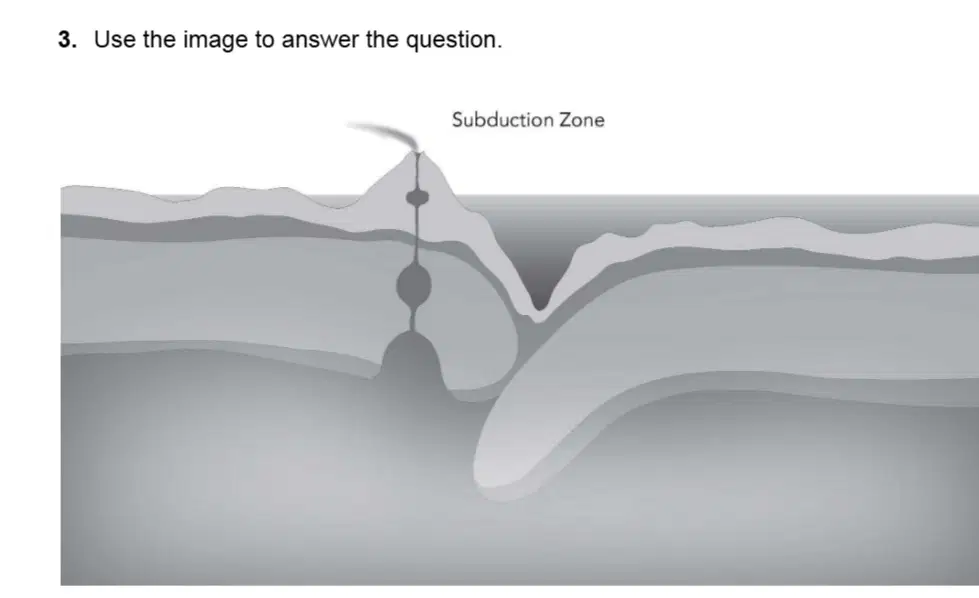
Use the image to answer the question. Subduction zones can result in all of the following geological features EXCEPT:
Volcanoes
Mountains
Mid-ocean ridges
Trenches
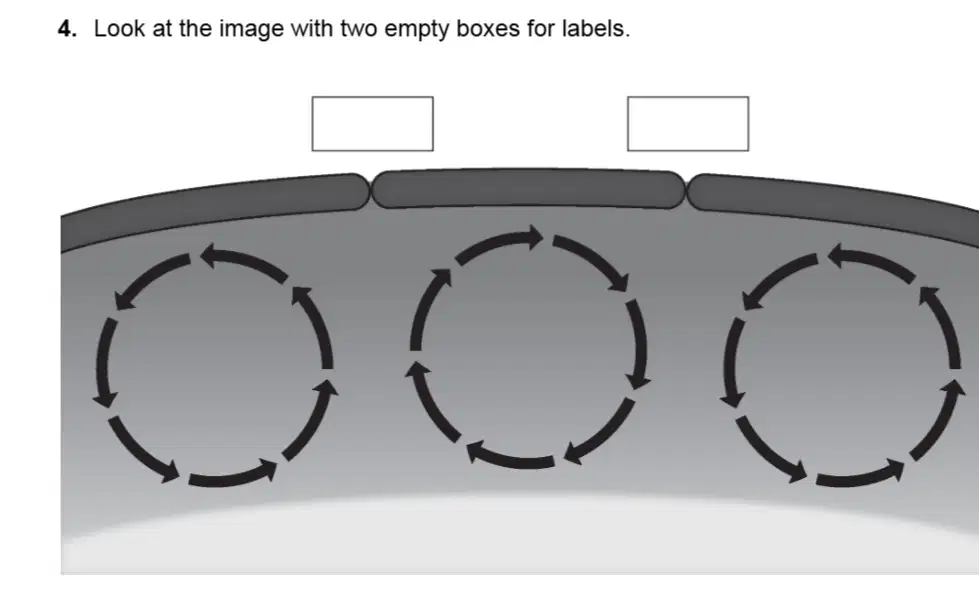
Look at the image with two empty boxes for labels. How can you correctly label the boundary type in each box?
Both labels should say transform boundary.
Both labels should say divergent boundary.
From left to right, the labels should say convergent boundary, then transform boundary.
From left to right, the labels should say divergent boundary, then convergent boundary.
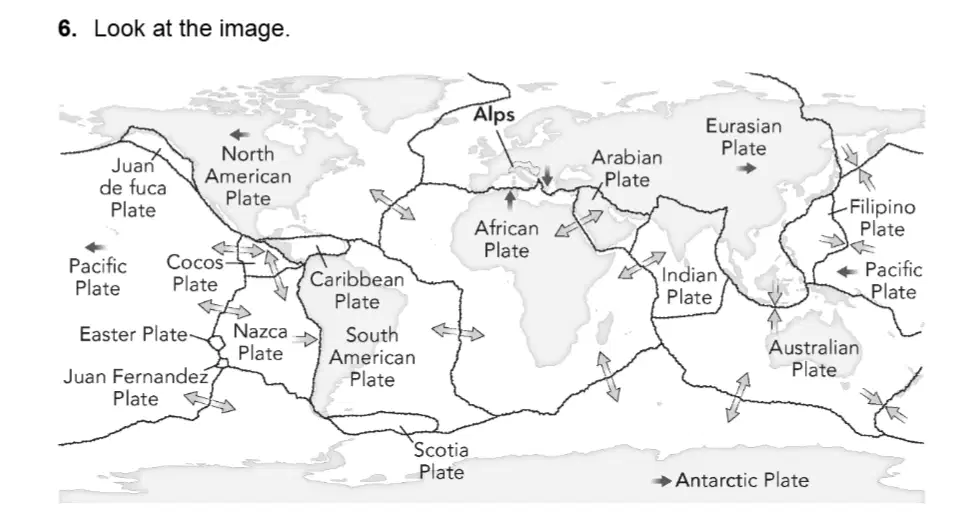
On which tectonic plate are the Alps located?
African Plate
North American Plate
Eurasian Plate
Indian Plate
What is a driving force behind the movement of the plates?
Plate tectonics
Continental Drift
Subduction
Convection Currents

