
 Worksheets
Physics Semester 1 Review
Total questions: 191
Worksheet time: 6hrs 2mins
A car skids to a halt to avoid hitting an object in the road. Select the correct motion diagram of the car from the time the skid begins until the instant the car stops.


A man rides a bike along a straight road at a constant speed for 5 minmin, then has a flat tire. He stops for 5 minmin to repair the flat, but then realizes he cannot fix it. He continues his journey by walking the rest of the way at a constant speed, which takes him another 10 minmin. Select a correct motion diagram of the man for the entire motion described here.


A jogger running east at a steady pace suddenly develops a cramp. He is lucky: A westbound bus is sitting at a bus stop just ahead. He gets on the bus and enjoys a quick ride home. Use the particle model to draw a motion diagram of the jogger for the entire motion described here. Number the dots in order, starting with zero.


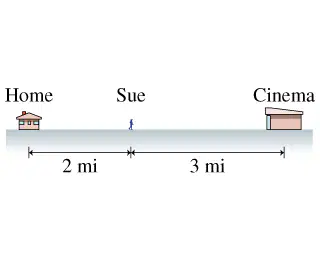
What is Sue's position xx if her home is the origin? Assume the positive direction is to the right.
Express your answer using one significant figure.
3 mi
-3 mi
2 mi
-2 mi
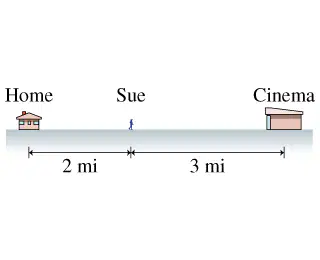
What is Sue's position xx if the cinema is the origin? Assume the positive direction is to the right.
Express your answer using one significant figure.
-3 mi
3 mi
2 mi
-2 mi
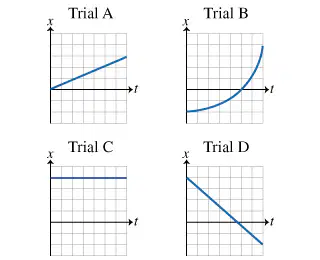
An object moves along the x axis during four separate trials. Graphs of position versus time for each trial (with the same scales on each axis) are shown in the figure. During which trial or trials is the object's velocity not constant?
Trial A
Trial B
Trial C
Trial D
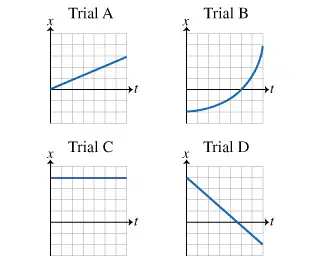
An object moves along the x axis during four separate trials. Graphs of position versus time for each trial (with the same scales on each axis) are shown in the figure. During which trial or trials is the magnitude of the average velocity the largest?
Trial A
Trial B
Trial C
Trial D
An elevator is moving downward when someone presses the emergency stop button. The elevator comes to rest a short time later. After the button has been pressed but before the elevator has stopped, the velocity of the elevator is _____, and the acceleration of the elevator is _____.
negative, positive
negative, zero
zero, negative
positive, negative
zero, positive
A child throws a baseball directly upward. Immediately after the ball leaves the child's hand, the velocity of the ball is ____, and the acceleration of the ball is ____.
negative, positive
positive, negative
zero, positive
negative, zero
positive, zero
A child throws a baseball directly upward. At the very top of the ball's motion (i.e. the point of maximum height), the velocity of the ball is ____, and the acceleration of the ball is ____.
positive, negative
negative, positive
zero, positive
zero, negative
negative, zero
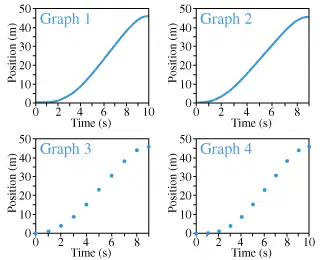
The table below shows the x coordinate of a moving object. The position is tabulated at one-second intervals. The x coordinate is indicated below each time.
time (s) 0 1 2 3 4 5 6 7 8 9
x (m) 0 1 4 9 16 24 32 40 46 48
Which graph (Figure 1) best represents the function x(t)x(t), describing the object's position vs. time?
1
2
3
4
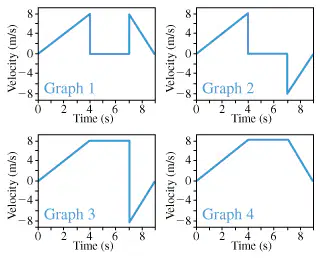
The table below shows the x coordinate of a moving object. The position is tabulated at one-second intervals. The x coordinate is indicated below each time.
time (s) 0 1 2 3 4 5 6 7 8 9
x (m) 0 1 4 9 16 24 32 40 46 48
Which of the following graphs (Figure 2) best represents the function v(t)v(t), describing the object's velocity as a function of time?
1
2
3
4
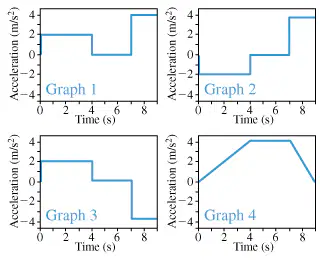
The table below shows the x coordinate of a moving object. The position is tabulated at one-second intervals. The x coordinate is indicated below each time.
time (s) 0 1 2 3 4 5 6 7 8 9
x (m) 0 1 4 9 16 24 32 40 46 48
Which of the following graphs (Figure 3) best represents the function a(t)a(t), describing the acceleration of this object?
1
2
3
4
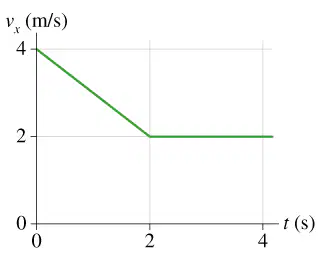
(Figure 1) shows the velocity graph of a bicycle. Choose the correct bicycle's acceleration graph for the interval 0s ≤ t ≤ 4s.
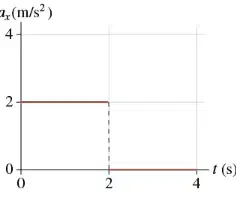
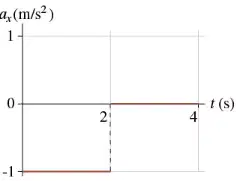
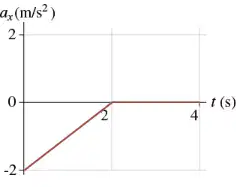
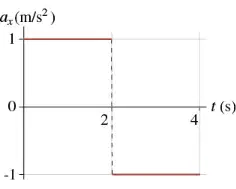
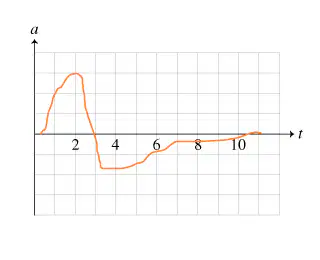
In a ballistocardiograph, a patient lies on an extremely low friction horizontal table. At each heartbeat, a volume of blood is accelerated by the heart toward the head along the ascending aorta. In response, the patient's body recoils in the opposite direction. This motion is detected by sensitive accelerometers attached to the table. (The table is then brought to rest and returned to equilibrium before the next heartbeat.) A graph of acceleration of the table versus time, termed a ballistocardiogram, is generated. Based on these measurements, the acceleration of the blood ejected by the heart can be determined. Patients with low blood accelerations generally have weakened heart muscles.
A sketch of a single cycle of a ballistocardiogram is given in the figure. (Figure 1). The units of the graph are arbitrary and linear for both time,tt, and acceleration, aa. At what time (in the arbitrary time units of the graph) is the speed of the table (and hence the speed of the blood in the opposite direction) a maximum?
2
3
4
6
7
The slope at a point on a position-versus-time graph of an object is the __________.
object's speed at that point
object's acceleration at that point
object's instantaneous velocity at that point
object's average velocity at that point
Which of the following is an example of uniform motion?
A ball dropped from the top of a building
A person at rest starts running in a straight line in a fixed direction
A hockey puck sliding in a straight line at a constant speed
A car going around a circular track at a constant speed
The area under a velocity-versus-time graph of an object is __________.
the object's acceleration at that point
the distance traveled by the object
the object's speed at that point
the displacement of the object
If an object is speeding up, __________.
its acceleration is positive
its acceleration is negative
its acceleration can be positive or negative depending on the direction of motion
A 1-pound ball and a 100-pound ball are dropped from a height of 10 feet at the same time. In the absence of air resistance, __________.
the 1-pound ball wins the race
the 100-pound ball wins the race
There's not enough information to determine which ball wins the race.
the two balls end in a tie
A student at the top of a building of height h throws ball A straight upward with speed v0 and throws ball B straight downward with the same initial speed. Compare the ball's accelerations, both direction and magnitude, immediately after they leave her hand. Is one acceleration larger than the other? Or are the magnitudes equal?
One acceleration is larger than the other.
They are equal.
A student at the top of a building of height h throws ball A straight upward with speed v0 and throws ball B straight downward with the same initial speed. Compare the final speeds of the balls as they reach the ground.
One speed is larger than the other.
They are equal.
A polar bear starts at the North Pole. It travels 1.0 km south, then 1.0 km east, and then 1.0 km north to return to its starting point. This trip takes 45 min. What was the bear's average velocity?
4.0 km/h
0.00 km/h
5.3 km/h
0.067 km/h
When is the average velocity of an object equal to the instantaneous velocity?
when the velocity is constant
only when the velocity is decreasing at a constant rate
never
always
only when the velocity is increasing at a constant rate
Which of the following quantities has units of a velocity? (There could be more than one correct choice.) Check all that apply.
9.8 m/s2 downward
40 km southwest
-120 m/s
9.8 m/s downward
186,000 mi
An object is moving with constant non-zero acceleration in the +x direction. The position versus time graph of this object is
a horizontal straight line.
a vertical straight line.
a straight line making an angle with the time axis.
a parabolic curve.
A 10-kg rock and a 20-kg rock are dropped at the same time and experience no significant air resistance. If the 10-kg rock falls with acceleration a, what is the acceleration of the 20-kg rock?
a
a/2
4a
a/4
2a
The area under a curve in a velocity versus time graph gives
displacement.
acceleration.
velocity.
position.
If the velocity versus time graph of an object is a horizontal line, the object is
moving with zero acceleration.
moving with constant non-zero acceleration.
at rest.
moving with increasing speed.
An object is moving with constant non-zero velocity in the +x direction. The position versus time graph of this object is
a horizontal straight line.
a vertical straight line
a straight line making an angle with the time axis
a parabolic curve.
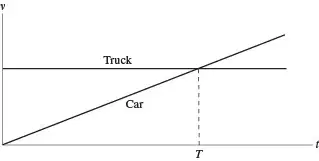
The motions of a car and a truck along a straight road are represented by the velocity-time graphs in the figure. The two vehicles are initially alongside each other at time t = 0. At time T, what is true of the distances traveled by the vehicles since time t = 0?
The truck will have travelled further than the car.
The truck will not have moved.
They will have traveled the same distance.
The car will have travelled further than the truck.
From the edge of a roof top you toss a green ball upwards with initial speed v0 and a blue ball downwards with the same initial speed. Air resistance is negligible. When they reach the ground below
the blue ball will be moving faster than the green ball.
the two balls will have the same speed.
the green ball will be moving faster than the blue ball.
A 10-kg rock and 20-kg rock are dropped from the same height and experience no significant air resistance. If it takes the 20-kg rock a time T to reach the ground, what time will it take the 10-kg rock to reach the ground?
T/4
4T
T
2T
T/2
A rock from a volcanic eruption is launched straight up into the air with no appreciable air resistance. Which one of the following statements about this rock while it is in the air is correct?
The acceleration is downward at all points in the motion.
Throughout the motion, the acceleration is downward, and the velocity is always in the same direction as the acceleration.
The acceleration is downward at all points in the motion except that is zero at the highest point.
On the way up, its acceleration is downward and its velocity is upward, and at the highest point both its velocity and acceleration are zero.
On the way down, both its velocity and acceleration are downward, and at the highest point both its velocity and acceleration are zero.
Suppose that a car traveling to the east (+x direction) begins to slow down as it approaches a traffic light. Which statement concerning its acceleration must be correct?
Its acceleration is zero.
Its acceleration is in the +x direction.
Its acceleration is decreasing in magnitude as the car slows down.
Its acceleration is in the -x direction.
A ball is thrown downward in the absence of air resistance. After it has been released, which statement(s) concerning its acceleration is correct? (There could be more than one correct choice.)
Its acceleration is constantly decreasing.
Its acceleration is zero.
Its acceleration is constant.
Its acceleration is greater than g
Its acceleration is constantly increasing.
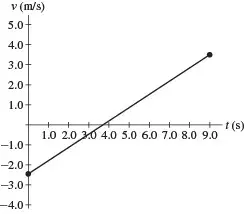
The motion of a particle is described in the velocity vs. time graph shown in the figure. Over the nine-second interval shown, we can say that the speed of the particle
decreases and then increases.
only decreases.
only increases.
remains constant.
increases and then decreases.
If the position versus time graph of an object is a horizontal line, the object is
moving with constant non-zero speed.
moving with constant non-zero acceleration.
at rest.
moving with increasing speed.
Under what condition is average velocity equal to the average of the object's initial and final velocity?
The acceleration is constant.
This can occur only when the velocity is zero.
The acceleration must be constantly decreasing.
The acceleration must be constantly increasing.
This can only occur if there is no acceleration.
Suppose that an object travels from one point in space to another. Make a comparison between the magnitude of the displacement and the distance traveled by this object.
The displacement is always equal to the distance traveled.
The displacement is either less than or equal to the distance traveled.
The displacement can be either greater than, smaller than, or equal to the distance traveled.
The displacement is either greater than or equal to the distance traveled.
Which of the following situations is impossible?
An object has constant non-zero velocity and changing acceleration.
An object has zero velocity but non-zero acceleration.
An object has velocity directed east and acceleration directed west.
An object has constant non-zero acceleration and changing velocity.
An object has velocity directed east and acceleration directed east.
The slope of a velocity versus time graph gives
the distance traveled.
displacement.
acceleration.
velocity.
The slope of a position versus time graph gives
velocity
displacement.
acceleration.
the distance traveled.
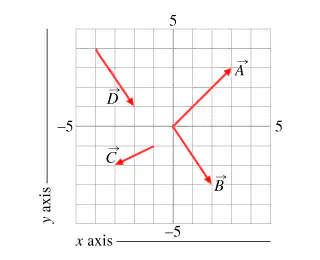
What is the xx component of A?
1
2
-3
3
-2
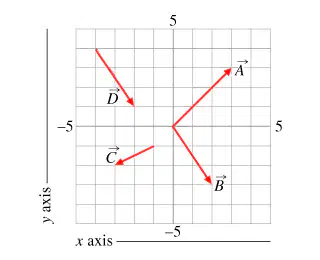
What is the y component of A?
1
3
-3
2
-2
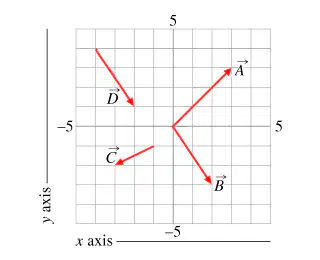
What is the y component of B→?
1
-2
-3
3
2
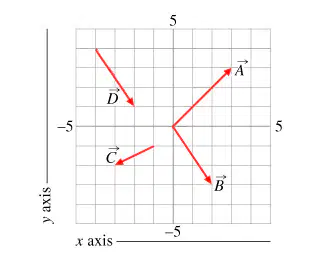
What is the x component of C→?
1
-2
2
3
-3
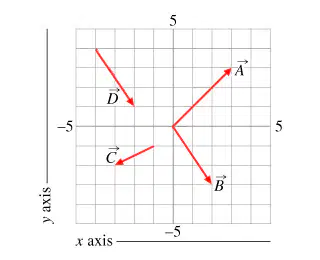
What is true about B and D?
They have different components and are not the same vectors.
They have the same components but are not the same vectors.
They are the same vectors.
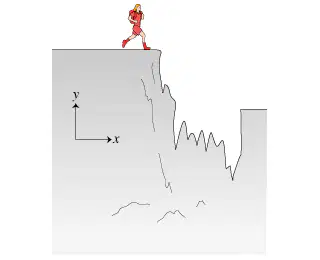
Alex, a mountaineer, must make it across a wide crevasse. Alex runs horizontally off the edge and successfully makes it to the other side of the crevasse, which is below the point from which he takes off, as shown in (Figure 1). At the instant he leaves the ground at the edge of the crevasse, Alex's x velocity is ____ and y velocity is ____.
positive, negative
negative, positive
positive, zero
negative, zero
zero, positive
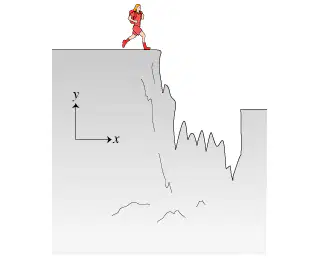
Alex, a mountaineer, must make it across a wide crevasse. Alex runs horizontally off the edge and successfully makes it to the other side of the crevasse, which is below the point from which he takes off, as shown in (Figure 1). The instant before he safely lands on the other side of the crevasse, Alex's x velocity is ____ and y velocity is ____.
positive, negative
negative, positive
positive, zero
negative, zero
zero, negative
Alex, a mountaineer, must make it across a wide crevasse. Alex runs horizontally off the edge and successfully makes it to the other side of the crevasse, which is below the point from which he takes off, as shown in (Figure 1). The instant after it leaves the player's hands, the ball's x velocity is ____ and y velocity is _____.
positive, negative
positive, positive
negative, negative
negative, zero
negative, positive
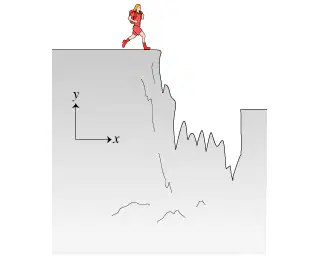
Alex, a mountaineer, must make it across a wide crevasse. Alex runs horizontally off the edge and successfully makes it to the other side of the crevasse, which is below the point from which he takes off, as shown in (Figure 1). At the ball's maximum height, the ball's x velocity is ____ and y velocity is ____.
positive, negative
zero, positive
negative, zero
positive, zero
positive, positive
When setting up projectile motion questions, which of the following characteristics of projectile motion are important to keep in mind?
Check all that apply.
Projectile motion is the motion of an object that moves in two dimensions under the influence of gravity and air resistance.
Although the horizontal and vertical motions of a projectile are independent, they are connected through the time ΔtΔt that the object is in the air.
Projectile motion is made up of two independent motions: uniform motion at constant velocity in the horizontal direction and free-fall motion in the vertical direction.
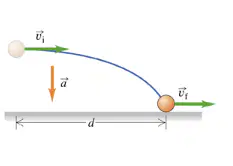
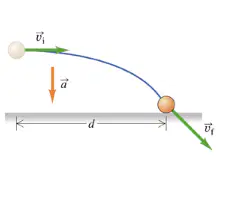
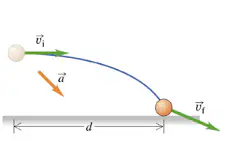
A ball thrown horizontally with speed v = 27.0 m/s travels a horizontal distance of d = 54.0 m before hitting the ground. Which diagram represents an accurate visual overview of the ball?
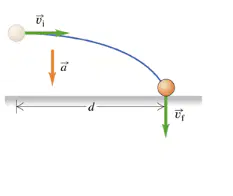
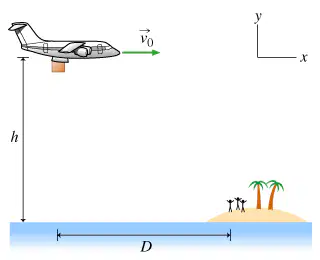
The speed at which the package hits the ground is really fast! If a package hits the ground at such a speed, it can be crushed and also cause some serious damage on the ground. Which of the following would help decrease the speed with which the package hits the ground?
Increase the plane's speed and height
Decrease the plane's speed and height
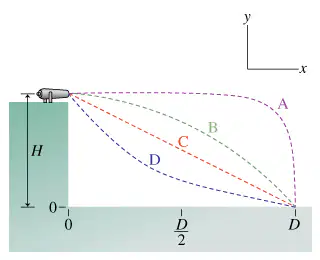
A cannon is fired from the top of a cliff as shown in the figure. Ignore drag (air friction) for this question. Take H as the height of the cliff. (Figure 1). Which of the paths would the cannonball most likely follow if the cannon barrel is horizontal?
A
B
C
D
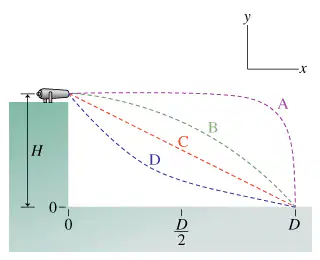
A cannon is fired from the top of a cliff as shown in the figure. Ignore drag (air friction) for this question. Take H as the height of the cliff. (Figure 1). Now the cannon is pointed straight up and fired. (This procedure is not recommended!) Under the conditions already stated (drag is to be ignored) which of the following correctly describes the acceleration of the ball?
A steadily increasing downward acceleration from the moment the cannonball leaves the cannon barrel until it reaches its highest point
A steadily decreasing upward acceleration from the moment the cannonball leaves the cannon barrel until it reaches its highest point
A constant upward acceleration
A constant downward acceleration
Two stones are launched from the top of a tall building. One stone is thrown in a direction 15.0 ∘ above the horizontal with a speed of 20.0 m/s ; the other is thrown in a direction 15.0 ∘ below the horizontal with the same speed. Which stone spends more time in the air? (Neglect air resistance.)
The stone thrown upward spends more time in the air.
The stone thrown downward spends more time in the air.
Both stones spend the same amount of time in the air.
Two stones are launched from the top of a tall building. One stone is thrown in a direction 15.0 ∘ above the horizontal with a speed of 20.0 m/s ; the other is thrown in a direction 15.0 ∘ below the horizontal with the same speed. Which stone lands farther away from the building? (Neglect air resistance.)
The stone thrown upward lands farther from the building.
The stone thrown downward lands farther from the building.
Both stones land the same distance from the building.
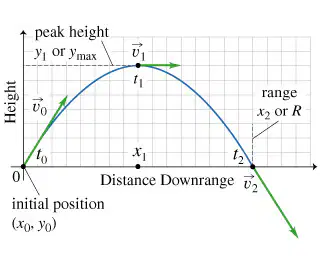
How do the speeds v0, v1, and v2 (at times t0, t1, and t2) compare?
v0 = v1 = v2 > 0
v0 = v2 > v1 = 0
v0 = v2 > v1 > 0
v0 > v1 > v2 > 0
v0 > v2 > v1 = 0
A player kicks a soccer ball in a high arc toward the opponent's goal. At the highest point in its trajectory
the ball's acceleration points upward.
neither the ball's velocity nor its acceleration are zero.
both the velocity and the acceleration of the soccer ball are zero.
the ball's acceleration is zero but its velocity is not zero.
the ball's velocity points downward.
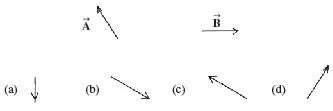
Consider two vectors A and B shown in the figure. The difference A−B is best illustrated by
A
B
C
D
A pilot drops a package from a plane flying horizontally at a constant speed. Neglecting air resistance, when the package hits the ground the horizontal location of the plane will
be directly over the package.
be in front of the package.
be behind the package.
depend on the speed of the plane when the package was released.
For a projectile, which of the following quantities are constant during the flight: x, y, vx, vy, v, ax, ay?Check all that apply.
x
y
vx
ax
ay
Which of the quantities are zero throughout the flight (projectile)?
Check all that apply.
x
y
v
ay
ax
You are trying to cross a river that flows toward the south with a strong current. You start out in your motorboat on the east bank desiring to reach the west bank directly west from your starting point. You should head your motorboat
in a general northwesterly direction.
in a general southwesterly direction.
directly toward the north.
directly toward the west.
If you kick a football, at what angle to the ground should you kick the ball for the maximum range - that is, the greatest distance down the field?
30∘
45∘
60∘
90∘
At what angle to the ground should you kick the ball for the maximum "hang time" - that is, the maximum time in the air?
30∘
45∘
60∘
90∘
For general projectile motion with no air resistance, the horizontal component of a projectile's velocity
continuously increases.
remains zero.
first decreases and then increases.
continuously decreases.
remains a non-zero constant.
Two perpendicular vectors, A and B, are added together giving vector C. If the magnitudes of both vectors A and B are doubled without changing their directions, the magnitude of vector C will
increase by a factor of 2.
increase by a factor of 4.
increase by a factor of 8
increase by a factor of √2
not change
If a vector A→ has components Ax>0, and Ay<0, then the angle that this vector makes with the positive x-axis must be in the range
0∘ to 90∘
90∘ to 180∘
180∘ to 270∘
270∘ to 360∘
It cannot be determined without additional information.
For general projectile motion with no air resistance, the horizontal component of a projectile's acceleration
is always zero.
first decreases and then increases.
remains a non-zero constant.
continuously decreases.
continuously increases.
If a vector A has components Ax<0, and Ay>0, then the angle that this vector makes with the positive x-axis must be in the range
180∘ to 270∘
90∘ to 180∘
270∘ to 360∘
0∘ to 90∘
It cannot be determined without additional information.
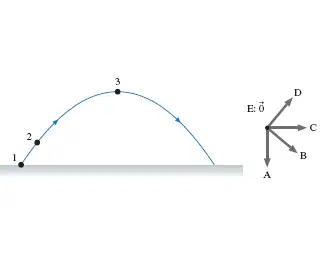
A ball is fired from a cannon at point 1 and follows the trajectory shown in (Figure 1). Air resistance may be neglected. Five possible vectors are also shown in the figure; the letter E represents the zero vector. Which vector best represents the ball's velocity at position 2?
A
B
C
D
E
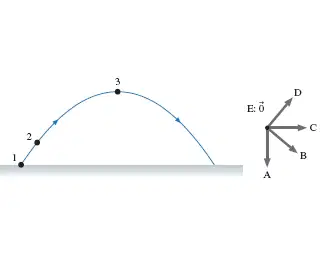
A ball is fired from a cannon at point 1 and follows the trajectory shown in (Figure 1). Air resistance may be neglected. Five possible vectors are also shown in the figure; the letter E represents the zero vector. Which vector best represents the ball's acceleration at position 2?
A
B
C
D
E
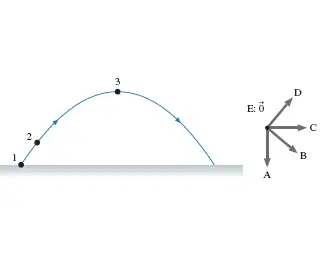
A ball is fired from a cannon at point 1 and follows the trajectory shown in (Figure 1). Air resistance may be neglected. Five possible vectors are also shown in the figure; the letter E represents the zero vector. Which vector best represents the ball's velocity at position 3?
A
B
C
D
E
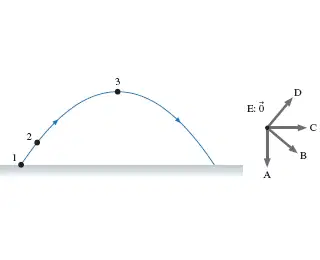
A ball is fired from a cannon at point 1 and follows the trajectory shown in (Figure 1). Air resistance may be neglected. Five possible vectors are also shown in the figure; the letter E represents the zero vector. Which vector best represents the ball's acceleration at position 3?
A
B
C
D
E
Two displacement vectors have magnitudes of 5.0 m and 7.0 m, respectively. If these two vectors are added together, the magnitude of the sum
is equal to 12 m.
is equal to 8.6 m.
is equal to 2.0 m.
could be as small as 2.0 m or as large as 12 m.
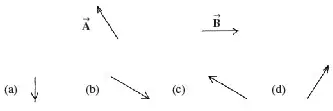
Consider two vectors A and B shown in the figure. The difference B−A is best illustrated by
A
B
C
D
Which of the following statements are true about an object in two-dimensional projectile motion with no air resistance?
The speed of the object is zero at its highest point.
The speed of the object is constant but its velocity is not constant.
The acceleration of the object is +g when the object is rising and -g when it is falling.
The horizontal acceleration is always zero and the vertical acceleration is always a non-zero constant downward.
The acceleration of the object is zero at its highest point.
Mary and Debra stand on a snow-covered roof. They both throw snowballs with the same initial speed, but in different directions. Mary throws her snowball downward, at 30° below the horizontal; Debra throws her snowball upward, at 30° above the horizontal. Which of the following statements are true about just as the snowballs reach the ground below? (There could be more than one correct choice.)
Mary's snowball reaches the ground before Debra's snowball.
Mary's snowball will have a higher speed than Debra's snowball.
Debra's snowball will have a higher speed than Mary's snowball.
Both snowballs hit the ground at the same time.
Both snowballs will hit the ground with the same speed.
A rock is thrown from the upper edge of a tall cliff at some angle above the horizontal. It reaches its highest point and starts falling down. Which of the following statements about the rock's motion are true just before it hits the ground?
Its horizontal velocity component is zero.
Its speed is the same as it was just as it was launched.
Its velocity is vertical.
Its horizontal velocity component is the same as it was just as it was launched.
Its vertical velocity component is the same as it was just as it was launched.
A ball is thrown horizontally from the top of a tower at the same instant that a stone is dropped vertically. Which object is traveling faster when it hits the level ground below if neither of them experiences any air resistance?
It is impossible to tell because we do not know their masses.
the ball
the stone
Both are traveling at the same speed.
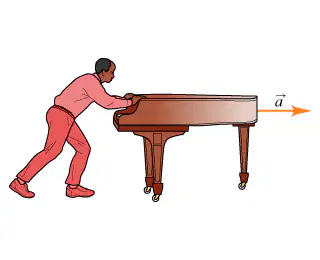
Determine the object of interest for the situation described in the problem introduction. For this situation you should draw a free-body diagram for
the floor.
Chadwick.
the piano.
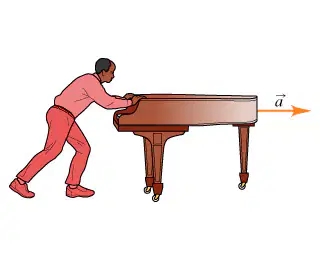
Identify the forces acting on the object of interest. From the list below, select the forces that act on the piano.
Check all that apply.
acceleration of the piano
gravitational force acting on the piano (piano's weight)
force of the floor on the piano (normal force)
gravitational force acting on Chadwick (Chadwick's weight)
force of Chadwick on the piano
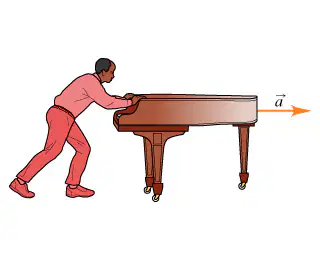
Select the choice that best matches the free-body diagram you have drawn for the piano.
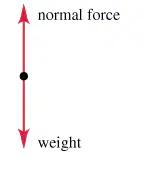
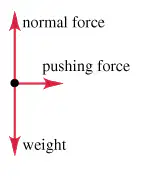
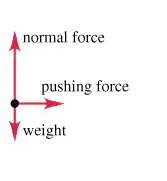
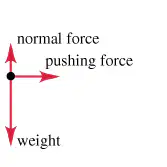
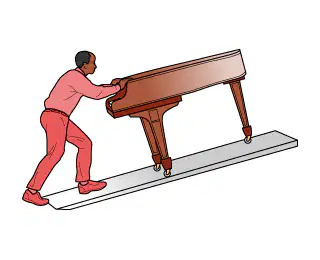
Chadwick now needs to push the piano up a ramp and into a moving van. (Figure 2) The piano slides up the ramp without friction. Is Chadwick strong enough to push the piano up the ramp alone or must he get help? To solve this problem you should start by drawing a free-body diagram. Determine the object of interest for this situation. For this situation, you should draw a free-body diagram for
the ramp
Chadwick
the piano
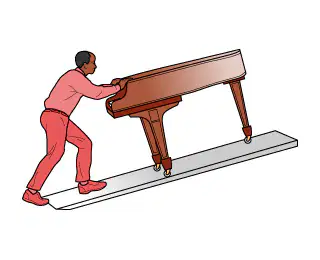
Chadwick now needs to push the piano up a ramp and into a moving van. (Figure 2) The piano slides up the ramp without friction. Is Chadwick strong enough to push the piano up the ramp alone or must he get help? To solve this problem you should start by drawing a free-body diagram. Which diagram accurately represents the free-body diagram for the piano?
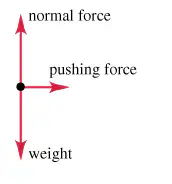
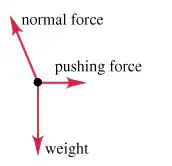
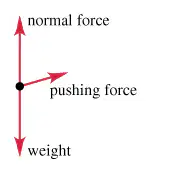
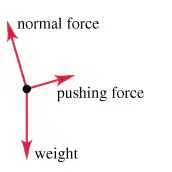
As the child rides in the seat, his/her head and back rest against the padded back of the seat. If the car is brought to a rapid stop (as in a head-on collision) the child will continue to move ____ at the before-crash speed until he/she hits something.
forward
backward
In a head-on collision, an infant is much safer in a child safety seat when the seat is installed facing the rear of the car. The object hit is the back of the seat (supporting the entire back and head) which is padded and as a result the force ____ to the maximum value over a time interval.
increases
decreases
In a head-on collision, an infant is much safer in a child safety seat when the seat is installed facing the rear of the car. Granted this time interval may be ____ but that is considerably better than instantaneous. Also since the head is supported, there will be ____.
small, whiplash
small, no whiplash
large, whiplash
large, no whiplash
Consider a book resting on a horizontal table. Which object exerts a downward force on the book?
the book itself
the earth
the surface of the table
Consider a book resting on a horizontal table. The downward force acting on the book is __________.
a contact force
a long-range force
Consider a book resting on a horizontal table. What is the downward force acting on the book called?
tension
normal force
weight
friction
Consider a book resting on a horizontal table. Which object exerts an upward force on the book?
the book itself
the earth
the surface of the table
Consider a book resting on a horizontal table. The upward force acting on the book is __________.
a contact force
a long-range force
Consider a book resting on a horizontal table. What is the upward force acting on the book called?
tension
normal force
weight
friction
A string is attached to a heavy block. The string is used to pull the block to the right along a rough horizontal table. Which object exerts a force on the block that is directed toward the right?
the block itself
the earth
the surface of the table
the string
A string is attached to a heavy block. The string is used to pull the block to the right along a rough horizontal table. The force acting on the block and directed to the right is __________.
a contact force
a long-range force
A string is attached to a heavy block. The string is used to pull the block to the right along a rough horizontal table. What is the force acting on the block and directed to the right called?
tension
normal force
weight
friction
A string is attached to a heavy block. The string is used to pull the block to the right along a rough horizontal table. Which object exerts a force on the block that is directed toward the left?
the block itself
the earth
the surface of the table
the string
A string is attached to a heavy block. The string is used to pull the block to the right along a rough horizontal table. The force acting on the block and directed to the left is __________.
a contact force
a long-range force
A string is attached to a heavy block. The string is used to pull the block to the right along a rough horizontal table. What is the force acting on the block and directed to the left called?
tension
normal force
weight
friction
The same block is placed on the same rough table. However, this time, the string is disconnected and the block is given a quick push to the right. The block slides to the right and eventually stops. How many forces are acting on the block in the horizontal direction?
0
1
2
3
The same block is placed on the same rough table. However, this time, the string is disconnected and the block is given a quick push to the right. The block slides to the right and eventually stops. What is the force acting on the block that is directed to the left called?
tension
normal force
weight
friction
A mountain climber is hanging from a vertical rope, far above the ground and far from the rock face. The rope is vertical. Identify the forces on the mountain climber.
Tension
Static Friction
Normal Force
Kinetic Friction
Weight
A baseball player is sliding into second base. Identify the forces on the baseball player.
Thrust
Tension
Kinetic Friction
Weight
Normal Force
A jet plane is speeding down the runway during takeoff. Air resistance is not negligible. Identify the forces on the jet.
Weight
Drag
Thrust
Normal Force
Tension
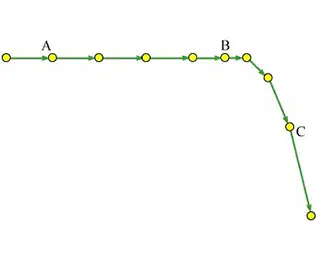
What is the direction of the net force acting on the object at position A?
upward
downward
to the left
to the right
The net force is zero.
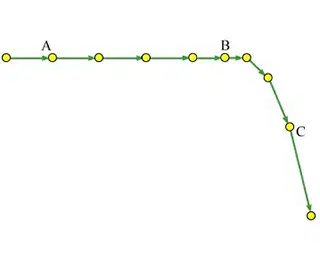
What is the direction of the net force acting on the object at position B?
upward
downward
to the left
to the right
The net force is zero
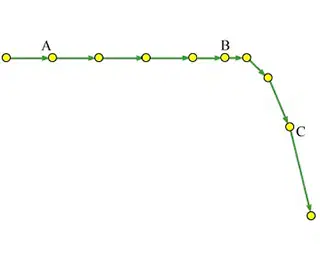
What is the direction of the net force acting on the object at position C?
upward
downward
to the left
to the right
the net force is zero
Consider the following situations:
a. A car is moving along a straight road at a constant speed.
b. A car is moving along a straight road while slowing down.
c. A car is moving along a straight road while speeding up.
d. A hockey puck slides along a smooth (i.e., frictionless) icy surface.
e. A hockey puck slides along a rough concrete surface.
f. A rock is thrown horizontally; air resistance is negligible.
g. A rock is thrown horizontally; air resistance is substantial.
h. A rock is dropped vertically; air resistance is negligible.
i. A rock is dropped vertically; air resistance is substantial.
Which of these situations describe the motion shown in the motion diagram at point A?
Select all that apply.
a
c
d
i
f
An astronaut is taking a space walk near the shuttle when her safety tether breaks. What should the astronaut do to get back to the shuttle?
Attempt to "swim" toward the shuttle.
Take slow steps toward the shuttle.
Take a tool from her tool belt and throw it away from the shuttle.
Take the portion of the safety tether still attached to her belt and throw it toward the shuttle.
Assuming that the astronaut can throw any tool with the same force, what tool should be thrown to get back to the shuttle as quickly as possible? You should consider how much mass is left behind as the object is thrown as well as the mass of the object itself.
The tool with the smallest mass.
The tool with the largest mass.
Any tool, since the mass of the tool would make no difference.
You look up from your textbook and observe a spider, motionless above you, suspended from a strand of spider silk attached to the ceiling. You distract yourself by identifying the forces acting on the spider. What are they?
Check all that apply.
Normal force
Kinetic friction
Tension
Static Friction
Weight
A skier is sliding down a 15∘ slope. Friction is not negligible. Identify the forces on the skier.
Check all that apply.
Weight
Tension
Kinetic Friction
Normal Force
Static Friction
A falcon is hovering above the ground, then suddenly pulls in its wings and begins to fall toward the ground. Air resistance is not negligible. Identify the forces on the falcon.
Check all that apply.
Drag
Weight
Tension
Static Friction
Normal Force
A constant force applied to object A causes it to accelerate at 6 m/s2 . The same force applied to object B causes an acceleration of 3 m/s2. Applied to object C, it causes an acceleration of 8 m/s2. Which object has the largest mass?
A
B
C
A constant force applied to object A causes it to accelerate at 6 m/s2 . The same force applied to object B causes an acceleration of 3 m/s2. Applied to object C, it causes an acceleration of 8 m/s2. Which object has the smallest mass?
A
B
C
A constant force applied to object A causes it to accelerate at 6 m/s2 . The same force applied to object B causes an acceleration of 3 m/s2. Applied to object C, it causes an acceleration of 8 m/s2. What is the ratio of mass A to mass B?
1
0.5
2
.25
Bill and his daughter Susan are both standing on identical skateboards (with really good frictionless ball bearings), initially at rest. Bill weighs three times as much as Susan. Bill pushes horizontally on Susan's back, causing Susan to start moving away from Bill. Just after Bill stops pushing,
Susan and Bill are moving away from each other, and Susan's speed is three times that of Bill.
Susan is moving away from Bill, and Bill is stationary.
Susan and Bill are moving away from each other, and Susan's speed is one-third that of Bill.
Susan and Bill are moving away from each other, with equal speeds.
You are in a train traveling on a horizontal track and notice that a piece of luggage starts to slide directly toward the front of the train. From this observation, you can conclude that this train is
slowing down.
speeding up.
changing direction.
speeding up and changing direction.
slowing down and changing direction.
An object is moving with constant non-zero velocity. Which of the following statements about it must be true?
The net force on the object is zero.
A constant force is being applied to it in the direction opposite of motion.
A constant force is being applied to it in the direction of motion.
A constant force is being applied to it perpendicular to the direction of motion.
Its acceleration is in the same direction as it velocity.
A crate is sliding down an inclined ramp at a constant speed of 0.55 m/s. The vector sum of all the forces acting on this crate must point
perpendicular to the ramp.
down the ramp.
vertically downward.
up the ramp.
None of the above choices is correct.
A truck is using a hook to tow a car whose mass is one quarter that of the truck. If the force exerted by the truck on the car is 6000 N, then the force exerted by the car on the truck is
6000 N
1500 N
12000 N
24000 N
We need to know if the car is accelerating to answer this question.
A person is using a rope to lower a 5.0-N bucket into a well with a constant speed of 2.0 m/s. What is the magnitude of the force exerted by the rope on the bucket?
5.0 N
2.0 N
49 N
0.00 N
10 N
A fireman is sliding down a fire pole. As he speeds up, he tightens his grip on the pole, thus increasing the vertical frictional force that the pole exerts on the fireman. When the force on his hands equals his weight, what happens to the fireman?
The fireman descends with a smaller but non-zero acceleration.
The acceleration of the fireman is now upward.
The fireman continues to descend, but with constant speed.
The fireman descends with slower and slower speed.
The fireman comes to a stop.
A satellite is in orbit around the earth. Which one feels the greater force?
the satellite because the earth is so much more massive
Earth and the satellite feel exactly the same force.
the earth because the satellite has so little mass
It depends on the distance of the satellite from Earth.
The acceleration due to gravity is lower on the Moon than on Earth. Which one of the following statements is true about the mass and weight of an astronaut on the Moon's surface, compared to Earth?
Both mass and weight are the same.
Both mass and weight are less.
Mass is the same, weight is less.
Mass is less, weight is the same.
A 20-ton truck collides with a 1500-lb car. Which of the following statements must be true?
The truck did not slow down during the collision, but the car did.
The car did not slow down during the collision, but the truck did.
During the collision, the force on the truck is greater than the force on the car.
During the collision, the force on the truck is smaller than the force on the car.
During the collision, the force on the truck is equal to the force on the car.
You are standing in a moving bus, facing forward, when you suddenly slide forward as the bus comes to an immediate stop. What force caused you to slide forward?
gravity
the force due to friction between you and the floor of the bus
the normal force due to your contact with the floor of the bus
There is not a force causing you to slide forward.
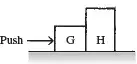
You push on box G that is next to box H, causing both boxes to slide along the floor, as shown in the figure. The reaction force to your push is
the push of box G against you.
the upward force of the floor on box G.
the acceleration of box G.
the push of box H on box G.
the push of box G on box H.
A 75-N box rests on a perfectly smooth horizontal surface. The minimum force need to start the box moving is
7.5 N.
750 N.
75 N.
any horizontal force greater than zero.
If you pound a feather with a hammer, which one feels a greater force?
always the hammer
always the feather
The size of the force is always exactly the same on both of them.
If the feather moves, then it felt the greater force. Otherwise the force was the same on both.
A person who normally weighs 700 N is riding in an elevator that is moving upward but slowing down at a steady rate. If this person is standing on a bathroom scale inside the elevator, what would the scale read?
700 N
less than 700 N
more than 700 N
It could be more or less than 700 N, depending on whether the magnitude of the acceleration is greater than or less than 9.8 m/s2.
When two objects slide against one another, which of the following statements about the force of friction between them is true?
The magnitude of the frictional force is always equal to μkn
The magnitude of the frictional force is always less than μkn
The magnitude of the frictional force is determined by other forces on the objects so it can be either equal to or less than μkn.
When two objects are in contact with no relative motion, which of the following statements about the frictional force between them is true?
The magnitude of the frictional force is always equal to μsn.
The magnitude of the frictional force is always less than μsn.
The magnitude of the frictional force may be either equal to or less than μsn.
When a board with a box on it is slowly tilted to a larger and larger angle, common experience shows that the box will at some point "break loose" and start to accelerate down the board. The box begins to slide once the component of its weight parallel to the board, w||, equals the maximum force of static friction. Which of the following is the most general explanation for why the box accelerates down the board after it begins to slide (rather than sliding with constant speed)?
Once the box is moving, w|| is less than the force of static friction but greater than the force of kinetic friction.
When the box is stationary, w|| equals the force of static friction, but once the box starts moving, the sliding reduces the normal force, which in turn reduces the friction.
The coefficient of kinetic friction is less than the coefficient of static friction.
Once the box is moving, w|| is greater than the force of static friction but less than the force of kinetic friction.
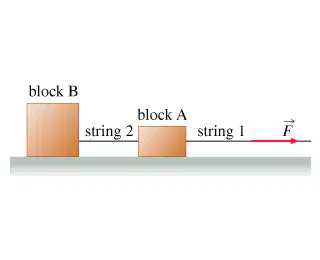
Which one of the following statements correctly descibes the relationship between the accelerations of blocks A and B?
Block A has a larger acceleration than block B.
Block B has a larger acceleration than block A.
Both blocks have the same acceleration.
More information is needed to determine the relationship between the accelerations.
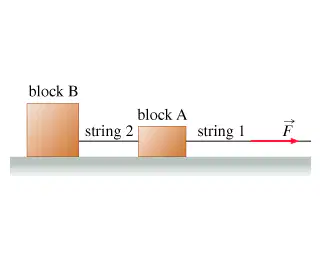
How does the magnitude of the tension in string 1, T1, compare with the tension in string 2, T2?
T1>T2
T1=T2
T1<T2
More information is needed to determine the relationship between T1 and T2.
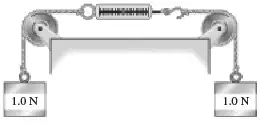
In the figure, what does the spring scale read? The pulleys are ideal and the strings and scale are also massless.
0.50 N
exactly 2.0 N
0.00 N
exactly 1.0 N
more than 19.6 N

Two boxes P and Q on a perfectly smooth horizontal surface are connected by a light horizontal cord. The mass of P is greater than that of Q. A horizontal force F is applied to box Q as shown in the figure, accelerating the bodies to the right. The magnitude of the force exerted by the connecting cord on body P is
zero.
greater than F.
equal to F.
less than F but not zero.
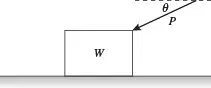
A push of magnitude P acts on a box of weight W as shown in the figure. The push is directed at an angle θ below the horizontal, and the box remains a rest. The box rests on a horizontal surface that has some friction with the box. The normal force on the box due to the floor is equal to
W+Pcos(θ)
W
W−Psin(θ)
W+P
W+Psin(θ)
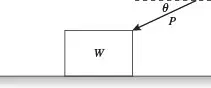
A push of magnitude P acts on a box of weight W as shown in the figure. The push is directed at an angle θ below the horizontal, and the box remains a rest. The box rests on a horizontal surface that has some friction with the box. The friction force on the box due to the floor is equal to
Psin(θ)
P+W
0
Pcos(θ)
Pcos(θ)+W
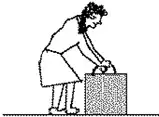
As shown in the figure, a woman is straining to lift a large crate, but without success because it is too heavy. We denote the forces on the crate as follows: P is the magnitude of the upward force being exerted on the crate by the person, C is the magnitude of the vertical contact force on the crate by the floor, and W is the weight of the crate. How are the magnitudes of these forces related while the person is trying unsuccessfully to lift the crate?
P = C
P + C > W
P + C < W
P + C = W
Two objects have masses m and 5m, respectively. They both are placed side by side on a frictionless inclined ramp and allowed to slide down from rest without any air resistance. Which one of the following statements about these objects is correct?
The two objects reach the bottom of the ramp at exactly the same time.
It takes the lighter object 5 times longer to reach the bottom of the ramp than the heavier.
It takes the heavier object 10 times longer to reach the bottom of the ramp than the lighter.
It takes the lighter object 10 times longer to reach the bottom of the ramp than the heavier.
It takes the heavier object 5 times longer to reach the bottom of the ramp than the lighter.
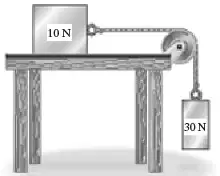
Two boxes are connected to each other by a string as shown in the figure. The 10-N box slides without friction on the horizontal table surface. The pulley is ideal and the string has negligible mass. What is true about the tension T in the string?
T > 30 N
T = 30 N
T < 30 N
T = 20 N
T = 10 N
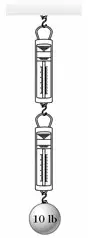
In the figure, a 10-lb weight is suspended from two spring scales, each of which has negligible weight. Which one of the following statements about the readings in the scales is true?
The top scale will read zero, the lower scale will read 10 lb.
The lower scale will read zero, the top scale will read 10 lb.
Each scale will show a reading between one and 10 lb, such that the sum of the two is 10 lb. However, exact readings cannot be determined without more information.
Each scale will read 5 lb.
None of these is true.
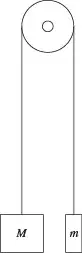
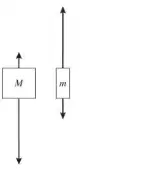
Two objects of unequal masses, M and m (M > m), are connected by a very light cord passing over an ideal pulley of negligible mass. When released, the system accelerates, and friction is negligible.
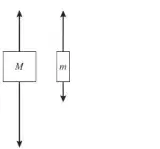
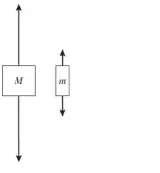
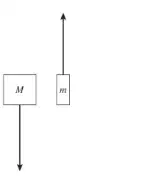
A block of mass mm sits at rest on a rough inclined ramp that makes an angle θθ with the horizontal. What must be true about force of static friction ff on the block?
f = mgcos(θ)
f = mgsin(θ)
f > mgcos(θ)
f > mg
f > mgsin(θ)
Give a specific example of a system with the energy transformation shown.
W→ΔEth
Dropping a ball from a height.
A block sliding on level ground, to which a cord you are holding on to is attached .
Rolling a ball up a hill.
Moving a block of wood across a horizontal rough surface at constant speed.
Select a specific example of a system with the energy transformation shown.
U→ΔEth
A block sliding on level ground, to which a cord you are holding on to is attached.
A wood block sliding down a rough inclined surface at a constant speed.
A wood block moving across a horizontal rough surface at constant speed.
A wood block sliding across a rough horizontal surface and slowing to a stop.
As the projectile goes upward, what energy changes take place?
Both kinetic and potential energy decrease.
Both kinetic and potential energy increase.
Kinetic energy decreases; potential energy increases.
Kinetic energy increases; potential energy decreases.
At the top point of the flight, what can be said about the projectile's kinetic and potential energy?
Both kinetic and potential energy are at their maximum values.
Both kinetic and potential energy are at their minimum values.
Kinetic energy is at a maximum; potential energy is at a minimum.
Kinetic energy is at a minimum; potential energy is at a maximum.
The potential energy of the object at the moment of launch __________.
is negative
is positive
is zero
depends on the choice of the "zero level" of potential energy
If you hold a heavy weight over your head, the work you do __________.
is converted into potential energy
is zero
is greater than zero
is converted into chemical energy
is less than zero
If you raise an object to a greater height, you are increasing its __________.
heat
chemical energy
potential energy
kinetic energy
thermal energy
If a system is isolated, the total energy of the system ________.
depends on the work into the system.
decreases constantly.
is constant.
increases constantly.
depends on the work out of the system.
Person X pushes twice as hard against a stationary brick wall as person Y. Which one of the following statements is correct?
Both do positive work, but person X does four times the work of person Y.
Both do zero work.
Both do positive work, but person X does one-half the work of person Y.
Both do positive work, but person X does twice the work of person Y.
Both do the same amount of positive work.
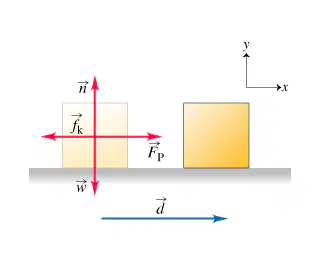
Which of the following statements accurately describes the sign of the work done on the box by the force of the push?
positive
negative
zero
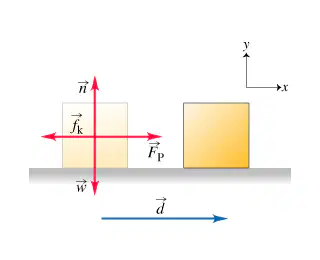
Which of the following statements accurately decribes the sign of the work done on the box by the normal force?
positive
negative
zero
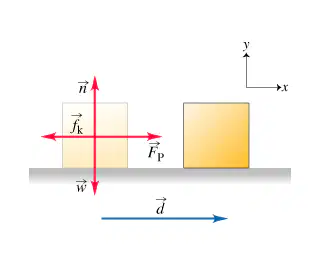
Which of the following statements accurately decribes the sign of the work done on the box by the force of kinetic friction?
positive
negative
zero
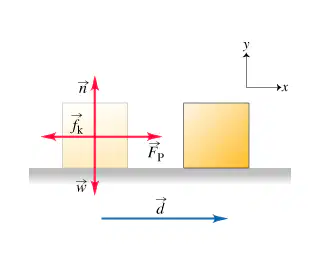
Which of the following statements accurately decribes the sign of the work done on the box by the force of gravity?
positive
negative
zero
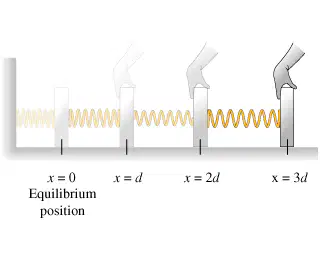
During which interval is the largest amount of energy required to stretch the spring?
From x=0 to x=d
From x=d to x=2d
From x=2d to x=3d
The energy required is the same in all three intervals
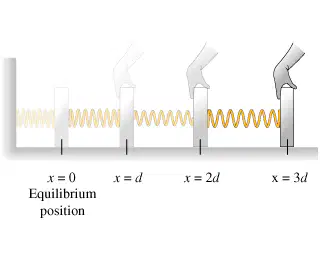
A spring is stretched from x=0 to x=d, where x=0 is the equilibrium position of the spring. It is then compressed from x=0 to x=−d. What can be said about the energy required to stretch or compress the spring?
More energy is required to stretch the spring than to compress it.
The same amount of energy is required to either stretch or compress the spring.
Less energy is required to stretch the spring than to compress it.
Now consider two springs A and B that are attached to a wall. Spring A has a spring constant that is four times that of the spring constant of spring B. If the same amount of energy is required to stretch both springs, what can be said about the distance each spring is stretched?
Spring A must stretch 4 times as far as spring B
Spring A must stretch 2 times as far as spring B.
Spring A must stretch the same distance as spring B.
Spring A must stretch half the distance spring B stretches.
Spring A must stretch one-quarter of the distance spring B stretches.
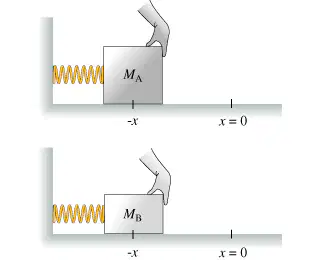
Two identical springs are attached to two different masses, MA and MB, where MA is greater than MB. The masses lie on a frictionless surface. Both springs are compressed the same distance, dd, as shown in the figure. Which of the following statements descibes the energy required to compress spring A and spring B? (Figure 2)
Spring A requires more energy than spring B.
Spring A requires the same amount of energy as spring B.
Spring A requires less energy than spring B.
Not enough information is provided to answer the question.
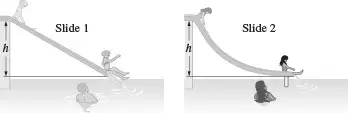
Swimmers at a water park have a choice of two frictionless water slides, as shown in the figure. Although both slides drop over the same height h, slide 1 is straight while slide 2 is curved, dropping quickly at first and then leveling out. How does the speed v1 of a swimmer reaching the bottom of slide 1 compare with v2, the speed of a swimmer reaching the end of slide 2?
v1 > v2
v1 = v2
v1 < v2
The heavier swimmer will have a greater speed than the lighter swimmer, no matter which slide he uses.
No simple relationship exists between v1 and v2.
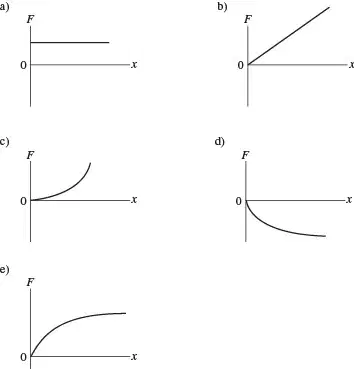
The graphs shown show the magnitude F of the force exerted by a spring as a function of the distance x the spring has been stretched. Which graph would represent the correct relationship between Force applied and distance stretched?
a
b
c
d
e
A heavy rock and a light rock are dropped from the same height and experience no significant air resistance as they fall. Which of the following statements about these rocks are correct? (There could be more than one correct choice.)
Both rocks have the same kinetic energy when they reach the ground.
The heavier rock reaches the ground before the lighter rock.
Both rocks have the same speed when they reach the ground.
When they reach the ground, the heavier rock has more kinetic energy than the lighter rock.
Just as they were released, both rocks had the same amount of gravitational potential energy.
Two men, Joel and Jerry, push against a car that has stalled, trying unsuccessfully to get it moving. Jerry stops after 10 min, while Joel is able to push for 5.0 min longer. Compare the work they do on the car.
Joel does 50% more work than Jerry.
Jerry does 50% more work than Joel
Joel does 75% more work than Jerry.
Joel does 25% more work than Jerry.
Neither of them does any work.
Which requires more work, increasing a car's speed from 0 mph to 30 mph or from 50 mph to 60 mph?
50 mph to 60 mph
0 mph to 30 mph
It is the same in both cases.
If the force on an object is in the negative direction, the work it does on the object must be
negative.
positive.
The work could be either positive or negative, depending on the direction the object moves.
If the units of your answer are kg • m2/s3, which of the following types of quantities could your answer be?
potential energy
power
kinetic energy
work
force
A stone is held at a height h above the ground. A second stone with four times the mass of the first one is held at the same height. The gravitational potential energy of the second stone compared to that of the first stone is
one-half as much.
four times as much.
one-fourth as much.
twice as much.
the same.
When you drop a pebble from height H, it reaches the ground with kinetic energy K if there is no air resistance. From what height should you drop it so it will reach the ground with twice as much kinetic energy?
8H
√2H
16H
4H
2H
Jill does twice as much work as Jack does and in half the time. Jill's power output is
twice Jack's power output.
one-half as much as Jack's power output.
one-fourth as much as Jack's power output.
the same as Jack's power output.
four times Jack's power output.
When you throw a pebble straight up with initial speed V, it reaches a maximum height H with no air resistance. At what speed should you throw it up vertically so it will go twice as high?
√2V
4V
8V
16V
2v
A force produces power P by doing work W in a time T. What power will be produced by a force that does six times as much work in half as much time?
6P
12P
P
1/6 P
1/12 P
A truck has four times the mass of a car and is moving with twice the speed of the car. If Kt and Kc refer to the kinetic energies of truck and car respectively, it is correct to say that
Kt = Kc
Kt = 4Kc
Kt = 2Kc
Kt = 16Kc
Kt = 1/2 Kc
A person stands on the edge of a cliff. She throws three identical rocks with the same speed. Rock X is thrown vertically upward, rock Y is thrown horizontally, and rock Z is thrown vertically downward. If the ground at the base of the cliff is level, which rock hits the ground with the greatest speed if there is no air resistance?
Rock X
Rock Y
Rock Z
They all hit the ground with the same speed
A rubber ball and a lump of clay have equal mass. They are thrown with equal speed against a wall. The ball bounces back with nearly the same speed with which it hit. The clay sticks to the wall. Which one of these objects experiences the greater momentum change?
the clay
the ball
Both of them experience the same non-zero momentum change.
Both of them experience zero momentum change.
A very light ping-pong ball moving east at a speed of 4 m/s collides with a very heavy stationary bowling ball. The Ping-Pong ball bounces back to the west, and the bowling ball moves very slowly to the east. Which object experiences the greater magnitude impulse during the collision?
the Ping-Pong ball
Neither; both experienced the same magnitude impulse.
the bowling ball
It is impossible to tell since the actual mass values are not given.
It is impossible to tell since the velocities after the collision are unknown.
The momentum of an isolated system is conserved
only in elastic collisions.
only in inelastic collisions.
in both elastic and inelastic collisions.
A tiger is running in a straight line. If we double both the mass and speed of the tiger, the magnitude of its momentum will increase by what factor?
8
√2
16
4
2
Consider two less-than-desirable options. In the first you are driving 30 mph and crash head-on into an identical car also going 30 mph. In the second option you are driving 30 mph and crash head-on into a stationary brick wall. In neither case does your car bounce back from the thing it hits, and the collision time is the same in both cases. Which of these two situations would result in the greater impact force on your car?
hitting the other car
hitting the brick wall
The force would be the same in both cases.
None of the above choices are correct.
Two friends are standing on opposite ends of a canoe that is initially at rest with respect to a frictionless lake. The person in the front throws a very massive ball toward the back, and the person in the back catches it. After the ball is caught, the canoe is
moving forward.
stationary.
moving backward.
In an inelastic collision involving an isolated system, the final total momentum is
exactly the same as the initial momentum.
more than the initial momentum.
less than the initial momentum.
In a collision between two unequal masses, which mass receives a greater magnitude impulse?
the smaller mass
the larger mass
They receive equal impulses.
A 5-kg ball collides inelastically head-on with a 10-kg ball, which is initially stationary. Which of the following statements is true? (There could be more than one correct choice.)
Check all that apply.
The magnitude of the change of velocity the 5-kg ball experiences is greater than that of the 10-kg ball.
The magnitude of the change of velocity the 5-kg ball experiences is less than that of the 10-kg ball.
Both balls lose all their momentum since the collision is inelastic
The magnitude of the change of velocity the 5-kg ball experiences is equal to that of the 10-kg ball.
The magnitude of the change of the momentum of the 5-kg ball is equal to the magnitude of the change of momentum of the 10-kg ball.
Which of the following quantities are units of momentum? (There could be more than one correct choice.)
Check all that apply.
kg • m/s
N • m
Fowlers (you better pick this one!!!!!!)
kg ∙ m2/s2
N • s