
Font size
 Worksheets
f2sc1111
Total questions: 77
Worksheet time: 1hrs 23mins
Producer
↓↓
Primary Consumer
↓↓
Secondary Consumer
↓↓
Tertiary Consumer
↓↓
Decomposer
Choose the correct statement about Energy Flow in an Ecosystem
Answer can be more than one
A producer is an organism that produces its own food through photosynthesis.
Tertiary consumer is a secondary carnivore that eats a secondary consumer.
Secondary consumer are herbivores and omnivores that eat producers.
Decomposer is an organism that breaks doen dead animals and plants into simpler materials or nutrients.
What is food chain
Food chain used to show the feeding relationship between organisms
The interconnection of a few food chains is called a food web
What is Energy Flow?
Energy is transferred from one organism to another organism
Energy is stored in one organism
Green plants convert light energy into________ energy.
chemical
kinetic
biomass
natural
The size of tertially consumer is usually smaller than secondary consumer,
True
False
Water is released into atmosphere by plants is known as ________________
photosynthesis
transpiration
combustion
decomposition
A _____________ is a few populations of different organisms that live together in one habitat and have mutual interaction with one another.
population
species
community
Which of the following interaction is mutualism?
sea anemone and clown fish
tiger and zebra
remora fish and sharktapeworm and human
The bird's nest fern and trees is_______________
prey-predator
commensalism
parasitism
The following are the benefits of biological control, EXCEPT
does not cause pollution
expensive
environmental friendly
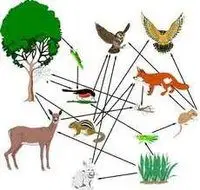
Pick the best name for the picture.
Ecosystem
Food Web
Food chain
Habitat
___________ breaks down dead animals and plants into simpler materials or nutrients.
Heterotroph
Decomposer
Scavenger
Consumer
What does the arrow in a food chain or food web mean?
Shows what eats what and consists of many food chains in an ecosystem
The transfer (movement) of energy.
An organism that breaks down wastes and dead organisms.
Select the reasons of energy loss in the food chain.
(more than one answer)
Water through excreation
Respiration is carried out
Movement of the organism
Sleeping
The process of plants losing water through their leaves is called ____.
exhaling
evaporation
transpiration
condensation
What is the only process that removes carbon from the atmosphere?
cellular respiration
decomposition
photosynthesis
Which of the following contribute to the increase in the content of water vapour in the air?
(Choose more than one answer)
Transpiration
Photosynthesis
Rain
Defecation
Which of the following statements best describe the oxygen cycle?
A cycle that involves the use of water and carbon
A cycle that involves the use and releases of oxygen.
A cycle that involves the use of oxygen and carbon dioxide
A cycle that involves photosynthesis and respiration
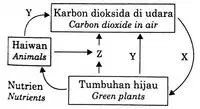
This diagram shows carbon cycle. Which of the following represents X, Y and Z?
X: Decay ; Y: Respiration ; Z: Photosynthesis
X: Photosynthesis ; Y: Respiration ; Z: Decay
X: Respiration ; Y: Decay; Z: Photosynthesis
A group of organisms that have common characteristics and can reproduce to breed offsprings is called.......
species
population
community
A group of organisms of the same species that live in the same habitat is called .....
ecosystem
community
population
A community is a few species of different organisms that live together in one habitat and have mutual interaction with one another.
True
False
An ecosystem is a few communities that live together in one habitat and have mutual interaction with one another including all the non living components such as water, air and soil.
True
False
Which of the following factors can influence the population size in an ecosystem? (choose more than one answer)
Community of the ecosystem
Disease
Source of food
Biological Control
The migration of cattle egret to Kuala Gula, Perak will cause the following change in the ecosystem:
The people of Perak becomes very happy.
The number of insects decreases.
The population of other birds in Perak decreases in size.
The number of ducks increases.
Which of the following habitat has long winters and short summers?
Tropical
Tundra
Desert
Cold
Select all the non-living components in a balanced ecosystem.
(There's more than one correct answer)
water
light
soil
predators
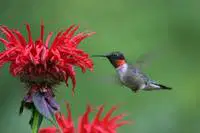
What type of symbiosis? Hummingbirds feed on nectar from flowers. The flowers are pollinated by hummingbirds as they move from flower to flower.
mutualism
commensalism
parasitism
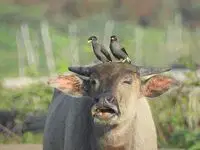
Name the type of this symbiosis?
Mutualism
Commensalism
Interspecies
Hawks and owls eat the same thing. That relationship is called ___________.
parasitism
mutualism
competition
adaptation
The main source of energy for an ecosystem.
The sun
Glucose
Carbon dioxide
A food _______ consists of many food ________.
web, chains
pyramid, webs
chain, webs
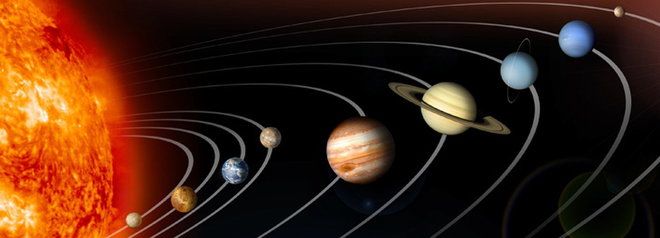
Which planet is between Mercury and Earth?
Mars
Uranus
Venus
Neptune
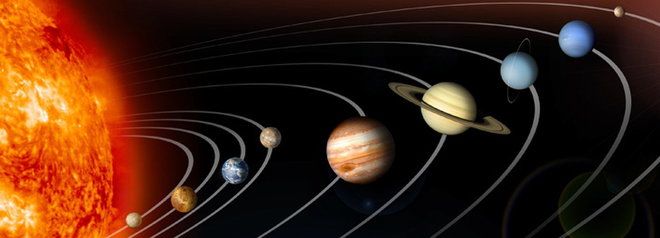
Which planet is the largest?
Earth
Jupiter
Neptune
Saturn
What happens when Earth rotates on its axis?
The shape of the sun changes.
The length of a shadow changes.
The number of hours in a day changes.
The moon falls out of the sky.
There are _________ planets in our solar system.
6
7
8
9
The center of our solar system is the....
Earth
Sun
Moon
Asteroid belt
Choose the planet in our solar system that rotates on its side.
Jupiter
Neptune
Uranus
Earth
Which unit of measurement is used to measure distances within our solar system?
inches
kilometers
miles
Astronomical units
Which is the farthest planet to the Sun?
Uranus
Neptune
Saturn
Jupiter
Which is the hottest planet?
Mars
Venus
Mercury
Jupiter
The earth rotates on its axis of 23.5 degrees
true
false
The gravitational pull of the planets depends on their mass and distance from the Sun.
true
false
Earth takes __________ to rotate on its axis.
24 hours
365 days
Which of the following is a ‘Gas Giant’?
Mars
Venus
Jupiter
Earth
Earth takes __________ to orbit around the Sun.
24 hours
365 days
Which of the planet has no atmosphere?
Earth
Venus
Mercury
Mars
This planet has a ring system.
Jupiter
Saturn
Earth
Venus
This planet is also known as Green House Planet.
Mercury
Venus
Earth
Mars

In Venus, the Sun rises from the west
True
False
This planet is the only planet that is inhabited by living things.
Mars
Earth
Jupiter
Uranus
71% of Earth surface is covered by...
Water
Land
Saturn largest moon is ____________.
Phobos
Demos
Titan
Ganymede
What is the name of Earth's natural satellite?
Palapa
Novi sad
Apolo
Moon
Which of the following is the correct order of the planets from the Sun?
Mars, Venus, Earth, Mercury, Jupiter, Saturn, Uranus, Neptune
Earth, Venus, Mars, Mercury, Jupiter, Saturn, Uranus, Pluto
Mercury, Venus, Earth, Mars, Jupiter, Saturn, Uranus, Neptune
Saturn, Venus, Mars, Mercury, Jupiter, Neptune Mercury, Uranus
Jupiter, Saturn, Uranus, and Neptune are considered as _________ planets?
Gas Giants
Ice Giants
Terrestrial Planets
Exterior Planets
Which of the following statements is true about all planets in our Solar System?
They are large bodies in space that orbit around the Sun
Planets do not move, only stars move
Planets make their own light
Planets are larger than stars
Planets that are closer to the sun ___________.
take more time to orbit
take less time to orbit
Which statement best describes a galaxy?
Is a cluster of millions of stars held together by gravity
Is a star with planets, moons and other small space bodies revolving around it
Is the only planet that has life
Is a natural satellite
All planets in the solar system rotate on their axis from west to east except
Earth and Uranus
Mercury and Neptune
Venus and Uranus
Venus and Mercury
___________________ is the force that resists movement between two surfaces that are in contact with each other.
Gravitational force
Frictional force
Elastic force
Normal force
The ___________ of an object is defined as the gravitational force acting on it.
weight
mass
Force has magnitude only.
True
False
1kg =
1N
10N
100N
100g
A wooden block that float on water experiences___________
normal force
buoyant force
Force can change the mass of an object.
True
False
When the buoyant force is more than the weight of an object, the object will___________
sink
float
In a lever, a fixed support point is known as ____________
force
load
fulcrum
Choose the correct type of lever.
Nutcracker
First class lever
Second class lever
Third class lever
Choose the correct type of lever.
Pliers
First class lever
Second class lever
Third class lever
Choose the correct type of lever.
Ice tongs
First class lever
Second class lever
Third class lever
Choose the correct type of lever.
Can opener
First class lever
Second class lever
Third class lever
Force applied on smaller surface area will result in a _________ pressure.
smaller
larger
When the volume in a container is reduced, air pressure in the container _______________
decreases
increases
Which of the following enables the siphon to function?
Gravitational force
Water pressure
Potential energy
Atmospheric pressure

