

wayground logo

Free Printable Worksheets

Font size

S
M
L
XL
Worksheets

Entire First Semester Review

Total questions: 49

Worksheet time: 38mins
Name
Class
Date
1.
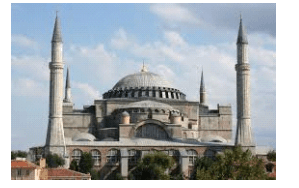
Identify this Byzantine Church that was commissioned by Justinian.
a)
Hagia Sophia
b)

Hippodrome

c)

Chora Church

d)
Taj Mahal
2.

Who conquered the Byzantine Empire?

a)

Ottoman Turks

b)

Islamic Turks

c)

Romans

d)

Huns

3.

Constantinople is now known as ?

a)

Alexandria

b)

Istanbul

c)

Rome

d)

Venice

4.

After the Roman Empire collapsed which emperor decided to move the capital and name it after himself?

a)

Theadora

b)

Constantine

c)

Justinian

d)

None of the above

5.

This European trader and explorer wrote of his journey and time in the court of Kublai Khan?

a)

Marco Polo

b)

Ibn Battuta

c)

Zheng He

d)

Vasco de Gama

6.
What was true of the Mongol Empire?
a)
The Mongol Empire treated all conquered people horribly.
b)
Mongols refused to adopt aspects of the cultures they conquered.
c)
The Mongol Empire was the largest unified land empire in history.
d)
Mongols forced conquered peoples to convert to their religion.
7.
What is true about the boundaries of the Mongol Empire?
a)
It included North and South America
b)
It was very small compared to other empires.
c)
It stretched across Europe and Asia.
d)
It was never peaceful or stable.
8.

Even though the Mongols conquered most cities they came across,

a)

they begged the surviving citizens to travel with them after

b)

they gave food/water to those who survived the initial onslaught

c)

They kept the silk road trade routes safer

d)

they left the local leaders in power to rule

9.

Which of the following describes how the Grand Canal helped the Chinese economy?

a)

It connected northern China to Southern China, which increased trade

b)

It carried farmers into town from far cities

c)

It created road construction jobs.

d)

It brought a boom in shipbuilding.

10.

Why did Europeans refer to fine dinnerware as "china”?

a)

Europeans copied Chinese art to print on their pottery.

b)

Chinese pottery was common in Europe because of its low cost.

c)

The shapes of Chinese plates and bowls were popular in Europe.

d)

Rich Europeans bought Chinese pottery because of its high quality.

11.

Which Chinese invention led to less use of arrows, swords, and spears in warfare?

a)

A. steel

b)

B. compass

c)

C. telegraph

d)

D. gunpowder

12.

In Medieval China, government improved because the selection of officials was based on

a)

Birthright

b)

Status

c)

Civil Service Exam scores

d)

former military service

13.

What is Confucianism?

a)

a philosophy taught by Confucius that stresses proper relationship

b)

a philosophy stressing the strict use of laws to control behavior

c)

an ancient Chinese philosophy based on the teachings of Laozi

d)

a belief that the stars and planets control human behavior

14.
Warriors in Japan who pledge loyalty to a Noble:
a)
Samuari
b)
Martial
c)
Tanka
d)
Guild
15.
Belief that all natural things are alive: 
a)
Clan
b)
Animism 
c)
Shrine
d)
Shogun
16.
Military ruler in Japan: 
a)
Sect
b)
Samurai
c)
Shogun
d)
Martial Arts 
17.
Powerful military lords who controlled small territories in Japan
a)
daimyo
b)
shoguns
c)
samurai
d)
emperior
18.

Which geographical feature was a barrier to African trade?

a)

Mount Kilimanjaro

b)

Amazon River

c)

Hadrian's Wall

d)

Sahara desert

19.

Pick the two trade items that helped West Africa grow.

a)

paper

b)

gold

c)

silk

d)

salt

20.
How did the empire of Ghana become rich?
a)
trade routes
b)
taxing traders
c)
mining gold 
d)
trading salt
21.

What city in Africa was the leading center of Islam?

a)

Mohenjo-Daro

b)

Gao

c)

Kumbi-Saleh

d)

Timbuktu

22.
Ghana grew very rich after they took over the ___________ trade routes.
a)
trans-saharan
b)
silk road
c)
sub-saharan
d)
european
23.

African storytellers are called

a)

griots

b)

priests

c)

shaman

d)

author

24.

What religion spread from Arabia into Africa beginning in the A.D. 600's?

a)

Judaism

b)

Islam

c)

Daoism

d)

Christianity

25.

Which African king helped spread Islamic influence through Africa and southwest Asia?

a)

King Nzinga

b)

Mansa Musa

c)

Sundiata Keita

d)

Nelson Mandela

26.

The _________ Empire fell, plunging Europe into the Dark Ages.

a)

Byzantine

b)

Persian

c)

Roman

d)

Greek

27.

Who was "tied" to the manor (unable to leave), forced to work the land and provide goods and services to their lord?

a)

Lords

b)

Knights

c)

Kings

d)

Serfs

28.

Who was the leader of the Catholic church?

a)

King

b)

Bishop

c)

Pope

d)

Cardinal

29.

What does it mean to be excommunicated by the Church?

a)

made a church leader.

b)

kicked out of the church.

c)

accepted into the church.

d)

church won't talk to you anymore.

30.

What was a guild?

a)

knight's code of honor.

b)

organization that helped protect craftsmen and set standards for production of goods.

c)

feudal group that was given land from the king.

d)

group of people that presented laws to the king.

31.

Leader of the Franks from 768 to 814 CE., unified Western Europe, crowned Holy Roman Emperor

a)

Leo II

b)

Odoacer

c)

Charlemagne

d)

Charles Martel I

32.

Feudal society was centered around what?

a)

Code of chivalry

b)

Manor system

c)

Ongoing conflict

d)

Religious devotion

33.
When Rome fell in AD 476, life in Europe changed.  How did life in the early Middle Ages differ from Roman times?
a)
trade increases
b)
people moved from rural areas to citiies
c)
education and literacy declined
d)
the population increases
34.

Religious men who lived apart from society in isolated communities

a)

medieval

b)

Charlemagne

c)

monks

d)

Pope

35.

Tasks of a monk could include...

a)

Hand copying books or parts of the Bible

b)

Long hours spent in prayer

c)

Teaching others at a school.

d)

Caring for the sick

e)

All of the above.

36.
A series of holy wars between Christians and Muslims over the Holy Land
a)
Crusades
b)
King
c)
Nobility
d)
Knight
e)
Peasant
37.
Someone who buys and sells goods in large quantities
a)
Merchant
b)
Manor
c)
Trade
d)
Plague
e)
Reconquista
38.
A disease that causes death and spreads quickly to a large number of people
a)
Plague
b)
Manor
c)
Merchant
d)
Trade
e)
Reconquista
39.

Long war to drive the Muslims out of the Iberian Peninsula

a)
Reconquista
b)
Manor
c)
Merchant
d)
Trade
e)
Plague
40.
King forced to sign the Magna Carta in 1215 by which he agreed to accept limits on his power as king
a)
King John
b)
Manor
c)
Merchant
d)
Trade
e)
Plague
41.
Who called for the Crusades, and why?
a)
Ferdinand and Isabella to eradicate heresy
b)
Pope Urban II to reclaim the Holy Land
c)
Seljuk Turks to halt the spread of Islam
d)
William, Duke of Normandy, to extend French rule
42.
Which of these contributed to the end of feudalism and the Middle Ages?
a)
decline of the merchant class
b)
expansion of clergy
c)
growth of cities
d)
shift of power from kings to local lords
43.
What did the Magna Carta do?
a)
extended property rights to peasants
b)
made the king subject to the rule of law
c)
organized barons into a parliament
d)
restored and organized English common law
44.

What killed 40-50% of the population of Europe in the 1300s?

a)
bubonic plague
b)
invasion of the Turks
c)
religious persecution
d)
wars among kingdoms
45.
Two important farming inventions of the Middle Ages that made turning over soil faster were the horse collar and
a)
the windmill.
b)
crop rotation.
c)
the wheeled plow.
d)
the village mill.
46.
The Black Death spread quickly along which trade route?
a)
China Road
b)
Ivory Road
c)
Silk Road
d)
Trade Road
47.
Which of the following was one effect of the Crusades on Western Europe?
a)
Feudalism became a stronger institution.
b)
Christians and Muslims united.
c)
Wealthy Europeans began to demand Eastern goods.
d)
The economy suffered because trade between western and eastern peoples was no longer possible.
48.
Why did peasants move to the cities?
a)
to avoid the plague
b)
to join the army
c)
to become nobility
d)
for jobs that had higher wages
49.

What was the purpose of the Inquisition?

a)

To force all non-Christians out of Spain

b)

To defeat the Mongols

c)

To improve education within Europe

d)

For King Henry to serve as military leader
