
Font size
 Worksheets
Environmental Systems Semester 1 Final
Total questions: 50
Worksheet time: 1hrs 15mins
What is the water cycle?
The process of water evaporating from the Earth's surface and condensing in the atmosphere, then falling back to the surface as precipitation.
The process of water freezing and melting in the Earth's polar regions.
The process of water being absorbed by plants and released through transpiration.
The process of water being stored in underground aquifers.
Plants interact with living and nonliving components in their environment. Which of the following is an interaction between the plant and a nonliving element?
Small insects eating the stems of the plants
Humans breathing oxygen released by plants
Bees gathering pollen from flowers of plants
Sandy soil holding the roots of the plants
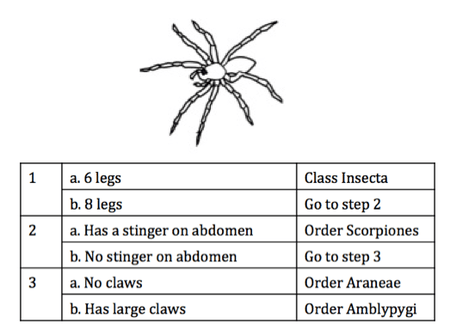

A student discovers an arachnid with a segmented abdomen, long legs, and a tail with no stinger.
The student uses the dichotomous key below to identify it.
1. a) Abdomen segmented.............go to 2
b) Abdomen not segmented ......go to 4
2. a) Abdomen with tail....................go to 3
b) Abdomen without tail...............go to 5
3. a) Tail with stinger..........................Scorpion
b) Tail without stinger.....................Whip scorpion
4. a) Legs longer than body.............Daddy Long Legs
b) Legs not longer than body……….Wind scorpion
5. a) Covered with spines .......................Mite
b) Few spines.....................................Tick
Whip Scorpion
Daddy Long Legs
Mite
Tick
Species that are crucial to the functioning of an ecosystem
keystone species
exotic species
invasive species
indicator species
endangered species
The ecological relationship between plants and pollinators can be best described as _____________________.
parasitic
mutualistic
commensalistic
nonobligate
Why do invasive species negatively impact their environment?
Invasive species only negatively impact their environment when they are animals, not plants
Invasive species alter an ecosystem by ___________in number quickly, which decreases native species and ___________ genetic diversity.
increasing / increases
increasing / decreases
decreasing / decreases
decreasing / increases

Biome with plants and grasses, but very few trees.
Grasslands
Desert
Deciduous Forest

Which biome is the most biodiverse?
Desert
Rainforest

Two examples of fossil fuels are (a) and (b) .


Which climate graph is for a wet and hot rainforest?

tropical rain forest

temperate deciduous forest

desert

According to the graph, which Biome has the highest annual temperature along with the lowest annual precipitation?

All energy in an ecosystem comes from the sun. This energy is passed through the ecosystem as organisms eat other organsims.
Ominvores
Herbivores
Detritivores
Flow of energy
If the producers have 1,000 joules of energy, click on the level that will have 10 joules.
Which nutrients are primarily responsible for eutrophication?
Phosphorus and nitrogen
Carbon and oxygen
Hydrogen and helium
Sulfur and potassium
Eutrophication is caused by
excess nutrients building up in the water.
industrial point-source pollution.
unlined landfills and septic tanks.
wastewater from homes mixing with drinking water.

Forests are carbon sinks because they remove carbon dioxide from the atmosphere through ____________.
combustion
respiration
photosynthesis
decomposition
Why do living things need nitrogen?
To get energy
To make amino acids
To make proteins
To make proteins AND amino acids
What is the largest reservoir for water?
the ocean
rocks and minerals
the atmosphere
glaciers
Carbon Dioxide (CO2) is released in which of the following processes?
photosynthesis
decomposition
combustion
cellular respiration

Match the following description to the name of the process.
condensation
clouds
evaporation
water vapor
precipitation
rain, snow, sleet
transpiration
evaporation of water in plants

When a dead plant decomposes into the soil, the interaction is between the __________ and the _____________.
atmosphere and hydrosphere
biosphere and geosphere
hydrosphere and biosphere
atmosphere and geosphere
When an animal or human breathes air, the interaction is between the __________ and the _____________.
atmosphere and hydrosphere
biosphere and geosphere
hydrosphere and biosphere
atmosphere and biosphere

When a river current erodes the banks of the river, the interaction is between the __________ and the _____________.
atmosphere and hydrosphere
biosphere and geosphere
hydrosphere and geosphere
atmosphere and biosphere

When lake water evaporates, the interaction is between the __________ and the _____________.
atmosphere and hydrosphere
biosphere and geosphere
hydrosphere and geosphere
atmosphere and biosphere
Label the layers of Earth's geosphere.
CRUST
INNER CORE
OUTER CORE
MANTLE
Match the following relationships to their definitions
Mutualism
Relationship where both species benefit
Commensalism
One species benefits, the other is neither helped nor harmed
Competition
Interaction where both species are harmed
Parasitism
One species benefits at the expense of the other
Predation
One species kills and consumes the other
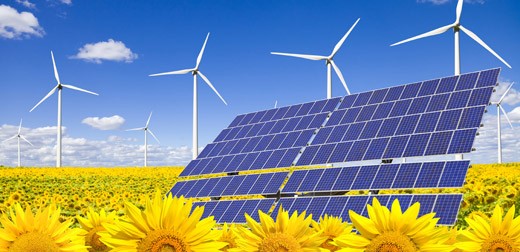
__________ is an energy resource that WILL NOT run out in the next several hundred years.
Renewable Energy Resource
Nonrenewable Energy Resource
Fossil fuels
biodegradable

Wind is a renewable resource.
True
False

Oil is a renewable resource.
True
False
Energy that is made from the power of moving water
Hydroelectric
Coal
Biomass
Wind
Which of the following are nonrenewable energy sources? (Select all that apply.)
Coal
Oil
Natural Gas
Nuclear Energy
Which of the following are renewable energy sources? (Select all that apply.)
Solar
Wind
Hydroelectric
Geothermal
Biomass
What is the primary purpose of the EPA?
To oversee financial markets
To regulate international trade
To protect human health and the environment
To manage national defense
Label the horizons in the soil profile.
R Horizon
C Horizon
B Horizon
A Horizon
O Horizon
The proportions of sand, silt, and clay in soil determine its (a) , which describes how well water flows through it, and its density, calculated by dividing (b) by (c) .
Which of the following is NOT an example of surface water?
aquifers
lakes
rivers
streams
wetlands
All of the land area whose water drains into a stream system.
Watershed
Reservior
Headwaters
Erosion
3% of water is ____
surface water
freshwater
saltwater
frozen


