
 Worksheets
2023 Veterinary Science #1-20 + Livestock ID
Total questions: 25
Worksheet time: 13mins
At what age is a horse said to have a “full mouth”, having replaced all temporary teeth with permanent ones?
One year of age
Three years of age
Five years of age
Seven years of age
The layman’s term “wolf teeth” refers to which kind of tooth in the horse?
Incisor
Canine
Premolar
Molar
What is the layman’s term for serious abdominal pain in the equine patient?
Lethargy
Colic
Maldigestion
Peritonitis
Situated primarily on the right side of the horse, what is the name of the blind-ended fermentation vat immediately after the ileum?
Large colon
Rumen
Jejunum
Cecum
Which macronutrient is NOT primarily absorbed by the horses’ small intestine?
Structural carbohydrates (dietary fiber)
Non-structural carbohydrates (starch)
Protein
Fat
What is the average gestational length in an adult horse?
240 days
290 days
340 days
390 days
A horse is considered a(n) __________ species, due to the frequency of their estrous cycle(s).
Monestrous
Diestrous
Polyestrous
Induced ovulatory
A castrated male horse is called a(n) __________?
Mule
Gelding
Stallion
Steer
In what part of the mare’s reproductive tract does embryonic implantation occur?
Uterus
Cervix
Ovary
Vulva
During the parturition process in the mare, one would expect which of the following sequences to normally occur (from first to last):
Foal passes through birth canal, frequent urination, appearance of water bag.
Appearance of water bag, placenta passed, foal passes through birth canal.
Appearance of water bag, foal passes through birth canal, placenta passed.
Foal’s front feet present, appearance of water bag, placenta passed.
A horse with a body condition score of 8 would likely have the following physical attributes:
A. Neck – noticeable thickening; Withers – fat beginning to be deposited
B. Ribs – individual ribs can be felt; Back – slight (positive) crease down back
C. Shoulders – blend smoothly into body; Ribs – fat over ribs fleshy/spongy
D. Ribs – difficult to feel; Tailhead – fat around tailhead very soft
Restraint with a mechanical twitch works by:
Releasing endorphins
Creating pain as a distraction to the horse
Using injectable sedatives
Diversionary device
In horses’ wounds can develop exuberant granulation tissue. This is commonly known as
Necrotic tissue
Healthy tissue growth
Epithelialization
Proud flesh
When treating a wound on a horse, of the following, what is the first step?
Apply antibiotic ointment
Remove the hair from the edges of the wound
Lavage the wound
Debride the wound
When bandaging wounds, the secondary layer performs what function?
Debridement
Covers surgical incisions/wounds
Provides support
Protects epithelialization
Reactive airway disease in horses, recognized as causing difficulty in breathing, chronic cough, wheezing, and nasal discharge, is commonly known by horse owners as:
Thumps
Hives
Heaves
Gasps
The normal resting respiratory rate for a mature, full-sized horse is:
28-36 breaths per minute
18-26 breaths per minute
8-16 breaths per minute
48-56 breaths per minute
The anatomical term for the large cartilaginous tube that connects the larynx to the bronchi of the lungs, and commonly known as the “windpipe” is known as:
Esophagus
Trachea
Aorta
Ileum
Which of the following is a common equine respiratory disease that horse owners will have their horses vaccinated for?
Equine herpesvirus types 1 and 4 (Equine Rhinopneumonitis)
West Nile Virus
Potomac Horse Fever
Eastern Equine Encephalitis
Oxygen in the lungs is exchanged between the blood capillaries and what respiratory structure?
Bronchi
Villi
Alveoli
Trachea

Brown Swiss
Ayrshire
Guernsey
Holstein

Brown Swiss
Jersey
Guernsey
Holstein
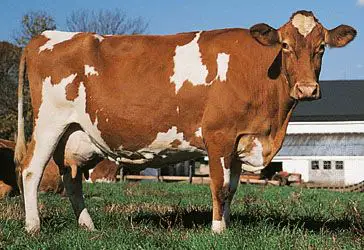
Brown Swiss
Ayrshire
Guernsey
Holstein

Brown Swiss
Ayrshire
Guernsey
Holstein

Brown Swiss
Ayrshire
Guernsey
Holstein

