wayground logo

Free Printable Worksheets

Font size

S
M
L
XL
Worksheets

Neet 2

Total questions: 50

Worksheet time: 30mins

Name
Class
Date
1.

Which reaction is not an electrophilic addition ?

a)

A

b)

B

c)

C

d)

D

2.

Which diagram gives the skeletal formula of

2-chloropentan-3-ol ?

a)

A

b)

B

c)

C

d)

D

3.

The formula CH3 can represent an anion, a cation or a free radical. Species with molecular formula CH3 can act as an electrophile, a free radical or a nucleophile depending on the number of outer shell electrons on the central carbon atom. How many outer shell electrons must be present for CH3 to act in these different ways ?

a)

A

b)

B

c)

C

d)

D

4.
a)

6

b)

4

c)

8

d)

7

5.
a)

1

b)

2

c)

3

d)

4

6.
a)

1

b)

2

c)

3

d)

4

7.
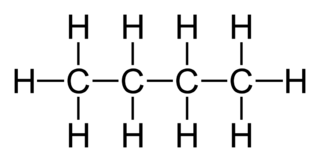
How many hydrogen atoms are in butane
a)
4
b)
6
c)
8
d)
10
8.
General formula of Alkane is 
a)
CnH2n+2
b)
CnH2n
c)
CnH2n+1OH
d)
CnH2n+1COOH
9.
The molecular formula for Heptane is
a)
C4H10
b)
C8H18
c)
C5H12
d)
C7H16
10.
Give the name of this compound...
C3H8
a)
Propene
b)
Butane
c)
Butene
d)
Propane
11.
The "ane" ending in "alkane" tells someone that they are dealing with _________-bonded carbons.
a)
single
b)
double
c)
triple
d)
quadruple
12.
Name this alkane
a)
Methane
b)
Ethane
c)
Propane
d)
Butane
13.
Name this alkane
a)
Methane
b)
Ethane
c)
Propane
d)
Butane
14.
If an alkane has 20 carbon atoms, how many hydrogen atoms will it have?
a)
20
b)
22
c)
40
d)
42
15.
How many carbon atoms are in propane
a)
1
b)
2
c)
3
d)
4
16.
a)

1

b)

2

c)

3

d)

4

17.
a)

1

b)

2

c)

3

d)

4

18.
a)

1

b)

2

c)

3

d)

4

19.
a)

1

b)

2

c)

3

d)

4

20.
a)

1

b)

2

c)

3

d)

4

21.
a)

1

b)

2

c)

3

d)

4

22.
a)

1

b)

2

c)

3

d)

4

23.
a)

1

b)

2

c)

3

d)

4

24.
a)

1

b)

2

c)

3

d)

4

25.
a)

1

b)

2

c)

3

d)

4

26.
a)

1

b)

2

c)

3

d)

4

27.
a)

1

b)

2

c)

3

d)

4

28.
a)

1

b)

2

c)

3

d)

4

29.
a)

1

b)

2

c)

3

d)

4

30.
a)

1

b)

2

c)

3

d)

4

31.
a)

1

b)

2

c)

3

d)

4

32.
a)

1

b)

2

c)

3

d)

4

33.
a)

1

b)

2

c)

3

d)

4

34.
a)

1

b)

2

c)

3

d)

4

35.
a)

1

b)

2

c)

3

d)

4

36.
a)

a

b)

b

c)

c

d)

d

37.
a)

a

b)

b

c)

c

d)

d

38.
V stands for ...
a)
Voltage
b)
Volts
c)
Voltemeter
d)
Vulcan
39.
Oxidation happens at the
a)
anode
b)
cathode
c)
salt bridge
d)
voltmeter
40.
Reduction happens at the 
a)
anode
b)
cathode
c)
salt bridge
d)
voltmeter
41.
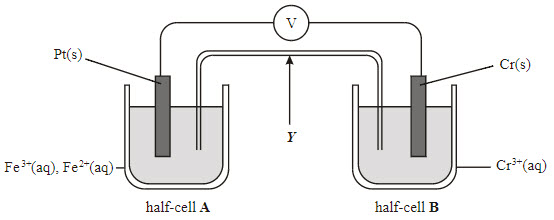
What is the function of Y in cell below?
a)
To complete the circuit
b)
To allow flow of electrons between both cells
c)
To allow flow of ions 
d)
To connect both half cells
42.
Metal A is more reactive than metal B. Which statement is correct?
a)
Electrons flow in the external circuit from A to B
b)
Positive ions flow through salt bridge from A to B
c)
Positive ions flow in external circuit from B to A.
d)
Electrons flow through salt bridge from B to A
43.
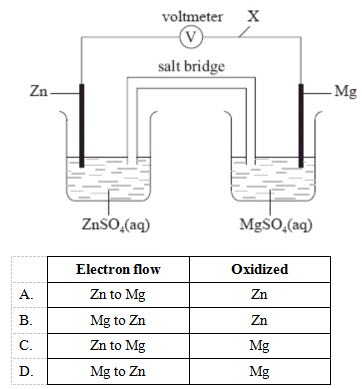
Which direction do the electrons flow in wire X and which metal is oxidized?
a)
A
b)
B
c)
C
d)
D
44.

Which material used as anode in lithium ion battery?

a)

Brass foil

b)

Copper coil coated with graphite

c)

Aluminium foil coated with graphite

d)

Steel coated graphite

45.

Which material used as anode in lithium ion battery?

a)

Brass foil

b)

Copper coil coated with graphite

c)

Aluminium foil coated with graphite

d)

Steel coated graphite

46.

Lithium ion Battery is an example for

a)

Primary Battery

b)

Fuel Cell

c)

Electrolytic Cell

d)

Secondary Battery

47.

Electrochemistry deals with

a)

Conversion of Chemical Energy into electrical energy

b)

conversion of Electrical energy into Chemical energy

c)

Both 1& 2

d)

None

48.

The bond between ice molecules is

a)

ionic

b)

covalent

c)

a hydrogen

d)

metallic

49.

What group is Aluminum in?

a)

13

b)

3

c)

12

d)

4

50.

The period for Bromine is ___________.

a)

3

b)

2

c)

4

d)

1