
 Worksheets
Ceramic Materials
Total questions: 25
Worksheet time: 21mins
The following are categorized as traditional ceramics except for:
Clay
Hydroxyapatite
Sand
Carbon nanotubes
Feldspar
Two (2) characteristics of the component ions in crystalline ceramic materials that influence their crystal structure are:
Relative ionic size (cations and anions)
Porosity
Magnitude of the electrical charge on each of the component ions
Defects
Opacity
Select stable ceramic crystal structures:
*Red circles represent anions; blue circles denote cations.


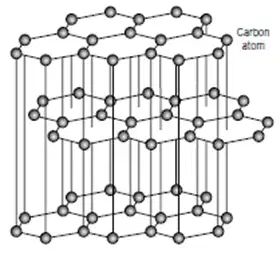
This figure represents the structure of:
Calcium fluoride
Graphite
Silica
Fullerenes
Sodium chloride
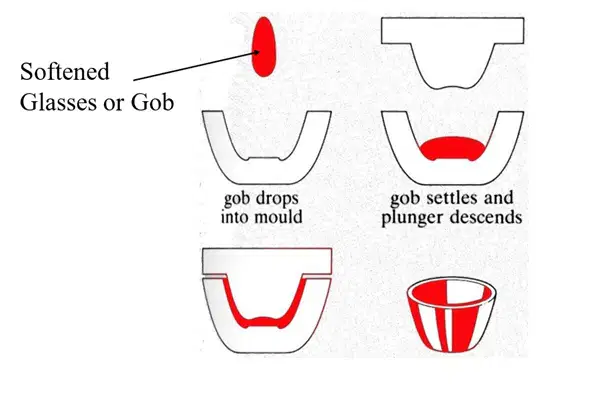
Identify the glass forming process for this figure.
Blowing
Drawing
Pressing
Drawing
When a ceramic material is cooled from an elevated temperature, internal stresses called (a) may be introduced as a result of the difference in cooling rate and thermal contraction between the surface and interior regions.
The strength of a glass piece may be enhanced by intentionally inducing (a) .
How many major steps in thermal tempering?
3
4
5
1
Explain all the steps in thermal tempering.
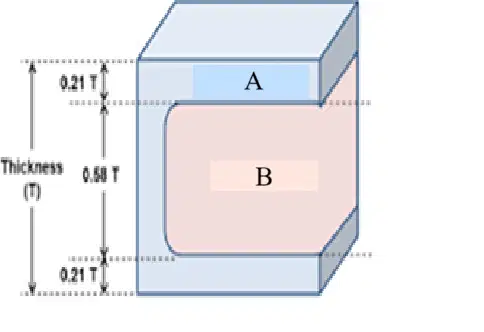
Identify residual stress over the cross section of a tempered glass plate at A and B.
A: tension and B: compression
A : compression and B: tension
A : shear and B: bending
A : compression and B: shear
A: tension and B: torsional
List THREE (3) common types of glass.
After shaping the clay into the desired form, it is allowed to air dry before being (a) in a kiln to enhance its mechanical strength.
The following are clay products except for:
Refractory Ceramics
White Wares/Porcelain
Structural Bricks
Armoured Glass
Firing is a high-temperature process in ceramics that turns a compacted powder (green body) into a rigid ceramic, either dense or porous, with (a) being the process that happens inside the material.
In sintering process, ceramic fine particles are bonded together by a .......................
vapour phase evaporation-condensation
liquid phase diffusion
solid-state diffusion
reactive liquid solution precipitation
Solid-state sintering is the bonding and (a) of particles by the application of heat below the melting point of a material.
During sintering, the free surface area of the compact ....................., which is usually accompanied by ........................ in density
decreases, decrease
decreases, an increase
increases, an increase
increases, an decreases
Illustrate the mechanism involved in the sintering process using a 3-step method for 4 ceramic particles.

The outstanding properties of refractory ceramics include the capacity to withstand high temperatures without melting or (a) and the capacity to remain unreactive and inert when exposed to severe environments.
List ONE (1) application of refractory ceramics.
Identify the common ceramic abrasives:
silicon carbide
aluminum oxide (or corundum)
tungsten carbide (WC)
silica sand
cements
Briefly explain Portland cement:
The following are the advantages of cement as construction materials except for:
Fire resistance
Cost-Effective
Carbon dioxide (CO2) emission
Weather Resistance
Strength & Durability
The following are ceramic biomaterials except for:
Lead zirconate titanate, PZT
Zirconia (ZrO₂)/ zirconia dioxide
Hydroxyapatite (HA) [Ca10(PO4)6(OH)2]
Bioactive glasses
Tricalcium phosphate (TCP, [Ca10(PO4)6])
The following are the properties that make ceramic desirable to be use as biomaterials include:
high coefficient of friction
low fracture toughness
chemical inertness
wear resistance

