wayground logo

Free Printable Worksheets

NEW

Font size

S
M
L
XL
Worksheets

Electricity Y10

Total questions: 26

Worksheet time: 32mins

Name
Class
Date
1.

Electric current is defined as

a)

detect electric current

b)

negative terminal to positive terminal

c)

positive terminal to negative terminal

d)

the flow rate of electric charges through a conductor

2.

Electric current flows from

a)

detect electric current

b)

negative terminal to positive terminal

c)

positive terminal to negative terminal

d)

the flow rate of electric charges through a conductor

3.
What is resistance measured in?
a)
Ω (Ohms)
b)
V (Volts)
c)
A (Amps)
d)
W (Watts)
4.

Electrons flows from

a)

detect electric current

b)

negative terminal to positive terminal

c)

positive terminal to negative terminal

d)

the flow rate of electric charges through a conductor

5.
What voltage is needed to cause a 2A current flow through a 10Ω resistor?
a)
5V
b)
0.2V
c)
20V
d)
200V
6.
What resistance is needed to cause a 50A current flow because of a 500V battery?
a)
10Ώ
b)
c)
2500Ώ
d)
550Ώ
7.

Which light globe(s) would never light up?

a)

A

b)

B,C,D

c)

A,B,C,D

d)

None

8.
How do you calculate resistance?
a)
Voltage X Current
b)
Current ÷ Voltage
c)
Voltage ÷ Current
d)
Current X Amps
9.

Voltage is the measure of the...

a)

difference in electrical energy between 2 parts of a circuit

b)

amount of electric charge that flows through a circuit

10.

If you increase the voltage across a resistor, what will happen to the current?

a)

Current will increase

b)

Current will decrease

c)

Current will stay the same

11.
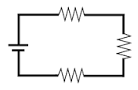
What type of circuit is pictured?
a)
series
b)
parallel
12.
What kind of circuit is this?
a)
Series
b)
Consecutive
c)
Parallel
d)
Training
13.

An electric kettle is commonly used to heat up water at home. The heating element used is nichrome wire and not copper. Which of the following reasons best explains why nichrome is used instead of copper?

a)

Nichrome conducts more current than copper, so more heat can be generated.

b)

Nichrome has higher resistance than copper, so more heat can be generated.

c)

Nichrome has higher voltage than copper, so more heat can be generated.

d)

Nichrome are cheaper than copper, so it is more economical.

14.

Which of the following materials is used in a light bulb to produce heat and light?

a)

Nichrome

b)

Copper

c)

Tungsten

d)

Steel

15.

A higher resistance in a circuit causes a _____________.

a)

higher voltage

b)

larger current

c)

smaller current

d)

lower voltage

16.

Which of the following is not a source of electrical energy?

a)

ammeter

b)

dry cell

c)

mains

d)

dynamo

17.

What is resistance?

a)

Flow of electrical charge

b)

Pressure from power to push electrons

c)

Limits the flow of electrons

18.

What is voltage?

a)

Flow of electrical charge

b)

Pressure from power to push electrons

c)

Limits the flow of electrons

19.
Ms Jo Jo rubbed two balloons with a piece of wool. What will happen when the balloons are brought near each other?
a)
The balloons will repel each other.
b)
The balloons will attract each other.
c)
The balloons will become positively (+) charged.
d)
The balloons will pop.
20.
What charge does a proton have?
a)
negative (-)
b)
positive (+)
c)
neutral or no charge (0)
21.
If a substance has a higher number of electrons than protons on its surface, what type of charge does it have?
a)
A positive charge.
b)
A negative charge.
c)
A neutral charge
d)
No charge at all
22.
Which of the following is caused by static electricity?
a)
a stove getting hot when it is turned on
b)
a magnet being attracted to a refrigerator
c)
a lightning strike during a storm
d)
a light bulb coming on when a switch is turned on
23.
An object becomes postiively charged when which of the following occurs?
a)
loses electrons
b)
gains electrons
c)
loses protons
d)
gains neutrons
24.
If an object has the same number of positive and negative charges, its electrical charge is...
a)
positive
b)
negative
c)
neutral or no charge
d)
opposite
25.
Objects that have opposite charges
a)
are attracted to each other, and the force between the objects pulls them together.
b)
are attracted to each other, and the force between the objects pushes them apart.
c)
are repelled by each other, and the force between the objects pulls them together.
d)
are repelled by each other, and the force between the objects pushes them apart.  
26.
If you rub a glass rod with a piece of silk, the rod becomes positively charged. This means that
a)
friction destroyed electrons in the rod.
b)
the silk has become negatively charged.
c)
protons have moved to the rod.
d)
glass attracts more protons.