
 Worksheets
Unit 4 Review (Types of Credit)
Total questions: 40
Worksheet time: 10hrs 0mins
Name
Class
Date
1.
Antonio has $4000 saved to use for a down payment, and he’s about to buy a car that costs $29,000. How much would you expect his loan principal to be?
a)
$4000
b)
$25,000
c)
$33,000
d)
$29,000 x his interest rate
2.
As you move through your payment schedule on an amortized loan, what will happen to the interest portion of each month’s payment?
a)
The interest portion will grow
b)
The interest portion will shrink
c)
The interest portion will stay the same
d)
The interest portion will sometimes grow and sometimes shrink
3.
Ramon and Stephen are each considering taking out a $1200 loan so they can buy dirt bikes to enjoy on the weekend. Ramon's bank is offering him a 4.3% interest rate, while Stephen's is offering him a 2.4% interest rate.Which of the following statements is TRUE.
a)
If each loan has a term of 3 years, Ramon's monthly payments will be higher
b)
If they both make $300 payments a month, Ramon will pay off his loan faster
c)
Both men would likely get a better interest rate if they used a credit card, rather than a personal loan, to make their purchases
d)
If Ramon applies to Stephen's bank, instead, for his loan, he's guaranteed to get the same 2.4% interest rate that Stephen's been offered
4.
Which of these statements best explains why it's often a good idea to pay more than the monthly amount due on an amortized loan?
a)
Every time you pay extra, the lender will reduce the interest rate they're charging by a small amount.
b)
The extra payment will be applied to the principal amount you owe, which will pay down your debt more quickly.
c)
The extra payment will be applied to the interest you owe, which will reduce the overall cost of your loan.
d)
Amortized loans typically have much higher interest rates than credit cards, so they're the best place to put your extra cash.
5.
Purchasing a car on a loan through the bank or dealership is called:
a)
franchising
b)
amortizing
c)
financing
d)
loaning
6.
Brenda's bank offers car financing for 3, 4, or 5 years. If Brenda chooses 5-year financing, how many monthly payments will she have?
a)
12
b)
36
c)
48
d)
60
7.
Which of the following has no effect on the monthly payment?
a)
Interest Rate
b)
Down Payment
c)
Number of months the car is expected to be financed
d)
Length of buyer's driving record
8.
An increase in which of the following will decrease the monthly payment?
a)
Interest rate
b)
Principal
c)
Down payment
d)
None of the above
9.
Which statement about car leases is TRUE?
a)
Leases typically have lower monthly payments than you'd pay to purchase the same car using a loan.
b)
Leases typically have higher monthly payments than you'd pay to purchase the same car using a loan.
c)
Leases are always the better option when getting a car, especially if you have a downpayment.
d)
Leases are never the better option when getting a car, especially if you have a downpayment.
10.
Which of the following does NOT represent an advantage of leasing a car?
a)
After the lease ends, you sell your car back to the dealer and get most of your payments back in equity.
b)
Leases only last a short number of years, so leasing allows you to regularly upgrade your car to newer, safer, more modern vehicles
c)
Because your car is covered under warranty for the duration of your lease, you're less likely to be liable for costly repairs or maintenance.
d)
If you really love the car, you're often able to buy it from the dealer at the end of the lease.
11.
Laura has a substantially higher credit score than her sister, Caroline. They are both shopping for new cars and plan to pay for them over 4 years. Which statement is likely TRUE?
a)
Laura’s APR and monthly payments will both be lower
b)
Laura’s APR and monthly payments will both be higher
c)
Laura’s APR will be lower but her monthly payment will be higher
d)
Laura’s APR will be higher but her monthly payment will be lower
12.
Which of the following is likely to INCREASE your monthly payment?
a)
Increasing the size of your down payment
b)
Decreasing the number of months in your term
c)
Qualifying for a lower APR
d)
Applying the trade-in value of your old car toward your new car purchase
13.
Janelle sees two different financing options, for the same brand new car, advertised online. She uses a loan calculator and finds that option 1 would give her monthly payments of $435/mo. Option 2 would give her monthly payments of $625/mo. Which statement is the most likely explanation for the difference in the payments?
a)
Option 1 has a higher APR
b)
Option 1 has a larger down payment
c)
Option 1 did not check her credit score
d)
Option 1 has a shorter term
14.
You have decided to purchase a new vehicle for $35,000. The dealership is offering a 2.7% APR and a $2,500 cash allowance. You have $10,000 to use as a down payment. How much will you need to finance?
a)
$22,500
b)
$12,500
c)
$25,000
d)
$35,000
e)
$35,945
15.
It’s time for Roxanne to start repaying her student loans, which are amortized over the next ten years. Her first month’s payment due is $396. How much should she expect to owe next month?
a)
Substantially less than $396
b)
Slightly less than $396
c)
Exactly $396
d)
Slightly more than $396
16.
If you were offered two auto loan options with the same principal and interest rate, but one was a 48-month loan and one was a 72-month loan, which outcome below will reflect the impact of that difference in term?
a)
The 48-month loan will cost less money overall
b)
The 48-month loan will have lower monthly costs
c)
The 48-month loan will take longer to pay off
d)
The 48-month loan will always be a better choice
17.
Shonda’s mom recommends that she spend a year building her credit history and boosting her credit score before she applies for a loan to buy her dream car, which costs $54,000. Why is that good advice?
a)
A good credit score will reduce her down payment
b)
A good credit score will reduce her principal
c)
A good credit score will reduce her interest rate
d)
A good credit score will allow her to pay the full $54,000 in cash
18.
Terminology
An agreement where an individual makes monthly payments to use a car for a certain length of time instead of purchasing the car
a)
Auto Lease
b)
Depreciation
c)
Financing
d)
Vehicle History Report
e)
Amortization
19.
Terminology
A decrease or loss in value
a)
Depreciation
b)
Auto Lease
c)
Financing
d)
Vehicle History Report
e)
Amortization
20.
Terminology
To buy an item with credit and pay it back over time with interest
a)
Financing
b)
Auto Lease
c)
Depreciation
d)
Vehicle History Report
e)
Amortization
21.
Terminology
A detailed history of a car including its previous owners, damage, repair work, and more
a)
Vehicle History Report
b)
Auto Lease
c)
Depreciation
d)
Financing
e)
Amortization
22.
Terminology
The paying off of debt over time in equal installments; part of each payment goes toward the loan principal while the other part goes toward interest
a)
Amortization
b)
Auto Lease
c)
Depreciation
d)
Financing
e)
Vehicle History Report
23.
Terminology
A partial payment made in cash at the beginning of the purchase of a good or service, while the remaining balance is due later or is financed as part of a loan
a)
Down Payment
b)
Auto Lease
c)
Depreciation
d)
Financing
e)
Vehicle History Report
24.
Choose the option that best completes this sentence: When using a credit card…
a)
You will pay interest whether or not you pay your bill every month.
b)
You are transferring money from your savings account directly to another party.
c)
You are getting a short-term loan to allow you to purchase an item now which you can pay for later.
d)
You always have the option to wait to make a payment because late payments don’t affect your credit.
25.
What makes a loan be categorized as secured?
a)
It is secured after all payments are made
b)
It is secured because it is backed up with some form of collateral
c)
It is secured when the borrower receives the loan amount from the bank
d)
It is secured when someone co-signs on the loan
26.
Which of the following statements is TRUE?
a)
To avoid appearing biased, a bank or other lender must offer the same interest rate to all of its borrowers.
b)
To avoid appearing biased, a bank or other lender must offer the same loans to any borrower.
c)
Banks can pick both the interest rate and the borrowers they lend money to.
d)
Banks can pick the borrowers they lend money to, but must set the same interest rate for everyone.
27.
Loan Repayment Using Simple Interest
Substitute these numbers into the formula: I = Prt
I = Interest
P = Principal
r = rate (decimal form)
t = time (years)
Joe wants to take out a loan from his bank for $4,000 to buy a used golf cart. The interest rate on the loan from the bank is 7%. He wants to pay the total amount in 9 monthly payments. What is the amount that Joe would pay in interest for his loan?
a)
$210.00
b)
$11.00
c)
$110.00
d)
21.00
e)
$31.00
28.
Nathan's loan balance is $8000.00
The monthly payment is $450.00
The interest owed this month is $75.00
What is the remaining balance after he makes the monthly payment?
a)
$7625.00
b)
$8525.00
c)
$8000.00
d)
$7925.00
e)
$7550.00
29.
If Fabrice has a $3500 balance on his credit card this month and an APR of 20%, his interest charge for the month will be...
a)
$58
b)
$3500
c)
$3480
d)
$20
e)
$25
30.
Isaac and his family want to take a trip to Disney World. They start charging all their monthly expenses on a credit card that gives them airline miles, in hopes of earning one or two free flights by next summer. In the month of February alone, they charge $4500 on the card. When the bill comes, Isaac pays the full balance. Which figure best estimates the interest he paid, given that his card has a 14% APR?
a)
$0
b)
$14
c)
$52.50
d)
$300
e)
$4500
31.
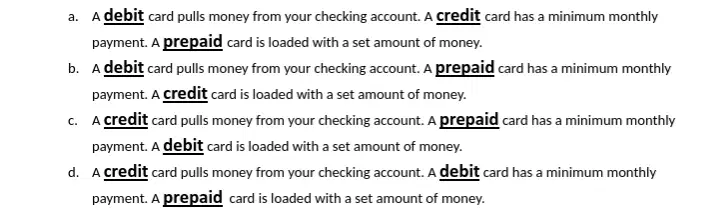
Which statement has the bolded words in the correct place?
a)
A
b)
B
c)
C
d)
D
32.
Which of the following statements best explains the purpose of a Schumer box?
a)
Gives the lender a clear report of your credit history and creditworthiness for a new card
b)
Calculates the total interest you will be charged on your previous month's purchases
c)
Gives the borrower a clear description of the APR, fees, and other major conditions of their credit card
d)
Provides a list of all purchases made on a credit card and the price of each item, for the benefit of the lender and the borrower
33.
The definition of credit card APR is...
a)
The total amount of purchases they charge on an annual basis
b)
The remaining balance left on a credit card once the minimum monthly payment is made
c)
The average credit score each person is assigned based on their payment history
d)
The percent the credit card company charges you for the benefit of receiving a temporary loan from them
34.
Which statement includes one real benefit from shopping with a credit card?
a)
You may earn cash back, travel rewards, or other perks for each dollar you spend
b)
Most stores will give you a discount if you pay with credit instead of cash or debit
c)
It pulls money directly from your bank account, preventing you from overspending
d)
If you do not have the money to pay your monthly bill, you can just wait a few months and pay the same amount then
35.
Kelsey wants to open a credit card and has narrowed her choice down to three possible options. Which factor is MOST important in determining which card she should get?
a)
Which card does her best friend have?
b)
Is there an annual fee with each card?
c)
Is each card FDIC insured?
d)
Which card has the most recognizable brand?
36.
Which statement best distinguishes the difference between a secured credit card and a prepaid card?
a)
A secured card is for people with bad credit, and a prepaid card is for people with no credit.
b)
A secured card requires a deposit, but the user still pays monthly; a prepaid card requires a deposit onto the card, which the user then spends from.
c)
A secured card is accepted at far more locations than a prepaid card.
d)
A secured credit card and a prepaid card are two words for the same thing.
37.
Mia doesn't have any credit history, so she's going to open a secured credit card to begin building her credit. She puts down an $250 security deposit. What feature of an unsecured credit card is Mia's security deposit most like?
a)
the APR
b)
the term
c)
the credit limit
d)
the annual fee
38.
Each of the following represents an installment loan EXCEPT…
a)
Home mortgage
b)
Auto loan
c)
Student loan
d)
Credit card
39.
Which statement is true of both debit AND credit cards?
a)
Both can trap you in an endless cycle of debt if you’re not careful
b)
Both allow you to make purchases in a store or online
c)
Both typically have interest rates between 10-30%
d)
Both require you to pay a minimum monthly payment when your bill arrives
40.
Felix opens a credit card with no annual fee, so he assumes that using the credit card regularly will be absolutely free for the next two years while he finishes grad school. Why is his assumption incorrect?
a)
Unless he pays the whole bill every month, he will pay interest according to his APR
b)
He will automatically pay penalty fees if he uses his credit card for more than 3 consecutive months
c)
If his grace period is any longer than 10 days, he will have to pay fees
d)
He will need to pay a separate student fee because he is still in grad school
100 %

